
Wristwatches · Wristwatch
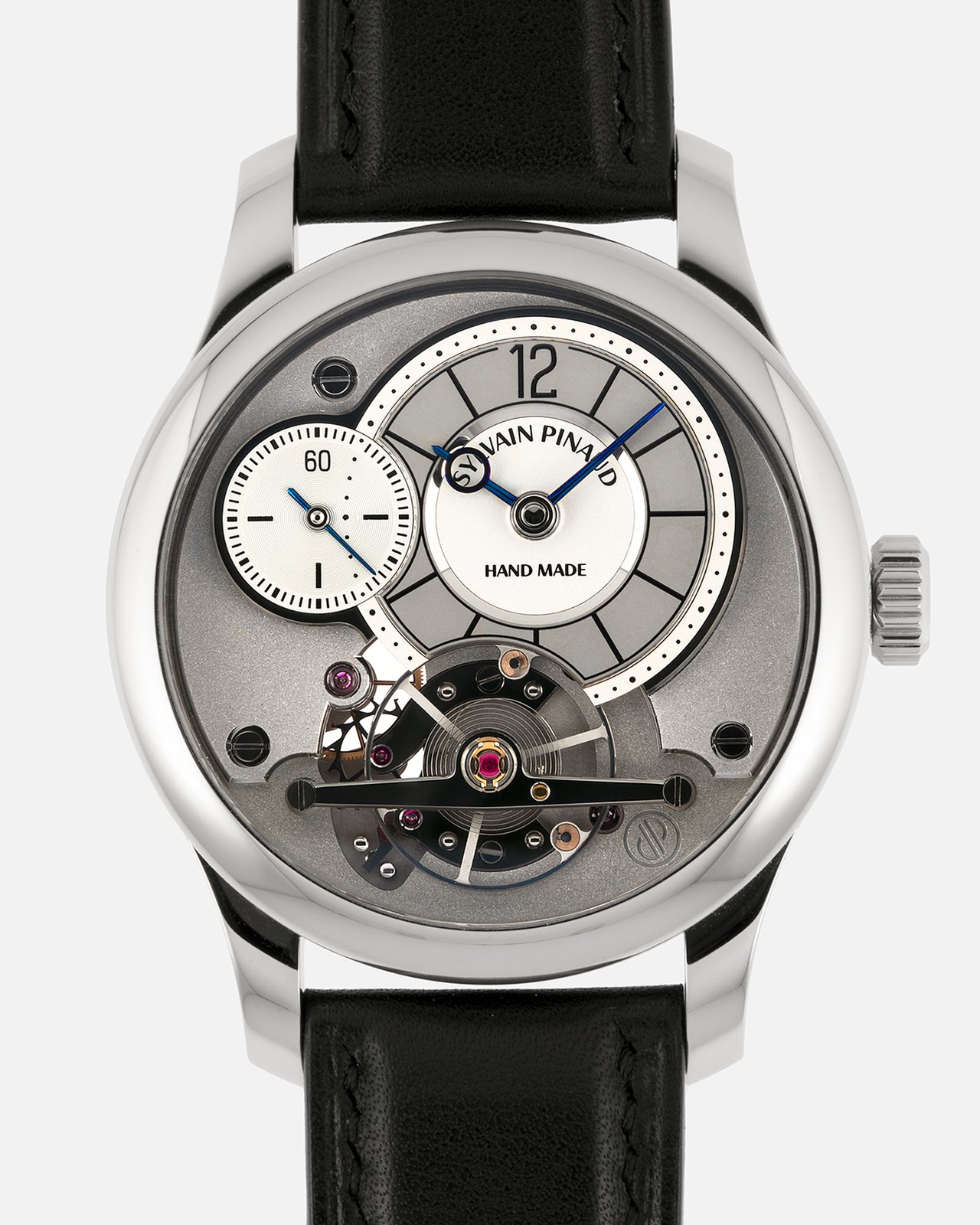
Sylvain Pinaud Origine Steel, 2025
- Maker / attribution
- Sylvain Pinaud (maker)
- Date
- 2025
- Historical period
- Contemporary Horology (2010 – Present)
- Country of origin
- Unrecorded in source
- Object type
- Wristwatch
- Materials / technique
- steel
- Dimensions
- Case 40 mm
- Stock no.
- Product 7834274431063
- Credit line
- Dealer listing, S.Song Watches (product 7834274431063)
- Catalogue title (original)
- Sylvain Pinaud Origine Steel (English)
View the source record (dealer listing) ↗ (opens another website in a new tab)Suggest a correction
Record summary
Catalogued by S.Song Watches (dealer), Seattle (stock number Product 7834274431063), this is a wristwatch by Sylvain Pinaud, dated 2025. The Atlas places it in the Contemporary Horology period (2010 – Present) of its Wristwatches collection. Materials and techniques recorded by the source: steel. Recorded dimensions: Case 40 mm. The record is illustrated with 6 photographs.
Assembled from the source record's structured fields. Dates and attributions are given as the source states them; where a field is missing the Atlas leaves it blank rather than estimating.
Catalogue description
Dealer description — S.Song Watches
Among the new generation of independent watchmakers, few have established a reputation quite as quickly as Sylvain Pinaud. Based in Sainte-Croix, Switzerland, Pinaud belongs to a relatively small group of contemporary artisans who approach watchmaking in its most traditional sense, designing, constructing and finishing their movements with an emphasis on hand craftsmanship rather than industrial production. Having previously worked as a watchmaker and restorer, his experience with historical mechanisms is particularly evident in the architecture and finishing of his creations, which combine classical watchmaking principles with a distinctly contemporary aesthetic. Pinaud first attracted widespread attention with his unusual Chronograph Monopoussoir, an ambitious, largely handmade chronograph featuring an exposed mechanism and an unconventional architectural layout. However, it was the introduction of the Origine in 2022 that would truly establish his reputation among collectors of independent watchmaking. Conceived as a time-only wristwatch, the Origine was designed to showcase the mechanical components ordinarily concealed beneath a conventional dial, with the regulating organ occupying a prominent position on the front of the watch. Its significance was further recognised when it received the Horological Revelation Prize at the 2022 Grand Prix d'Horlogerie de Genève, an extraordinary achievement for such a small independent workshop. Here, we have the Origine in stainless steel, featuring a beautifully restrained silver dial. Measuring 40mm in diameter, the case adopts relatively classical proportions, with a smoothly polished bezel, gently sculpted lugs and a substantial winding crown. Unlike the more elaborate cases employed by some contemporary independents, Pinaud has deliberately kept the exterior relatively understated, allowing the dial and movement architecture to take centre stage. The dial is undoubtedly one of the most distinctive aspects of the Origine. Rather than adopting a conventional central time display, Pinaud has arranged the hours and minutes within an off-centre subsidiary dial at approximately 2 o'clock, with a smaller seconds counter positioned towards 10 o'clock. Both feature beautifully executed silver chapter rings with elongated black numerals and markings, complemented by delicate heat-blued steel hands. The classical typography and restrained detailing are particularly evocative of early twentieth-century pocket watches, providing a wonderful contrast against the considerably more contemporary arrangement of the dial. The remaining surface is finished in a finely textured, frosted silver-grey treatment, serving as a relatively neutral backdrop for the exposed mechanical components. Occupying the lower portion of the dial is the large free-sprung balance, suspended beneath a beautifully polished, elongated steel bridge. Its prominent position allows the oscillations of the regulating organ to be appreciated directly from the front, while the surrounding exposed wheels, jewels and polished screws introduce additional layers of mechanical detail. What makes the arrangement particularly successful is the clear separation between the various elements. The hours and minutes occupy the upper right, the subsidiary seconds sits towards the upper left, and the balance dominates the lower portion of the dial. Despite the apparent asymmetry, the composition feels remarkably balanced, with each component given sufficient space to be appreciated individually. Turning the watch over reveals the manually wound movement, conceived and constructed specifically for the Origine. Its architecture is firmly rooted in traditional haute horlogerie, with broad, beautifully shaped bridges, carefully executed internal angles, black-polished steel components and extensive hand-finishing throughout. Particularly impressive is the contrast between the frosted surfaces of the bridges and the highly polished bevels, which catch the light and emphasise the sculptural quality of the movement. Rather than concealing the mechanism beneath conventional decorative plates, Pinaud has arranged the components to make the movement's construction and finishing an integral part of the watch's appeal. Production of the Origine is extremely limited, reflecting the considerable amount of individual handwork involved in each example. Unlike larger independent manufactures that have gradually increased their output through more industrialised production methods, Pinaud continues to operate on a remarkably small scale, with much of the construction, assembly and finishing undertaken within his own workshop. What I find particularly appealing about the Origine is how successfully Pinaud has combined the traditional disciplines of classical watchmaking with an entirely original design. The asymmetrical dial, exposed balance and unconventional arrangement of the subsidiary displays could easily have resulted in an overly complicated appearance, yet the restrained silver palette and beautifully proportioned chapter rings bring everything together into a remarkably cohesive composition. The Origine is well within the new school of independent watchmaking, with an emphasis on simplicity and incredible hand finishing. With only 10-12 pieces made a year, this is an extremely rare watch with huge demand.
Historical context
Contemporary Horology (2010 – Present)
Silicon components, connected watches, optical-lattice research clocks and a thriving independent scene.
Smartwatches became the world's best-selling watches, while mechanical watchmaking focuses on craft, innovation (silicon components, new escapements) and independent makers.
Read the period in the timelineMore wristwatches from this periodEarlier: Mechanical Renaissance
Atlas type guide
Wristwatches
Bracelet watches were worn by women from the early nineteenth century — Breguet made one for Caroline Murat, Queen of Naples, in 1810–12 — but the wristwatch only became a man's instrument with military use and aviation in the early twentieth century. Between the World Wars it overtook the pocket watch; the 1920s and 1930s brought rectangular Art Deco cases, water-resistant cases and the first automatic winding systems.
After 1945 the wristwatch became a carrier of identity — dress watches, sports and dive watches, chronographs, calendars — produced by Swiss, American, Japanese, German, Soviet and Chinese industries. The quartz revolution after 1969 and the mechanical renaissance since the 1990s, including the rise of independent watchmakers, complete the story.
What to look for
- The reference number (between the lugs or inside the case back) and serial number, the starting point for dating.
- The calibre: its maker and number are often stamped under the dial or on the bridge.
- Originality of dial, hands and crown — refinished ('redial') dials are common.
- Case material marks: 18K/750, 14K/585, stainless steel, gold-filled, plated.
Dating clues
- Wire-lug cases: before c. 1925.
- Water-resistant screw-down cases: from 1926.
- Quartz movements: from 1969; sapphire crystals widespread after c. 1980.
General guidance written by the Atlas editors about this kind of object. It is not a statement about this particular piece; for that, rely on the source record above and on physical examination.
Related records
Wristwatches · 2010
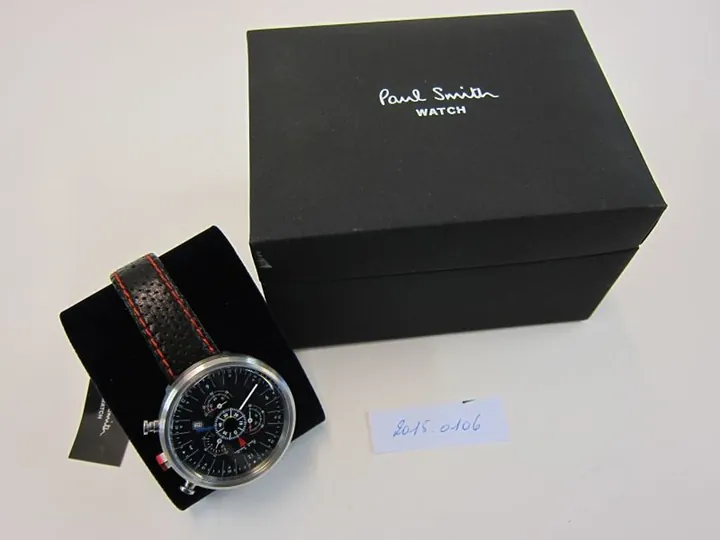
Wristwatch, 2010
Modemuseum Hasselt
Wristwatches · 2018 (Series 4 released in September 2018; '1977' in the source is the model number A1977)
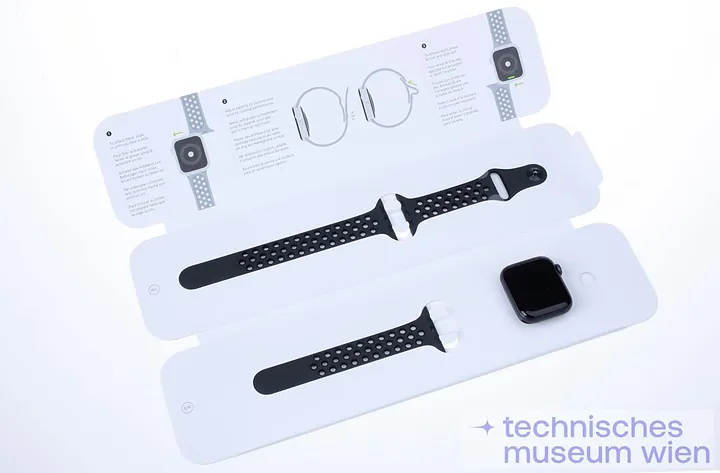
Apple Watch Series 4 (GPS, 40 mm, model A1977), 2018
Vienna Museum of Science and Technology
Wristwatches · c. 2010s
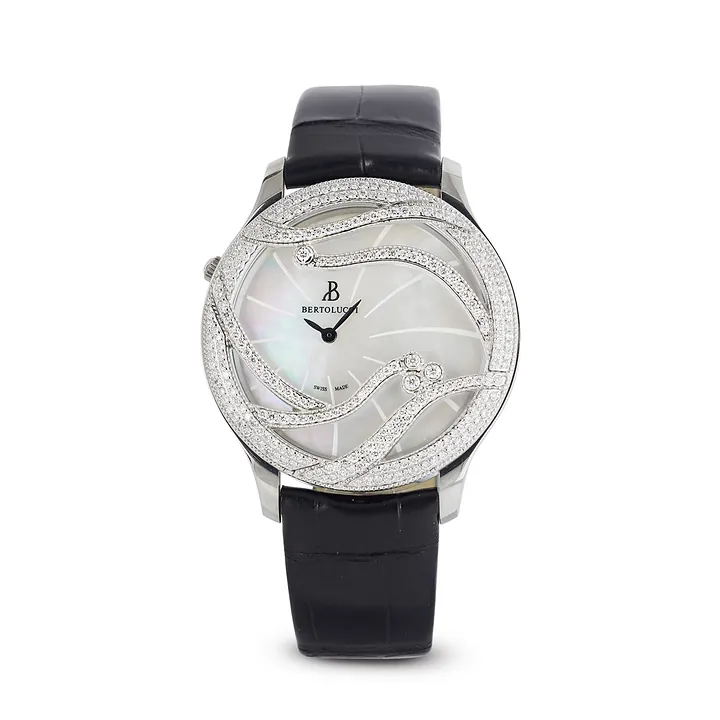
Bertolucci Stria III, ref. 11513.50.45.B88.6C1.501, c. 2010s
Antiquorum auction archive, Geneva
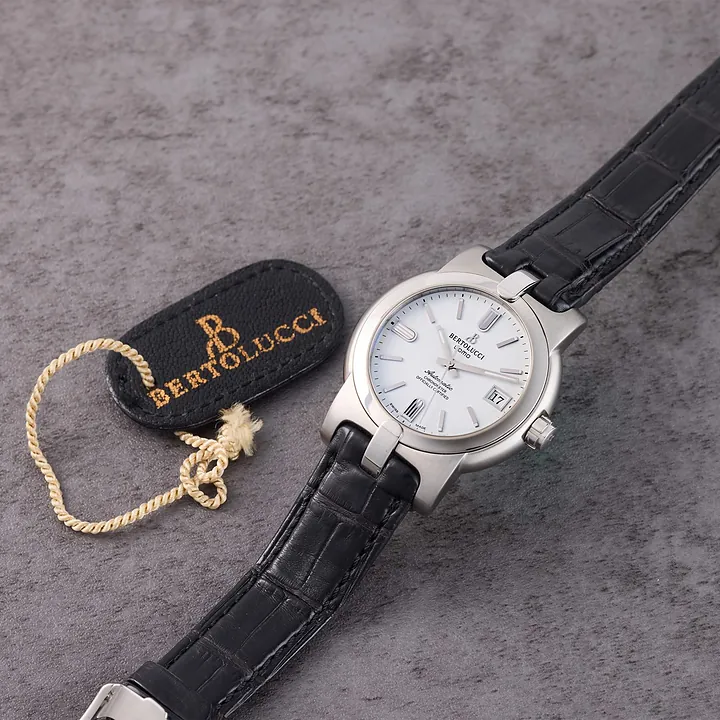
Wristwatches · c. 2010s
Bertolucci Uoma, ref. 824.51.41.10B, c. 2010s
Antiquorum auction archive, Geneva

Wristwatches · c. 2010s
Breguet Type XXI, ref. 3810, c. 2010s (Antiquorum Lot 381-24)
Antiquorum auction archive, Geneva

Wristwatches · c. 2010s
Breguet Type XXI, ref. 3810, c. 2010s (Antiquorum Lot 386-229)
Antiquorum auction archive, Geneva

Wristwatches · Sold in September 2010
Breitling Cosmonaute, ref. A 22322, Sold in September 2010
Antiquorum auction archive, Geneva
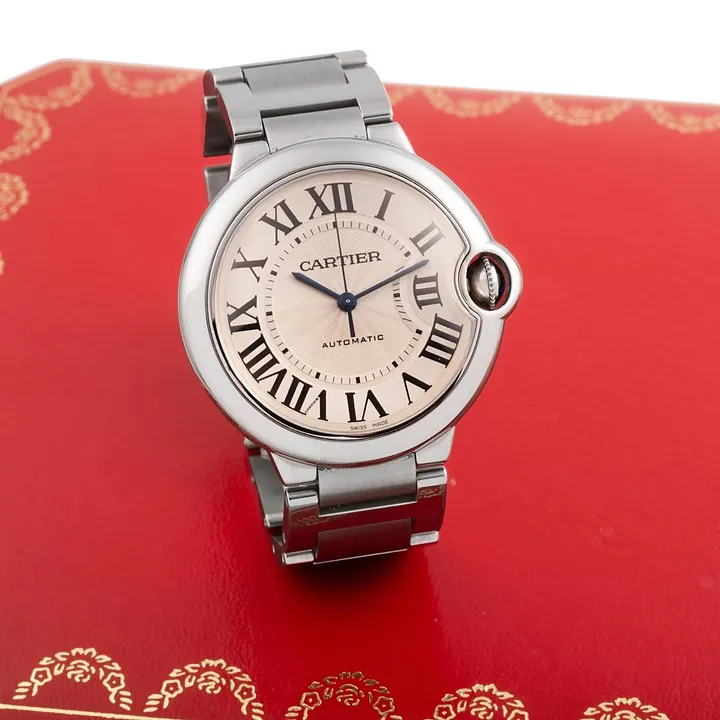
Wristwatches · c. 2010s
Cartier Ballon Bleu, ref. 3284, c. 2010s
Antiquorum auction archive, Geneva