
Pocket Watches · Calendar watch
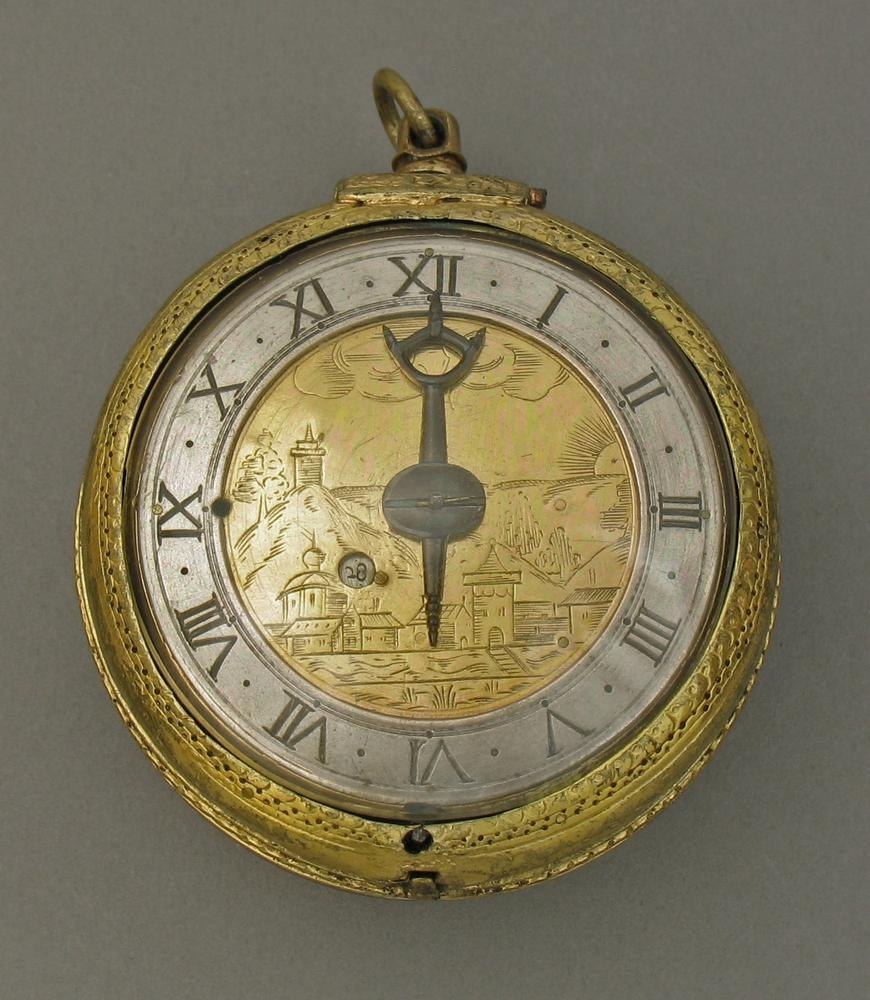
Striking stackfreed watch with indication for date, (day-of-month)
- Maker / attribution
- Unrecorded in source
- Date
- 1590–1610
- Historical period
- Early Modern Horology (1600 – 1750)
- Country of origin
- Germany
- Place
- Germany
- Object type
- Calendar watch
- Materials / technique
- brass, gold
- Dimensions
- Diameter: 58 millimetres (case)
- Holding institution
- British Museum
- Accession / object no.
- 1958,1201.2219
- Credit line
- British Museum, London
- Catalogue title (original)
- Striking stackfreed watch with indication for date, (day-of-month); with rounded case (English)
View the source record ↗ (opens another website in a new tab)Suggest a correction
Record summary
Held and catalogued by British Museum (object number 1958,1201.2219), this is a calendar watch, made in Germany, dated 1590–1610. The Atlas places it in the Early Modern Horology period (1600 – 1750) of its Pocket Watches collection. Materials and techniques recorded by the source: brass, gold. Recorded dimensions: Diameter: 58 millimetres (case). The record is illustrated with 6 photographs.
Assembled from the source record's structured fields. Dates and attributions are given as the source states them; where a field is missing the Atlas leaves it blank rather than estimating.
Catalogue description
Description — British Museum
Striking stackfreed watch with indication for date, (day-of-month); with rounded case.
Curator's comments — British Museum
Comment from Hugh Tait, Catalogue of Watches in the British Museum. Vol. I (1987) Maker Unknown; probably German, late 16th or early 17th century Striking Watch with Indication for the Date (Day of the Month) Back: standard; in the centre, a threaded hole for the attachment of the bell, which appears to be original. Band: constructed in the same manner as registration no. 1958,1201.2217. The original silver overlay has been replaced in recent times by a flat silver strip, engraved with scrolls and pierced. This later strip is pinned at the sides and is fitted underneath the plate for the pendant; the finial was screwed through the overlay. Turned pendant with later ring. Lid: the centre has been removed and a glass fitted, secured by a ring riveted to the underside of the rim; no latch. Dial: the original silver chapter-ring has been replaced by a more modern silver chapter-ring numbered I-XII, without quarter divisions or touch-pins. The gilt-metal central roundel is engraved with a landscape depicting a riverside town with the setting sun on the right and clouds in the sky; a small hole has been cut between the centre and VIII to permit the date ring to be seen. The rim is plain. The dial plate has been regilded. Key-operated latch at VI. The hand is a later replacement. Strike-release hole at IX. Movement: Brass plates and pillars, the pillars with engraved straight lines and conical sinks. All the furniture has been replaced, except the brass stackfreed-wheel and cam, long-type cock; the upper surface of the pillar-plate has been 'stoned' off. The going-train has been renewed throughout, the clip for the crown-wheel is original. The outer block for the striking mainspring has been removed; the third-wheel and the fly-pinion are replacements, the remainder of the train is of steel; the brass locking-arm is screwed to its arbor and pierced and engraved to resemble a dolphin. Diameter (of case): 58.0mm. Provenance: Ilbert Collection, 1958. Notes: 1. Although the date-ring (and the wheel driving it) are modern replacements, it is probable that this watch originally had such a mechanism, because the appropriate sink in the plate can still be seen. 2. It seems probable that although this watch was in an exceedingly poor condition, for some reason the work of restoration was begun but never completed. 3. For other examples of a double-walled band, the outer executed in silver, see registration nos 1958,1201.2217 and 1958,1201.2226. 4. The central roundel of the dial may be a modern addition, as the engraving is not entirely convincing. 5. For other examples of the use of the motif of engraved lines and conical sinks, see registration nos 1958,1201.2211; 1888,1201.158; 1888,1201.154 and 1888,1201.166; also the chaise-watch by 'M R' (in Volume II). 6. The floral elements in the design of the pierced back can be most closely paralleled on two oval watch-cases, registration nos 1888,1201.153 and 1958,1201.2226.
Provenance
Previous owner/ex-collection:, Courtenay Adrian Ilbert, Previous owner/ex-collection:, Ida Netter, (sale, London, Christie's, 20 June 1939, lot 73), Previous owner/ex-collection:, Otto Koch; Acquired 1958
Historical context
Early Modern Horology (1600 – 1750)
Huygens' pendulum and balance spring transform accuracy; English makers develop the anchor and deadbeat escapements.
The balance spring (c. 1675) improved watches dramatically and introduced the minute hand. English pair-cased verge watches with pierced balance cocks and French oignons were typical; enamel painting at Blois and Geneva, and the repeating watch (1680s), made watches objects of great refinement.
Read the period in the timelineMore pocket watches from this periodEarlier: Renaissance Horology
Atlas type guide
Calendar, moon-phase and perpetual calendar watches
Calendar complications range from a simple date to the perpetual calendar, which automatically allows for months of different lengths and leap years until 2100. Pocket watches with perpetual calendars were made in the eighteenth and nineteenth centuries; Patek Philippe made the first perpetual calendar wristwatch in 1925, and series production followed in 1941. The annual calendar (Patek Philippe, 1996) needs correction only once a year.
Moon-phase displays use a disc with two moons and 59 teeth advanced daily, approximating the 29.5-day lunation; more precise trains reduce the error to one day in over a century.
What to look for
- Apertures or subsidiary dials for day, date, month and leap year.
- Moon disc under a 'bosom' shaped aperture.
- Recessed correctors on the case band for setting the calendar.
Dating clues
- Triple-date wristwatches: popular c. 1940–1955.
- Perpetual calendar wristwatches: from 1925 (unique) and 1941 (series).
General guidance written by the Atlas editors about this kind of object. It is not a statement about this particular piece; for that, rely on the source record above and on physical examination.
Related records
Pocket Watches · 1600–1699
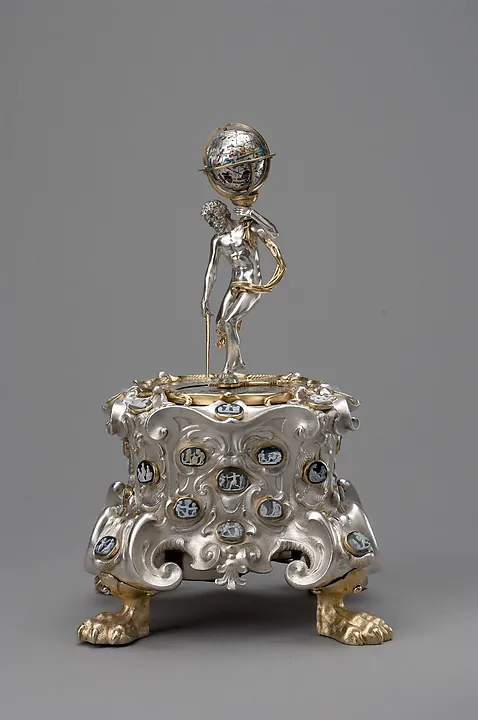
Pocket watch by Georg Ernst, Germany, 1600–1699
Fine Arts Museum Vienna
Pocket Watches · 1600–1699
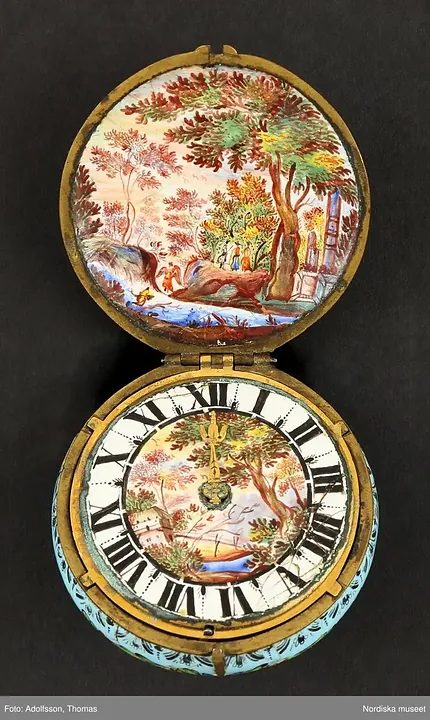
Pocket watch by Johan Etmiller, Germany, 1600–1699
Nordic Museum Foundation
Pocket Watches · early 17th century
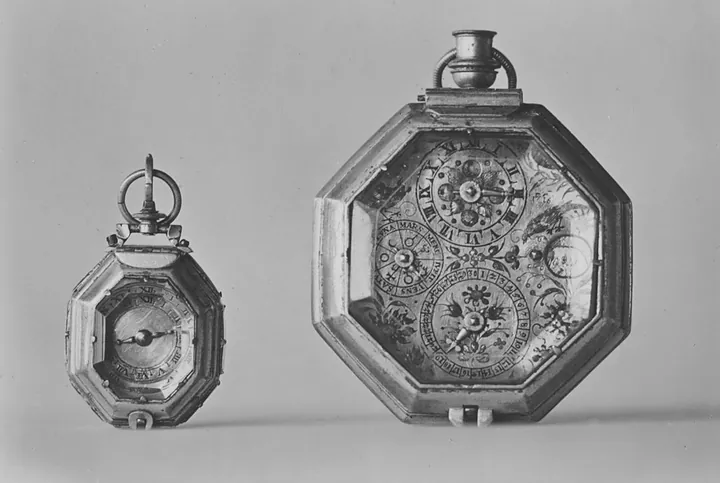
Watch with gilt brass case, crystal and blue glass panels signed 'Conradt Kreizer', Germany, early 17th century
Victoria and Albert Museum, London
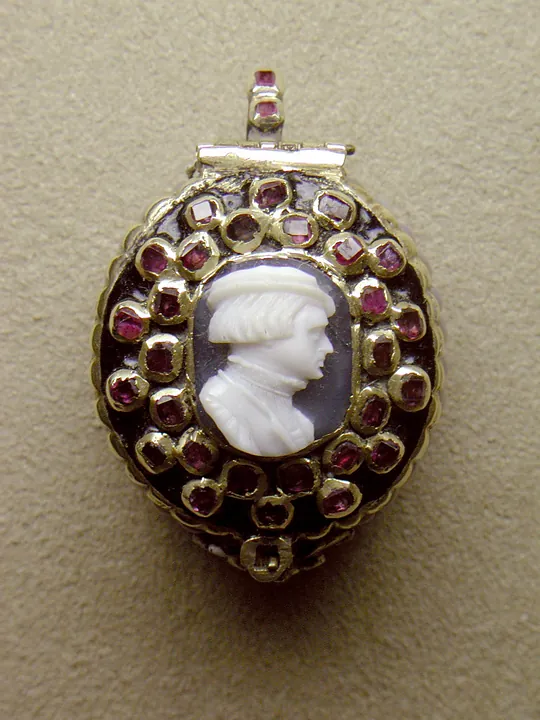
Pocket Watches · watch c. 1650, cameo 16th–17th century
Watch by Wilhelm Peffenhauser, Germany, watch c. 1650, cameo 16th–17th century
The Metropolitan Museum of Art, New York
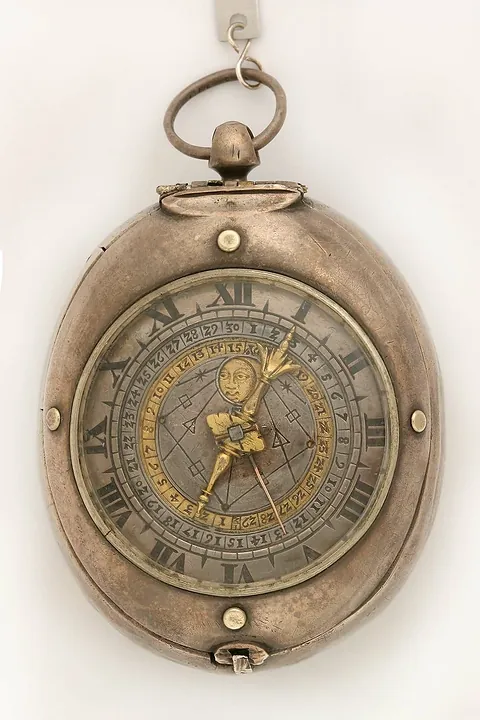
Pocket Watches · c. 1650
Pocket watch by Johann Sayller, Germany, c. 1650
German Clock Museum
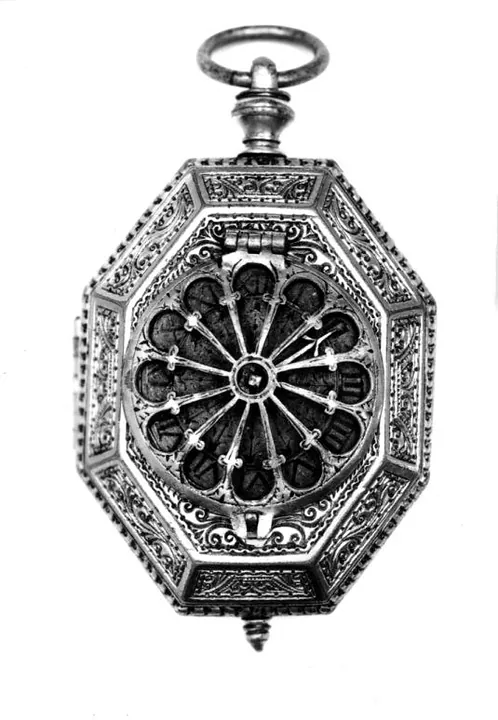
Pocket Watches · 1650–1699
Pocket watch, Germany, 1650–1699
Badisches Landesmuseum Karlsruhe
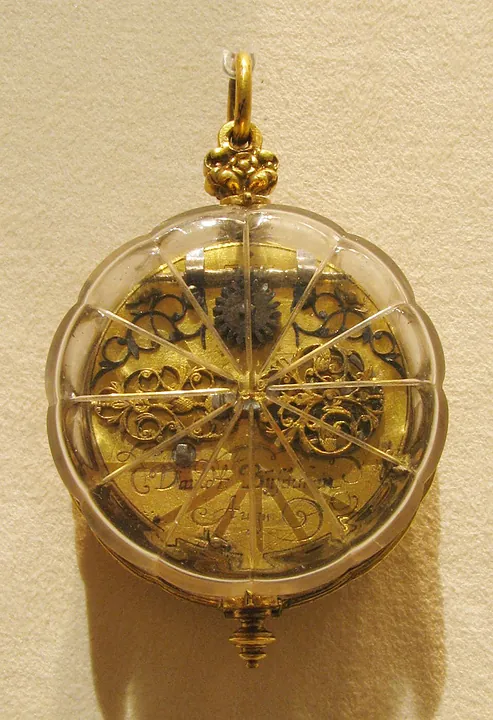
Pocket Watches · probably after 1657
Watch by David Buschman, Germany, probably after 1657
The Metropolitan Museum of Art, New York
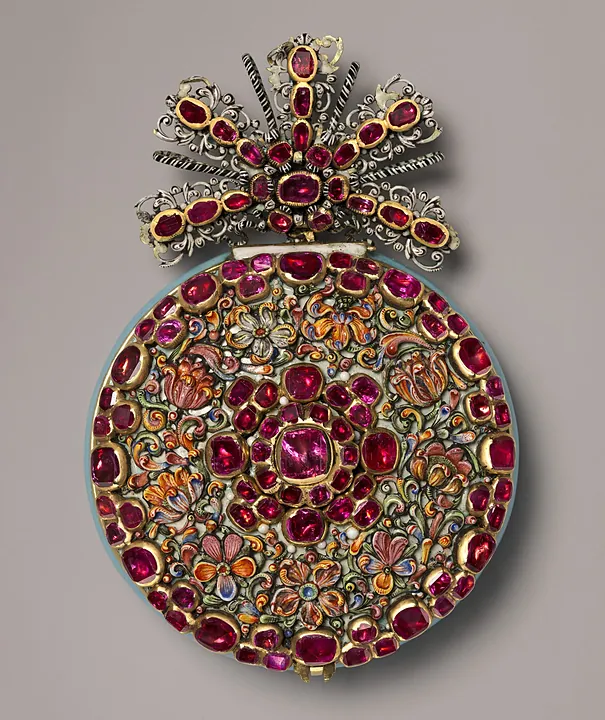
Pocket Watches · c. 1670
Watch by Nicolaus Rugendas the Younger, Germany, c. 1670
The Metropolitan Museum of Art, New York