
Pocket Watches · Hour-striking watch
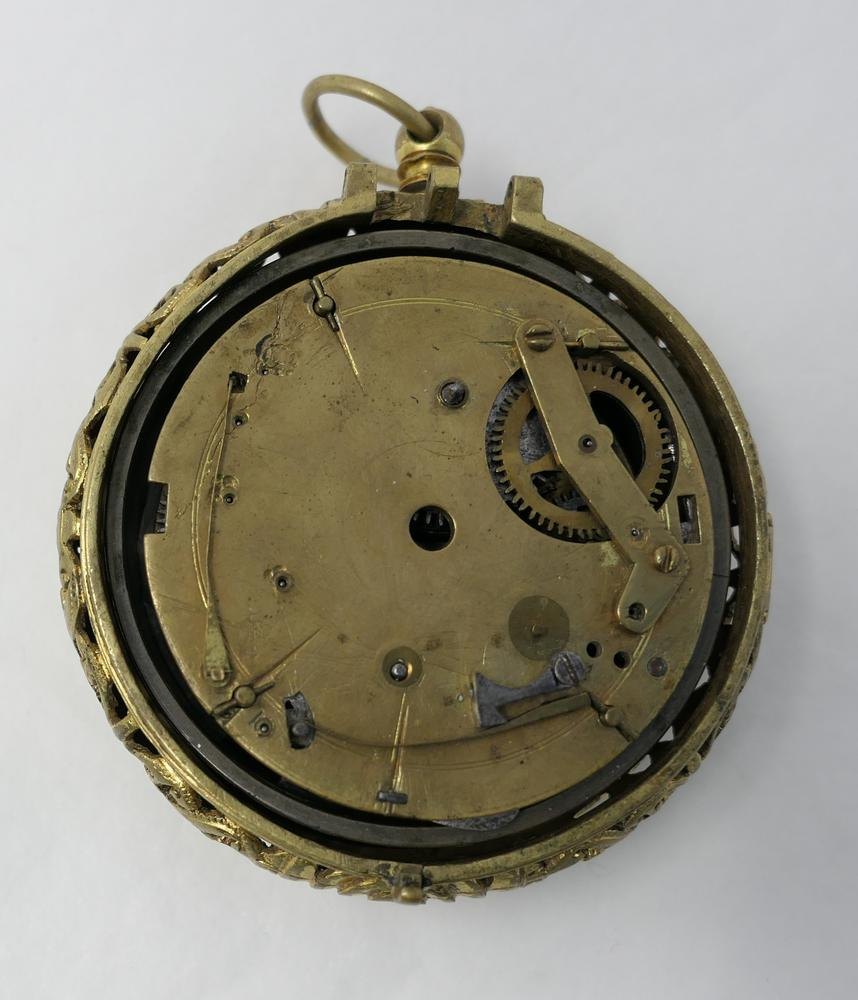
Stackfreed watch with hour-striking mechanism and rounded case
- Maker / attribution
- DS (Made by)
- Date
- 1614
- Historical period
- Early Modern Horology (1600 – 1750)
- Country of origin
- Austria
- Place
- Steier (historic)
- Object type
- Hour-striking watch
- Materials / technique
- brass, gold
- Dimensions
- Diameter: 64 millimetres (case)
- Holding institution
- British Museum
- Accession / object no.
- 1889,0902.1
- Credit line
- British Museum, London
- Catalogue title (original)
- Stackfreed watch with hour-striking mechanism and rounded case (English)
View the source record ↗ (opens another website in a new tab)Suggest a correction
Record summary
Held and catalogued by British Museum (object number 1889,0902.1), this is a hour-striking watch by DS, made in Steier (historic), Austria, dated 1614. The Atlas places it in the Early Modern Horology period (1600 – 1750) of its Pocket Watches collection. Materials and techniques recorded by the source: brass, gold. Recorded dimensions: Diameter: 64 millimetres (case). The record is illustrated with 5 photographs.
Assembled from the source record's structured fields. Dates and attributions are given as the source states them; where a field is missing the Atlas leaves it blank rather than estimating.
Catalogue description
Description — British Museum
Stackfreed watch with hour-striking mechanism and rounded case.
Curator's comments — British Museum
Comment from Hugh Tait, Catalogue of Watches in the British Museum. Vol. I (1987) Maker Unknown, initials DS (?) Steier (near Linz), Austria, 1614 Watch with Hour-Striking Mechanism Back: standard, with swags of drapery attached to the base of the handles of the urn; in the centre, a threaded hole and square boss for the attachment of the bell, which appears to be original. Band: standard; turned pendant with ring; pendentive finial (missing). Lid: missing. Dial: missing. Movement: (a) Brass plates and pillars; pillars engraved with three intersecting straight lines and two short lines at 3 and 9 o'clock. (b) Stackfreed assembly replaced by ordinary stop-work in brass; stop-work added to the striking-train; brass count-wheel, brass combined cock for pin-wheel, striking index and regulator scale (non-mechanical); regulator and short cock missing. (c) Punch-marks: i. DS within a punch, shaped like a standing cup or goblet (near centre of plate). ii. 16 STEIR 14, executed with individual punches (near edge of plate to right of stop-work for going-train). These punches for the date are identical to those used on the count-wheel and regulator scale. (d) The wheels are of steel, except for the second-wheel in the going-train and the fourth (locking) wheel in the striking-train; the contrate-wheel is missing. The crown-wheel runs between a bracket and the mainspring block. The lower balance-pivot runs in the plate. The outer block for the mainspring of the striking-train is in the reverse direction; this block and the brass locking-arm are engraved with floral scrolls. Diameter (of case): 64.0 mm Provenance: Dr Playfair, Deputy-General Inspector of Hospitals at Agra, about 1870, who is said to have received it from a native Indian who had reputedly stated that 'it was found a great many years ago in the Fort at Agra'; Mr P. Bruff, of the States Railway, Agra (by 1873); 'cleaned . by a watchmaker in Norway' (before September 1877); Mr Alexander Grant (by 1877); the Alexander Grant Sale, Sotheby & Co., July 1889, lot 489; given by Sir Augustus W. Franks in 1889. Notes: 1. The history of this watch before it entered Dr Playfair's possession is based on verbal testimony but the probability of it having been found in the old Baoli, or wellhouse, in the Fort at Agra is strengthened by a passage in a letter from Mr P. Bruff to Mr Alexander Grant, dated 13 September 1877, which reads: 'When I obtained it, it was nothing but a mass of dirt and rust - it has been cleaned and taken to pieces by a watchmaker in Norway'. Furthermore, H. G. Keene, Chief Judge at Agra, who had described the watch in great detail in 1874, stressed that '. many of its parts are missing, and the watch cannot be made to go'; the illustration of the pillar-plate in Keene's article of 1874 established that the watch had not undergone any alterations since then, except for the subsequent cleaning in Norway. Thus, only the punch-mark DS, which is not recorded by Keene, was brought to light by the cleaning and is referred to in Bruff's letter of 13 September 1877. 2. Agra had, since Babur's victory in 1526 and the subsequent establishment of the Mughal Empire in northern India, flourished as the chief seat of the court of the Great Moghul. In the reign of Jahangir (1605-28), son of Akbar the Great, the Portuguese commercial interests were already being skilfully pressed through a Jesuit at the court in Agra when a succession of English East India Company representatives (beginning with Edward Hawkins in late 1607) arrived to seek trading rights and, belatedly, it was realised in London that an English resident at the court of the Moghul was needed, 'such a one, whose person may breed regard'. As a result, in September 1615, the Embassy of Sir Thomas Roe, the first English Ambassador to the Mughal Court, arrived in Agra bearing presents from King James I of England. Although it is tempting to suppose that this watch dated 1614 might have been included among the official presents, it could have travelled to Agra among the personal belongings of a member of the Embassy who had, perhaps, been on a very recent mission to the Continent and so had an opportunity to acquire this Germanic type of watch. In 1613-14, Sir Thomas Roe himself had been in Flushing and Spa, both prosperous centres in the southern Netherlands, a country that had, since 1598, been an independent autonomous state under the joint sovereignty of Isabella, daughter of Philip II, and her husband, the Austrian Archduke Albert. 3. The ancient town of Steier (near Linz) in Austria is probably the place referred to in the inscription on the watch movement: 16 STEIR 14. For another watch from Steier, see registration no. 1958,1201.2215. 4. The attribution of this watch to an otherwise unknown maker, 'D. Steir' (see G. H. Baillie, Watchmakers and Clockmakers of the World, 1929, 2nd edn, London, 1947, p. 301), is based on the assumption that this dated inscription on the watch movement contains the surname of the maker. If this were so, it would be contrary to normal practice, especially as the movement already bears the maker's punch-mark, DS (within a goblet-shaped shield). It is probably no more than a coincidence that the maker's surname and the town both begin with an 's'. 5. The mark DS (made with individual punches and not contained within a shield or device) occurs on an early seventeenth-century vertical table-clock (with alarum and striking mechanism) in the Gershom Parkington Collection, Bury St Edmunds, Suffolk. This mark is quite unrelated to the mark on the Museum's watch, except for the use of the same initials, DS; it may be the mark of a different maker, but at this period makers frequently used various marks in the course of a working life. See S. Benson Beevers, 'The John Gershom Parkington Memorial Collection of Time Measurement Instruments', The Connoisseur Year Book, 1958, p. 2, no. 10; also, Richard Meyrick, 'The John Gershom Parkington Memorial Col.
Inscriptions & marks
inscription; 16STEIER14 [movement]; maker's mark; DS [movement]
Provenance
Previous owner/ex-collection:, Sir Alexander Grant, 10th Baronet, Previous owner/ex-collection:, P Bruff, Previous owner/ex-collection:, Dr Playfair; Donated by:, Sir Augustus Wollaston Franks, Purchased through:, Sotheby's
Historical context
Early Modern Horology (1600 – 1750)
Huygens' pendulum and balance spring transform accuracy; English makers develop the anchor and deadbeat escapements.
The balance spring (c. 1675) improved watches dramatically and introduced the minute hand. English pair-cased verge watches with pierced balance cocks and French oignons were typical; enamel painting at Blois and Geneva, and the repeating watch (1680s), made watches objects of great refinement.
Read the period in the timelineMore pocket watches from this periodEarlier: Renaissance Horology
Atlas type guide
Pocket watches
The pocket watch was the dominant personal timekeeper from the late seventeenth century until the First World War. Its development tracks the history of the escapement: verge watches with fusees until the late eighteenth century; Thomas Mudge's lever escapement (c. 1755) and the cylinder escapement popularised by George Graham and later by Swiss makers; and the Swiss and English lever watches of the nineteenth century. Lépine's bar-bridge calibre and keyless winding made watches thinner and easier to use.
Industrialisation transformed the trade: American factories such as Waltham (from 1850) and Elgin produced interchangeable parts by machine, and Swiss makers responded with their own mechanisation after the 1876 Philadelphia Exhibition. By 1900 a reliable watch was affordable to millions; the finest makers continued to produce complications and precision watches.
What to look for
- The escapement: verge (crown wheel), cylinder, duplex, English or Swiss lever.
- Key winding (a square arbor in dial or back) or keyless crown winding.
- Signatures and serial numbers on the movement, dial and inside case back.
- Hallmarks, case maker's marks and gold or silver standards stamped in the case.
- Dial material: enamel, silver, gold, later printed metal.
Dating clues
- Verge watches dominate before c. 1800; cylinder watches c. 1770–1900; lever watches after c. 1820.
- Keyless winding: increasingly common after c. 1860.
- Manufacturer serial number lists exist for Waltham, Elgin, Longines, Omega, Patek Philippe and others.
General guidance written by the Atlas editors about this kind of object. It is not a statement about this particular piece; for that, rely on the source record above and on physical examination.
Read next:Verge escapementDetached lever escapementFuseeIdentification Centre
Related records
Pocket Watches · c. 1725
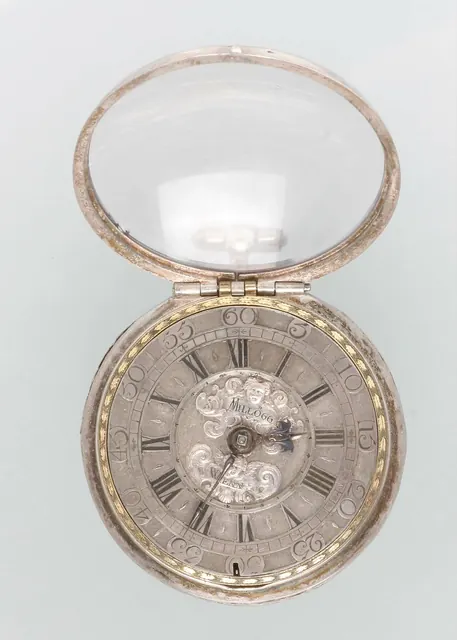
Pocket watch by Marcus Antonius Millögg, Austria, c. 1725
German Clock Museum
Pocket Watches · 1640–1660
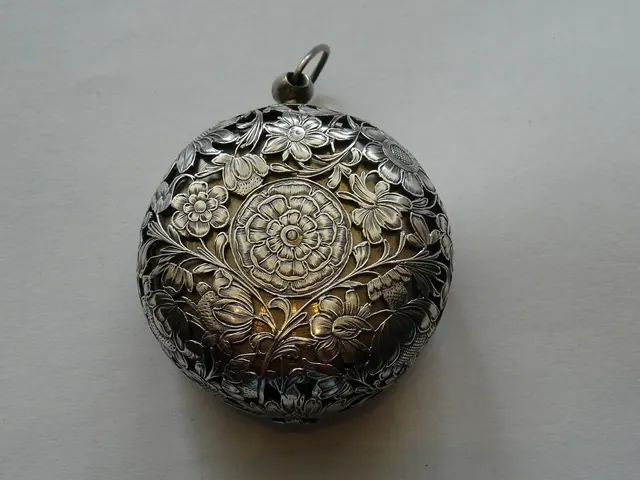
Watch by Andreas Nagel, Austria, 1640–1660
Musée du Louvre, Paris
Pocket Watches · c. 1675–80
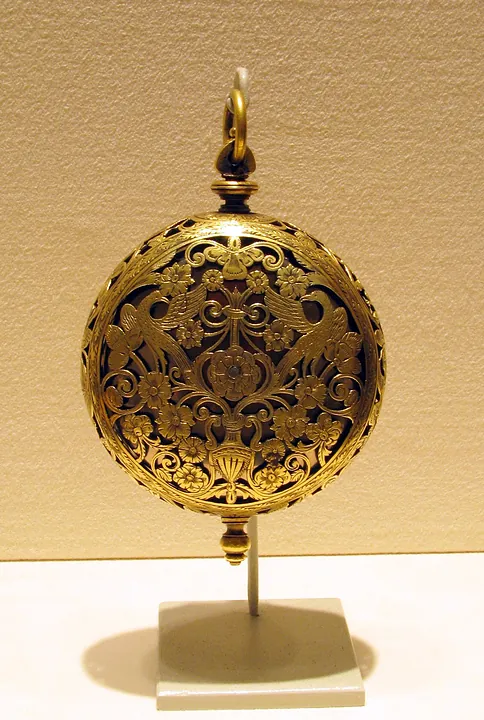
Repeater watch
The Metropolitan Museum of Art, New York
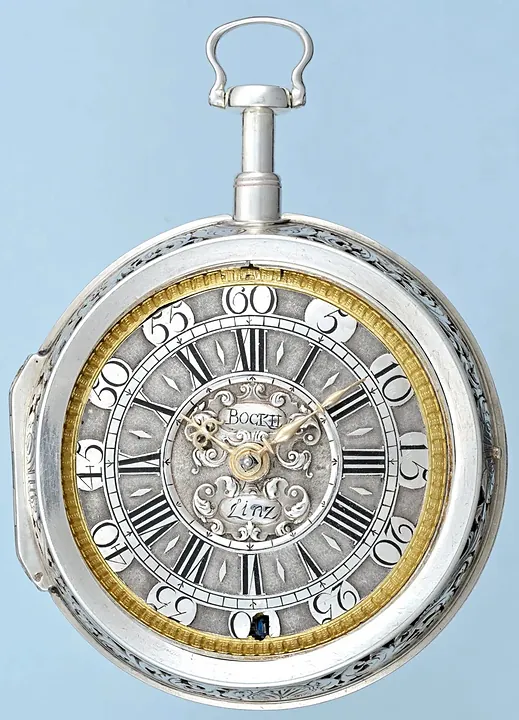
Pocket Watches · c. 1705
Rare Champleve Dial Austrian Repeater, circa 1705
Pieces of Time (dealer), London
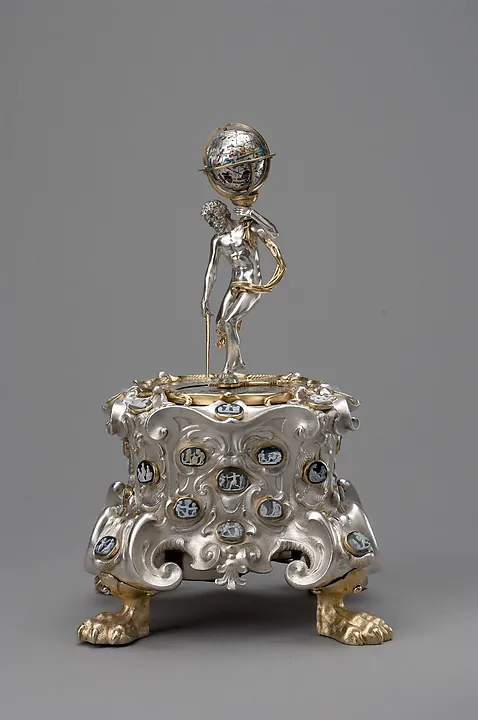
Pocket Watches · 1600–1699
Pocket watch by Georg Ernst, Germany, 1600–1699
Fine Arts Museum Vienna
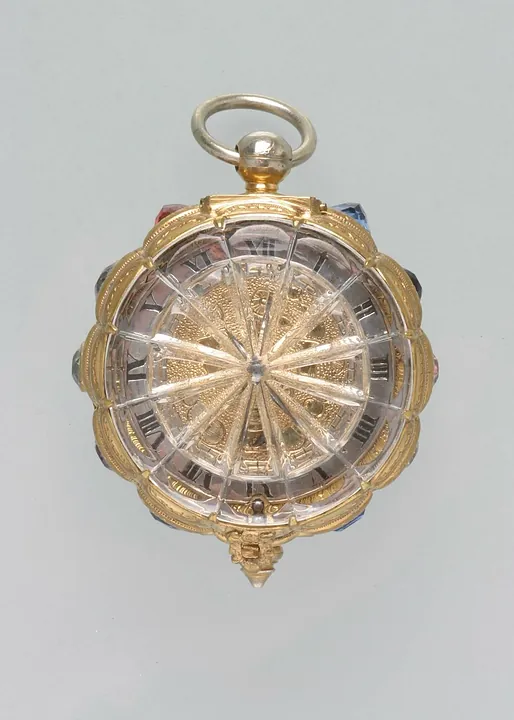
Pocket Watches · c. 1600
Pocket watch by Balthasar de Paep, Belgium, c. 1600
German Clock Museum
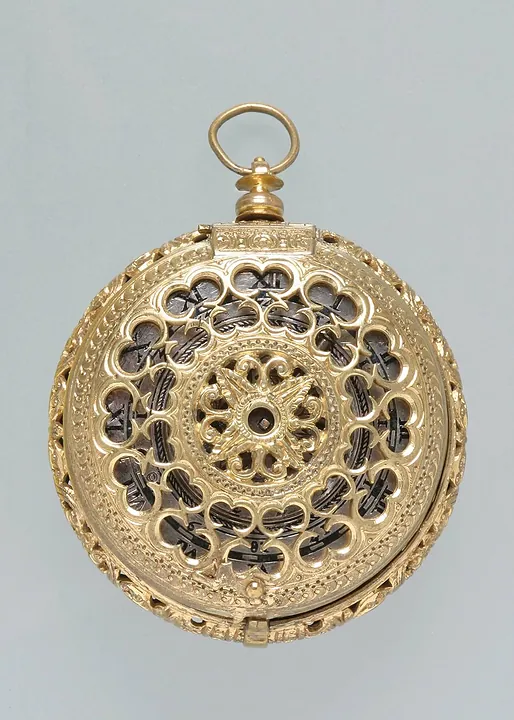
Pocket Watches · c. 1600
Pocket watch by Hans Reinboldt, France, c. 1600
German Clock Museum
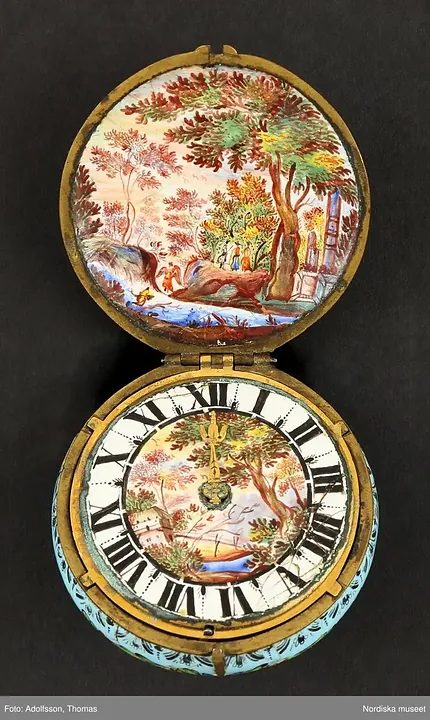
Pocket Watches · 1600–1699
Pocket watch by Johan Etmiller, Germany, 1600–1699
Nordic Museum Foundation