
Pocket Watches · Stackfreed watch
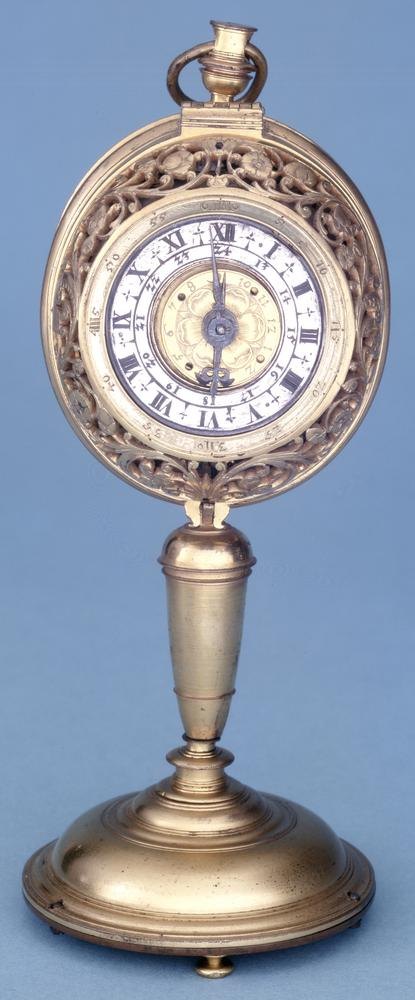
Stackfreed watch with hour and quarter-striking mechanisms and alarum mechanism
- Maker / attribution
- Nikolaus Rugendas (Made by)
- Date
- 1610–1620
- Historical period
- Early Modern Horology (1600 – 1750)
- Country of origin
- Germany
- Place
- Augsburg
- Object type
- Stackfreed watch
- Materials / technique
- brass, gold
- Dimensions
- Height: 165 millimetres (incl stand) Length: 71.60 millimetres Width: 62.60 millimetres
- Holding institution
- British Museum
- Accession / object no.
- 1888,1201.166
- Credit line
- British Museum, London
- Catalogue title (original)
- Stackfreed watch with hour and quarter-striking mechanisms and alarum mechanism; concentric minute hand; complete with gilt-metal stand and oval case (English)
View the source record ↗ (opens another website in a new tab)Suggest a correction
Record summary
Held and catalogued by British Museum (object number 1888,1201.166), this is a stackfreed watch by Nikolaus Rugendas, made in Augsburg, Germany, dated 1610–1620. The Atlas places it in the Early Modern Horology period (1600 – 1750) of its Pocket Watches collection. Materials and techniques recorded by the source: brass, gold. Recorded dimensions: Height: 165 millimetres (incl stand) Length: 71.60 millimetres Width: 62.60 millimetres. The record is illustrated with 6 photographs.
Assembled from the source record's structured fields. Dates and attributions are given as the source states them; where a field is missing the Atlas leaves it blank rather than estimating.
Catalogue description
Description — British Museum
Stackfreed watch with hour and quarter-striking mechanisms and alarum mechanism; concentric minute hand; complete with gilt-metal stand and oval case.
Curator's comments — British Museum
Text from 'Watches', by David Thompson, London, 2008, p. 30-31. Nikiaus Rugendas GILT-BRASS CASED QUARTER-STRIKING STACKFREED CLOCK-WATCH WITH ALARM AND PEDESTAL AUGSBURG, c. 1620 SIGNED: 'Niclaus Rugendas' At the beginning of the seventeenth century it was still relatively rare for people to own watches and they remained in the hands of a wealthy minority, especially when brand new. Therefore owning a watch held quite a degree of status value. In order, perhaps, to make something out of the ordinary, a small number of watchmakers turned their hand to watches that were not intended to be carried around. These are now generally referred to as monstrance watches, and were designed to stand on a table or desk, rather like a monstrance containing a reliquary. At a more sophisticated level is an even smaller group of watches that were conceived to perform a dual function: to be worn in the normal way when required, but also to be placed on a baluster stand to be used as a small monstrance watch. However, its weight would have made the wearing of such a watch somewhat uncomfortable and the fact that there is no cover for the dial might suggest that it was never really intended for such use, even though the pendant arrangement makes it possible. This rare piece was made by Niklaus Rugendas of Augsburg, a member of a dynasty of famous watch- and clockmakers who lived in that city during the sixteenth and seventeenth centuries. The matter of this watch's authorship is not made clearer by the fact that there were three watchmakers in Augsburg all called Niklaus Rugendas: grandfather, father and son. The grandfather was born in Melsugen in Hessen in 1582 and went to Augsburg in 1608. He was married there in 1615, began his business in 1616 and died in 1658. As this watch dates from c. 1620, it would therefore have been made by this man, rather than his son. The watch is of high quality, with a bell for the quarter-strike mounted under the dial within a raised bezel pierced and engraved with foliate scrolls. The design of the back is typical of a watch made in South Germany in this period. An unusual feature, and one peculiar to Germanic clock- and watchmaking of the sixteenth and early seventeenth centuries, is that the watch has six-hour striking: it strikes the hours 1-6 four times in twenty-four hours. At the front, the dial consists of a raised gilt ring engraved with the quarters I-IIII and with minutes numbered 5-60 every five minutes. Within this ring an applied silver chapter ring is engraved I-XII and 13-24 in concentric circles, surrounding a central alarm-setting disc engraved with a rose. Unfortunately both the hour and minute hands are later replacements. The finely made movement has separate gear trains for the going, the hour-strike, the quarter-strike and the alarm. The wheels are made of gilt brass, except for the contrate and crown wheels of the alarm, which are made of steel, a common feature in watches of this period. To aid the user when winding the watch, the four winding squares are engraved with the letters G (gang) for the going train, S (schlag) for the hour-strike, F (fiertel) for the quarter-strike and W (wecker) for the alarm. Originally the watch was furnished with a stackfreed mechanism to aid better timekeeping, but the components subsequently have been removed. View more about curator's comments Comment from Hugh Tait, Catalogue of Watches in the British Museum. Vol. I (1987) Made by 'Niclaus Rugendas' (signed); probably Augsburg, middle of 17th century Watch with Hour- and Quarter-Striking Mechanisms and Alarum Mechanism, and a Concentric Minute Hand, Complete with Gilt-Metal Stand Case: Back: pierced and engraved with symmetrical floral scrollwork, the lower end of both sides terminating in grotesque scaly beasts with biting heads; the rim engraved with four single rosettes at the cardinal points. In the centre, a square boss (new screw) for the attachment of the oval bell, which appears not to be original. Band: pierced with a reduced version of the design on the back, with the biting animal heads at vi on either side of the hole threaded to accept the screw at the upper end of the stem of the stand; turned urn-shaped pendant with ring at XII. Lid: none intended. Dial: the pierced, domed dial-plate is fixed by two screws at XII and VI to a narrow, flat oval ring which had a slotted projection to engage with the catch at VI. The pierced decoration is in the form of a running foliated floral scroll. A raised ring riveted to the dial-plate encircles and protects the dial; the inner sloping face of this ring is engraved with the Roman numerals I-IIII (for the quarters) and 5, 10 . 60 (for the five-minute marks). The applied silver chapter-ring is numbered I-XII and 13-24, the numerals being filled with black enamel; the gilt-metal alarum-setting disc is engraved 1-12 and, in the centre, with a 'seeded' rose. Both hands are later replacements. Movement: Brass plates, turned urn-shaped pillars, brass wheels throughout, apart from the usual exceptions in the alarum-train. The stackfreed assembly has been removed, and the cam-wheel replaced with a blued-steel wheel acting as stop-work; brass count-wheel; later simple regulator; silver quarter-strike indicating dial. The four winding squares are identified by initials, indicative of the functions of the trains: G(ang), S(chlag), F(iertel), W(ecker). The maker's signature is engraved near the winding square for the going-train: 'Niclaus Rugendas'. The shutter system for the alarum has been modified. The movement is held to the underside of the narrow flat oval ring (to which the dial-plate is fixed) by three studs, each of which has its own latch. The quarter bell immediately beneath the dial is fixed to a 'standard' screwed to the plate of the movement. The two locking-arms are engraved with a thin line passing through a conical sink. Metal stand: Gilt metal, with domed circular foot rising to a cylindrical collar,.
Inscriptions & marks
signature; Niclaus Rugendas [winding square]
Provenance
Bequeathed by:, Octavius Morgan; Acquired 1888
Historical context
Early Modern Horology (1600 – 1750)
Huygens' pendulum and balance spring transform accuracy; English makers develop the anchor and deadbeat escapements.
The balance spring (c. 1675) improved watches dramatically and introduced the minute hand. English pair-cased verge watches with pierced balance cocks and French oignons were typical; enamel painting at Blois and Geneva, and the repeating watch (1680s), made watches objects of great refinement.
Read the period in the timelineMore pocket watches from this periodEarlier: Renaissance Horology
Atlas type guide
Pocket watches
The pocket watch was the dominant personal timekeeper from the late seventeenth century until the First World War. Its development tracks the history of the escapement: verge watches with fusees until the late eighteenth century; Thomas Mudge's lever escapement (c. 1755) and the cylinder escapement popularised by George Graham and later by Swiss makers; and the Swiss and English lever watches of the nineteenth century. Lépine's bar-bridge calibre and keyless winding made watches thinner and easier to use.
Industrialisation transformed the trade: American factories such as Waltham (from 1850) and Elgin produced interchangeable parts by machine, and Swiss makers responded with their own mechanisation after the 1876 Philadelphia Exhibition. By 1900 a reliable watch was affordable to millions; the finest makers continued to produce complications and precision watches.
What to look for
- The escapement: verge (crown wheel), cylinder, duplex, English or Swiss lever.
- Key winding (a square arbor in dial or back) or keyless crown winding.
- Signatures and serial numbers on the movement, dial and inside case back.
- Hallmarks, case maker's marks and gold or silver standards stamped in the case.
- Dial material: enamel, silver, gold, later printed metal.
Dating clues
- Verge watches dominate before c. 1800; cylinder watches c. 1770–1900; lever watches after c. 1820.
- Keyless winding: increasingly common after c. 1860.
- Manufacturer serial number lists exist for Waltham, Elgin, Longines, Omega, Patek Philippe and others.
General guidance written by the Atlas editors about this kind of object. It is not a statement about this particular piece; for that, rely on the source record above and on physical examination.
Read next:Verge escapementDetached lever escapementFuseeIdentification Centre
Related records
Instruments · c. 1700
Equatorial sundial-MHS 1870
Musée d'histoire des sciences de la Ville de Genève
Pocket Watches · 1600–1699
Pocket watch by Georg Ernst, Germany, 1600–1699
Fine Arts Museum Vienna
Pocket Watches · 1600–1699
Pocket watch by Johan Etmiller, Germany, 1600–1699
Nordic Museum Foundation
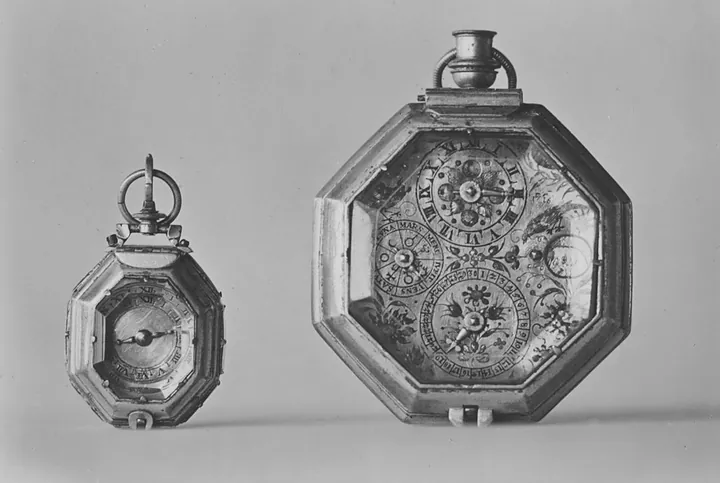
Pocket Watches · early 17th century
Watch with gilt brass case, crystal and blue glass panels signed 'Conradt Kreizer', Germany, early 17th century
Victoria and Albert Museum, London
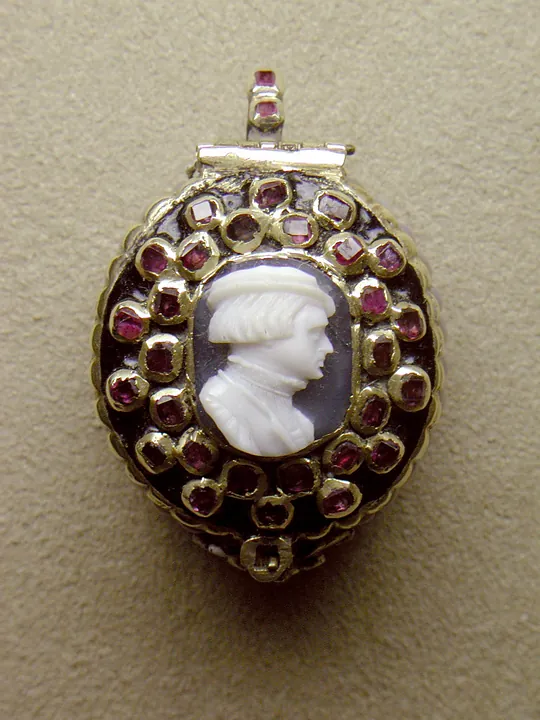
Pocket Watches · watch c. 1650, cameo 16th–17th century
Watch by Wilhelm Peffenhauser, Germany, watch c. 1650, cameo 16th–17th century
The Metropolitan Museum of Art, New York
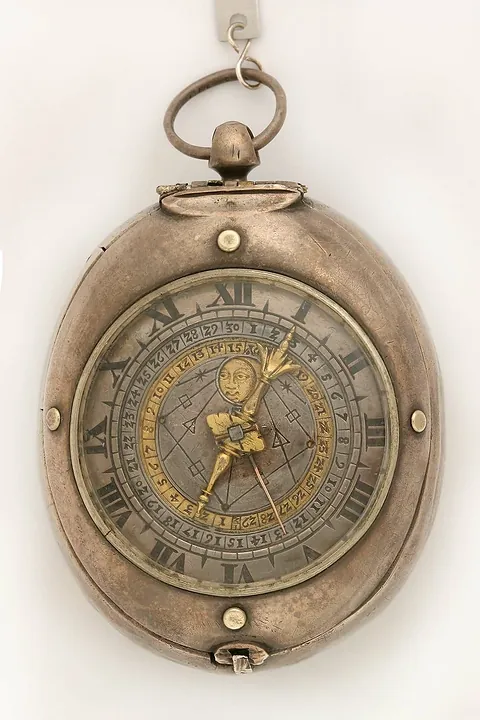
Pocket Watches · c. 1650
Pocket watch by Johann Sayller, Germany, c. 1650
German Clock Museum
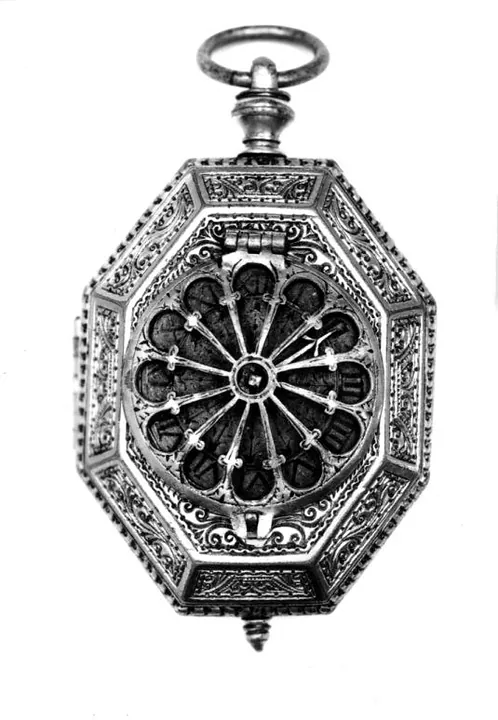
Pocket Watches · 1650–1699
Pocket watch, Germany, 1650–1699
Badisches Landesmuseum Karlsruhe
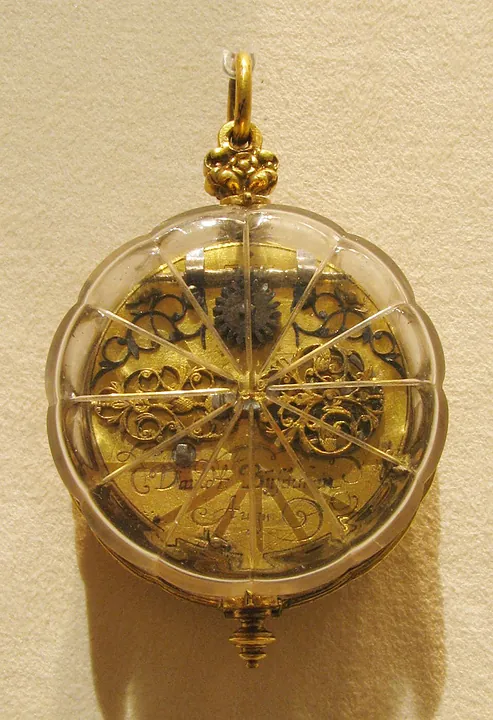
Pocket Watches · probably after 1657
Watch by David Buschman, Germany, probably after 1657
The Metropolitan Museum of Art, New York