
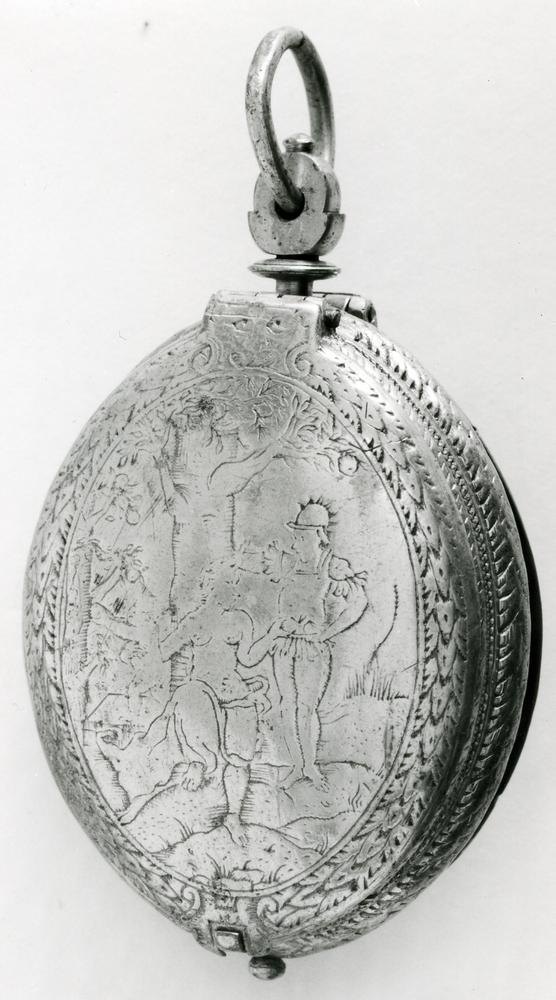
Pocket Watches · Stackfreed watch
Stackfreed watch-movement, going-train only
- Maker / attribution
- Jan Janssen Bockelts the Elder (Attributed to); M (Case made by (attributed))
- Date
- 17thC(early)
- Historical period
- Early Modern Horology (1600 – 1750)
- Country of origin
- Germany
- Place
- Aachen, Netherlands (?)
- Object type
- Stackfreed watch
- Materials / technique
- brass, gold, silver
- Dimensions
- Length: 52.20 millimetres (case) Width: 41.50 millimetres (case)
- Holding institution
- British Museum
- Accession / object no.
- 1958,1201.2225
- Credit line
- British Museum, London
- Catalogue title (original)
- Stackfreed watch-movement, going-train only; oval case (English)
View the source record ↗ (opens another website in a new tab)Suggest a correction
Record summary
Held and catalogued by British Museum (object number 1958,1201.2225), this is a stackfreed watch attributed to Jan Janssen Bockelts the Elder, made in Aachen, Netherlands (?), Germany, dated 17thC(early). The Atlas places it in the Early Modern Horology period (1600 – 1750) of its Pocket Watches collection. Materials and techniques recorded by the source: brass, gold, silver. Recorded dimensions: Length: 52.20 millimetres (case) Width: 41.50 millimetres (case). The record is illustrated with 3 photographs.
Assembled from the source record's structured fields. Dates and attributions are given as the source states them; where a field is missing the Atlas leaves it blank rather than estimating.
Catalogue description
Description — British Museum
Stackfreed watch-movement, going-train only; oval case.
Curator's comments — British Museum
Comment from Hugh Tait, Catalogue of Watches in the British Museum. Vol. I (1987) Made by Jan Jansen Bockeltz (attrib.); probably Aachen or the Netherlands, first half of 17th century Watch (Movement with Going-Train Only) Case: Back: exterior engraved with an open-air scene, in which a seated half-nude female figure, holding a standing child with her outstretched right hand, leans her back against the trunk of a tall fruit-tree; the child picks fruit from a smaller tree on the left; the seated female's head is turned to the right and, with her left hand, she appears to offer a fruit to the standing male figure on the right; the man wears a helmet and 'classical' armour; stylised laurel-leaf border; hinge engraved with an animal mask. Interior engraved with scrollwork forming a cartouche, within which is scratched a later inscription: 1623/M (placed sideways); border has scale pattern. Band: a cast strip with a raised semicircular profile engraved with a laurel-wreath design and on either side a narrow engraved beading; at XII, a later pendant and ring; a very small turned pendentive finial. Lid: a later replacement in brass; without any apertures or piercings; the exterior is crudely engraved with a land-scape containing a church and another building, and a surrounding laurel-wreath border; the interior is plain. Dial: the flat silver oval dial-plate is a later replacement and is engraved I-XII within two pairs of scribed circles; centre engraved with a sunburst; dial-plate held to the movement by three pillars secured by cross-pinning; later hand. On the reverse, MA in a lozenge, probably a maker's mark of the nineteenth century already present when the silver was re-used to make this dial. Movement: Brass pillars and plates; steel wheels, all traces of gilding have been stoned off the surface of the plates and pillars; steel 'furniture' on the pillar-plate; the stackfreed spring is on the right; manual type of regulator; later short cock and bar-balance. Around the rim of the pillar plate is engraved a narrow band of ornament, partially filed away at a later date. The movement is now held in place within the case by two modern screws passing through opposite sides of the band and located in two threaded holes in the brass pillars. The maker's initials are engraved near the foot of the balance-cock. The mainspring is contained in a brass band engraved with scrolling foliage; the crown-wheel runs between two engraved brackets; the balance has a simple potence; the second- and third-wheels run in a bridge below the plate. Dimensions (of case): 52.3 x 41.5 mm. Provenance: Ilbert Collection, 1958. Notes: 1. The case may not be the original for this movement because it shows considerable signs of alteration, including the plugging of the four small holes in the band. The original dial was probably made as an inseparable part of the case; the upper rim of the band shows many signs of cutting and filing consistent with the removal of the fixed type of dial. 2. The removal of the original dial has necessitated a reduction in the height of the movement, with the result that the pillars have been slightly shortened and the bottom end of the potence now projects beyond the upper surface of the plate and is level with the top of the bridge for the third- and fourth-wheels. 3. The movement has undergone considerable modification and probably none of the 'furniture' on the pillar-plate is original. Certainly, the stackfreed spring is a replacement, as there is evidence to show that the original was positioned on the left of the pillar-plate. 4. In section the band compares closely to the band of registration no. 1958,1201.2224, but whereas this band was cast in this form, the semicircular moulding on the band of the previous watch appears to have been achieved by the use of a hammer. 5. The maker's mark has not been recorded on another watch-movement nor on a watch-case, but it is to be found in an almost identical form on two contemporary table-clocks in gilt-metal cases: (a) in the foreground of the finely engraved panels depicting 'Musica' and 'Geometria' on the doors of the clock preserved in the Musées Royaux d'Art et d'Histoire, Brussels (no. G. 1059), described and illustrated in A.-M. Berryer and L. Dresse de Lébioles, 'La Mesure du Temps à travers les Ages', Brussels, 1961, pp. 36-7, pls IV and V, where the mark is regarded as the signature of the engraver of the panels rather than the signature of the maker, but no engraver is known to have used this mark. NB It is not known if every part of the movement has yet been examined to establish whether the same mark appears on any part of the mechanism. This same clock has also been described and illustrated in 'La Mesure du Temps', catalogue of an exhibition under the auspices of the Union Professionnelle des Maîtres Horlogers-Bijoutiers-Orfèvres at Namur, July 1962, p. 43, fig. 32, where the mark has been misread as 'AB'. (b) on the back-plate of the movement of a very similar table-clock (Sotheby & Co., Sale Catalogue, 28 Oct. 1963, lot 106, with illus. NB The maker's mark is wrongly described as a punch-mark and a line-drawing reproduces the mark with several minor inaccuracies). Although this movement bears the same engraved maker's mark as the case of the Brussels clock, the case of the Sotheby's clock is unmarked despite the fact that it is engraved in an almost identical way. The panel on the door depicting 'Musica' is repeated almost line for line, except for the omission of a castle in the far distant landscape and the monogram in the left foreground; the panel on the other door depicting 'Geometria' repeats a similar, but quite distinct, version of the same subject. There can be little doubt that these two clocks originated in the late sixteenth century or during the first half of the seventeenth century in the same workshop and, from the slender evidence, it would seem possible that the maker of the movements was also the rather unu.
Inscriptions & marks
maker's mark; I4B [balance-cock]; casemaker's mark; 1623 M
Provenance
Previous owner/ex-collection:, Courtenay Adrian Ilbert; Purchased through:, Christie's
Historical context
Early Modern Horology (1600 – 1750)
Huygens' pendulum and balance spring transform accuracy; English makers develop the anchor and deadbeat escapements.
The balance spring (c. 1675) improved watches dramatically and introduced the minute hand. English pair-cased verge watches with pierced balance cocks and French oignons were typical; enamel painting at Blois and Geneva, and the repeating watch (1680s), made watches objects of great refinement.
Read the period in the timelineMore pocket watches from this periodEarlier: Renaissance Horology
Atlas type guide
Pocket watches
The pocket watch was the dominant personal timekeeper from the late seventeenth century until the First World War. Its development tracks the history of the escapement: verge watches with fusees until the late eighteenth century; Thomas Mudge's lever escapement (c. 1755) and the cylinder escapement popularised by George Graham and later by Swiss makers; and the Swiss and English lever watches of the nineteenth century. Lépine's bar-bridge calibre and keyless winding made watches thinner and easier to use.
Industrialisation transformed the trade: American factories such as Waltham (from 1850) and Elgin produced interchangeable parts by machine, and Swiss makers responded with their own mechanisation after the 1876 Philadelphia Exhibition. By 1900 a reliable watch was affordable to millions; the finest makers continued to produce complications and precision watches.
What to look for
- The escapement: verge (crown wheel), cylinder, duplex, English or Swiss lever.
- Key winding (a square arbor in dial or back) or keyless crown winding.
- Signatures and serial numbers on the movement, dial and inside case back.
- Hallmarks, case maker's marks and gold or silver standards stamped in the case.
- Dial material: enamel, silver, gold, later printed metal.
Dating clues
- Verge watches dominate before c. 1800; cylinder watches c. 1770–1900; lever watches after c. 1820.
- Keyless winding: increasingly common after c. 1860.
- Manufacturer serial number lists exist for Waltham, Elgin, Longines, Omega, Patek Philippe and others.
General guidance written by the Atlas editors about this kind of object. It is not a statement about this particular piece; for that, rely on the source record above and on physical examination.
Read next:Verge escapementDetached lever escapementFuseeIdentification Centre
Related records
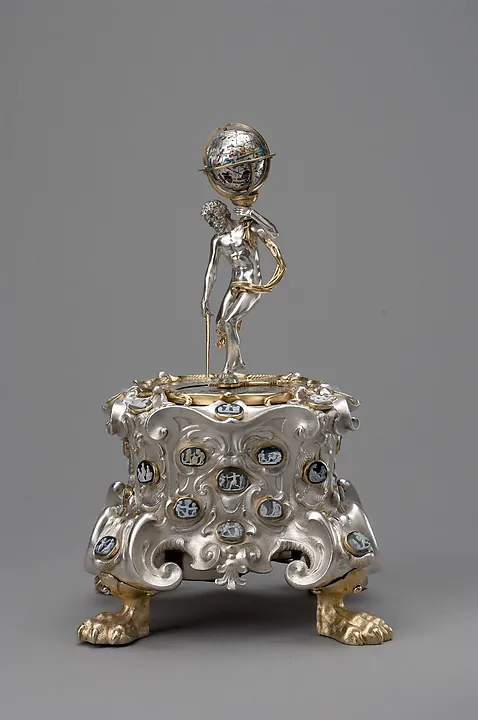
Pocket Watches · 1600–1699
Pocket watch by Georg Ernst, Germany, 1600–1699
Fine Arts Museum Vienna
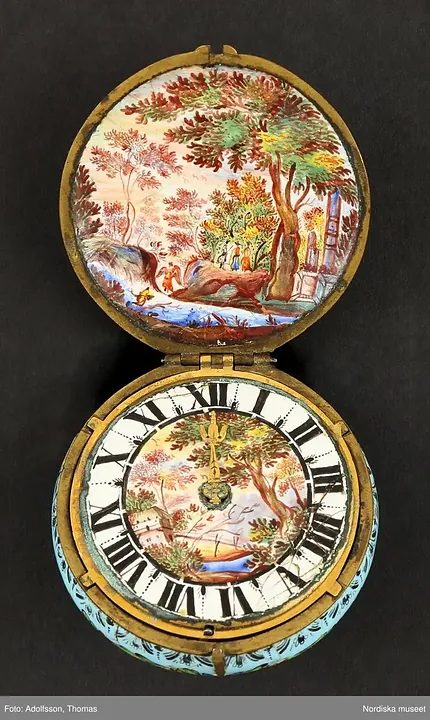
Pocket Watches · 1600–1699
Pocket watch by Johan Etmiller, Germany, 1600–1699
Nordic Museum Foundation
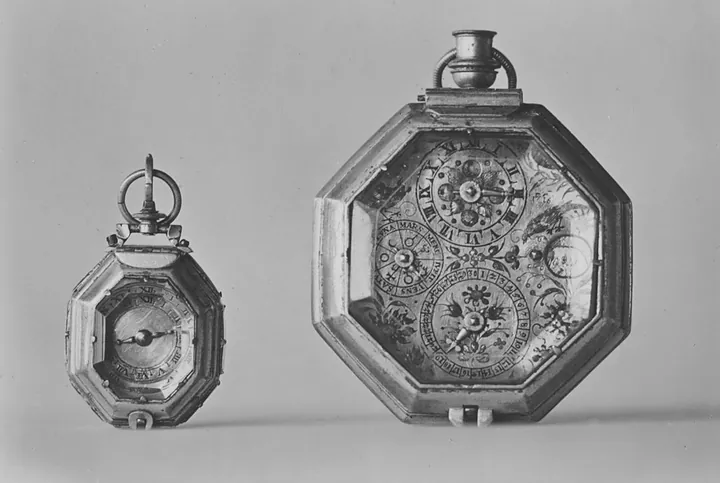
Pocket Watches · early 17th century
Watch with gilt brass case, crystal and blue glass panels signed 'Conradt Kreizer', Germany, early 17th century
Victoria and Albert Museum, London
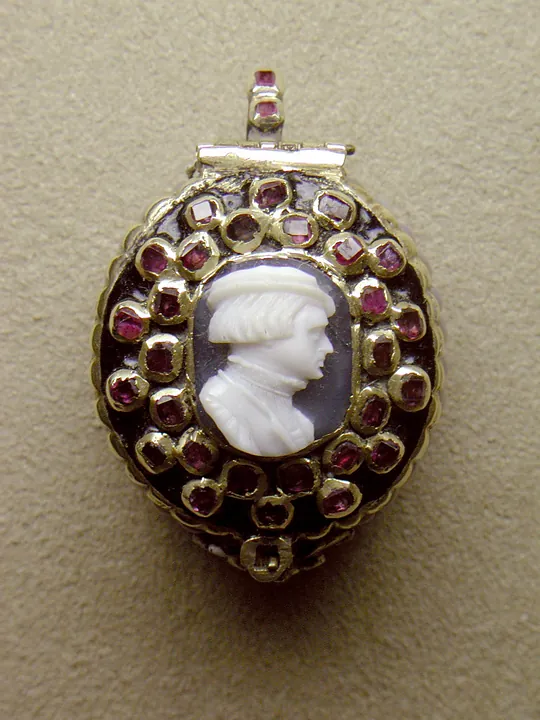
Pocket Watches · watch c. 1650, cameo 16th–17th century
Watch by Wilhelm Peffenhauser, Germany, watch c. 1650, cameo 16th–17th century
The Metropolitan Museum of Art, New York
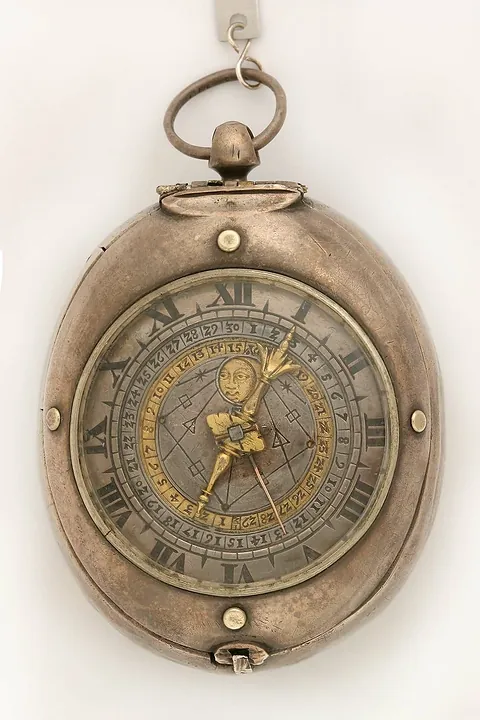
Pocket Watches · c. 1650
Pocket watch by Johann Sayller, Germany, c. 1650
German Clock Museum
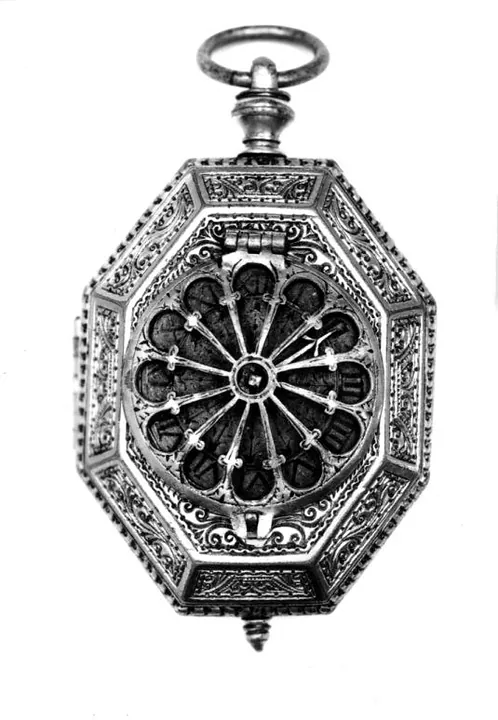
Pocket Watches · 1650–1699
Pocket watch, Germany, 1650–1699
Badisches Landesmuseum Karlsruhe
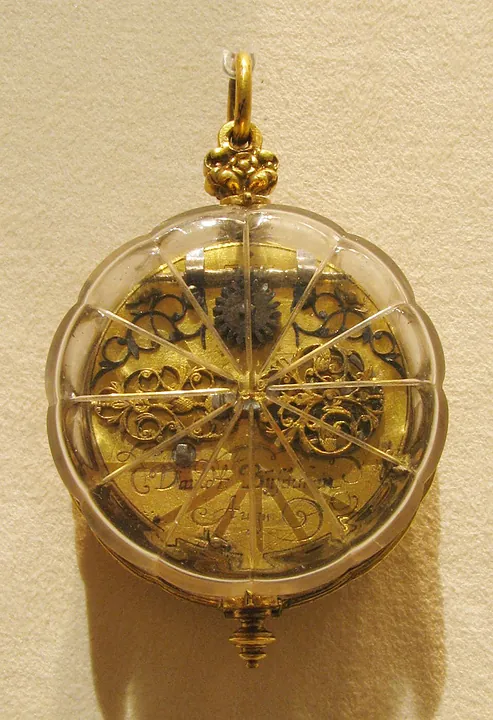
Pocket Watches · probably after 1657
Watch by David Buschman, Germany, probably after 1657
The Metropolitan Museum of Art, New York
Pocket Watches · c. 1670
Watch by Nicolaus Rugendas the Younger, Germany, c. 1670
The Metropolitan Museum of Art, New York