
Wristwatches · Wristwatch
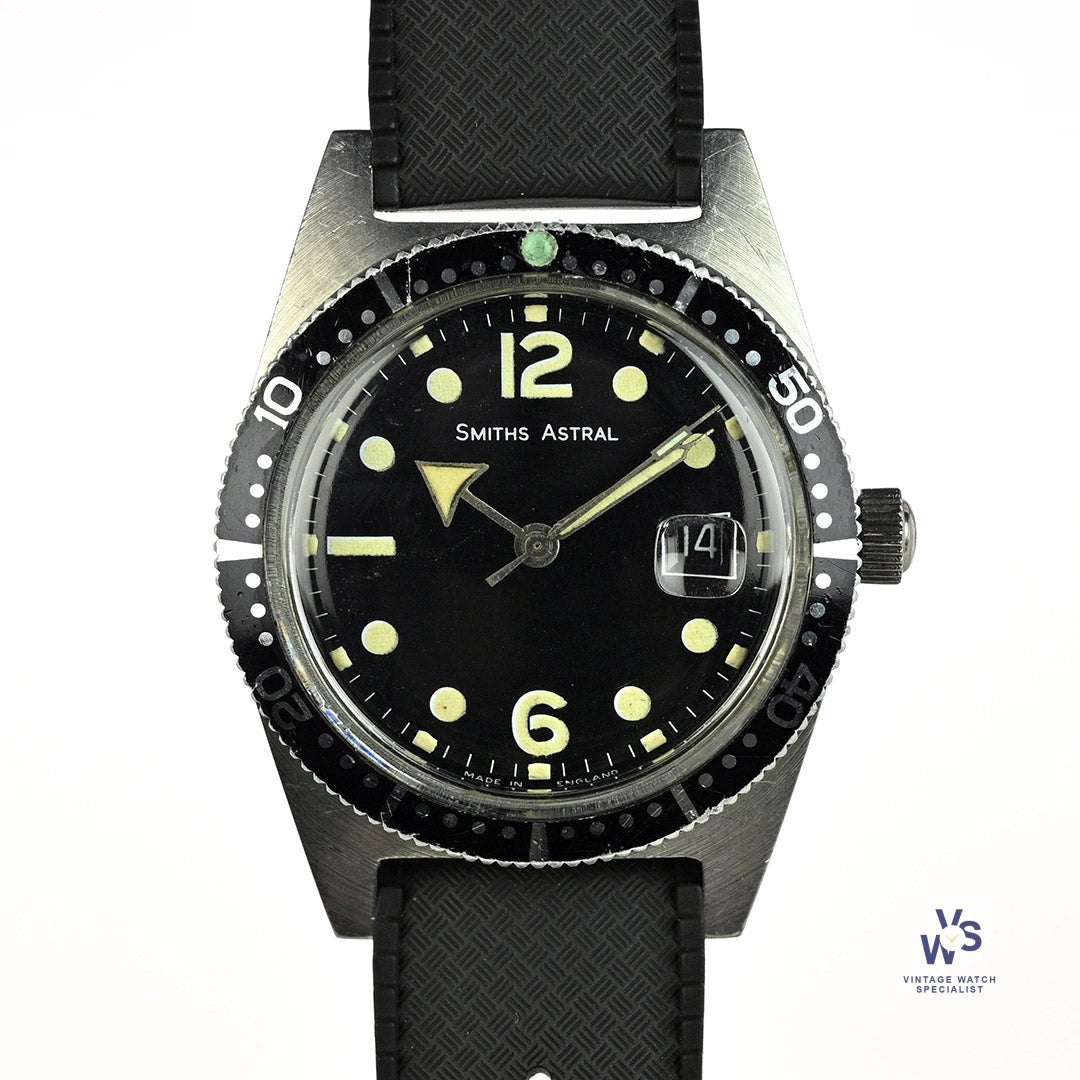
Smiths Astral Diver with Date, Original Lume, circa 1960s
- Maker / attribution
- Smiths (maker)
- Date
- c. 1960s
- Historical period
- Modern Mechanical Horology (1945 – 1969)
- Country of origin
- England
- Object type
- Wristwatch
- Stock no.
- vws4193
- Credit line
- Dealer listing, Vintage Watch Specialist (vws4193)
- Catalogue title (original)
- Smiths Astral Diver with Date - Original Lume - c.1960s (English)
View the source record (dealer listing) ↗ (opens another website in a new tab)Suggest a correction
Record summary
Catalogued by Vintage Watch Specialist (dealer), United Kingdom (stock number vws4193), this is a wristwatch by Smiths, made in England, dated c. 1960s. The Atlas places it in the Modern Mechanical Horology period (1945 – 1969) of its Wristwatches collection. The record is illustrated with 6 photographs.
Assembled from the source record's structured fields. Dates and attributions are given as the source states them; where a field is missing the Atlas leaves it blank rather than estimating.
Catalogue description
Dealer description — Vintage Watch Specialist
A rugged 1960s Smiths Astral diver date with black dial, rotating bezel and classic British tool watch character Smiths Astral Diver REF. CM4501, Stainless Steel case Smiths Astral models were typically simple, everyday watches, but in later years the line expanded to include more robust, sport-oriented designs. Examples like this diver-style Astral reflect that shift, incorporating rotating bezels, luminous dials and practical features suited to active use. While not as widely documented as Smiths’ dedicated dive watches, these pieces show the brand adapting to changing tastes in the 1960s and 70s, blending reliability with increasingly functional, tool-watch aesthetics. What's on Offer A far cry from the usual Astral, this is Smiths leaning firmly into tool-watch territory. A proper diver-style piece from the 1960s, with a bold black dial, heavy lume plots and a rotating bezel built for purpose rather than decoration. The layout is clean and highly legible, with oversized hour markers, a broad arrow handset and a central seconds hand, all designed for visibility in low light. The date window at three, complete with reverse cyclops magnifier, adds a practical touch, while the lume has aged to a soft, creamy tone that works beautifully against the dial. The stainless steel case has a reassuring presence on the wrist, and the caseback is marked water-resistant to 20 atmospheres — exactly what you’d want to see on a watch of this type. There are light signs of wear throughout, entirely consistent with age, but nothing that detracts from its overall character. Fitted to a black rubber Tropic strap, it wears exactly as it should — purposeful, understated and quietly confident. A slightly under-the-radar British take on the classic dive watch. Ready to enjoy having just returned from the watchmaker after a complete overhaul/service.
Historical context
Modern Mechanical Horology (1945 – 1969)
Tool watches for divers, pilots and astronauts; electric watches anticipate the electronic age.
The classic era of the mechanical wristwatch: dive watches, chronographs for motor racing and space flight, GMT watches for jet travel, slim dress watches, automatic calendars, and the rise of Japanese manufacturers alongside Swiss, American, German and Soviet industries.
Read the period in the timelineMore wristwatches from this periodEarlier: Golden Age of Mechanical Watchmaking
Atlas type guide
Dive and water-resistant watches
Keeping water and dust out of a wristwatch was a long-standing challenge. Rolex's screw-down Oyster case (1926) and Omega's Marine (1932) were landmarks; in the early 1950s Blancpain's Fifty Fathoms and Rolex's Submariner defined the professional dive watch with rotating bezels for timing dives, luminous dials and high water resistance. The ISO 6425 standard (1982) later codified what a 'diver's watch' must do.
Dive watches became icons of post-war design and exploration, and their evolution — helium escape valves, ceramic bezels, saturation-diving depth ratings — records the history of underwater work.
What to look for
- Unidirectional or bidirectional rotating bezel with minute markings.
- Screw-down crown and case back; depth rating printed on the dial.
- Luminous hands and markers (radium before c. 1960, tritium c. 1960–1998, then Super-LumiNova).
- Reference numbers on the case between the lugs or inside the back.
Dating clues
- Screw-down Oyster cases: from 1926.
- Professional dive watches: from 1953.
- Tritium 'T' marks on dials: c. 1960–1998.
General guidance written by the Atlas editors about this kind of object. It is not a statement about this particular piece; for that, rely on the source record above and on physical examination.
Related records
Clocks · 1971–1979
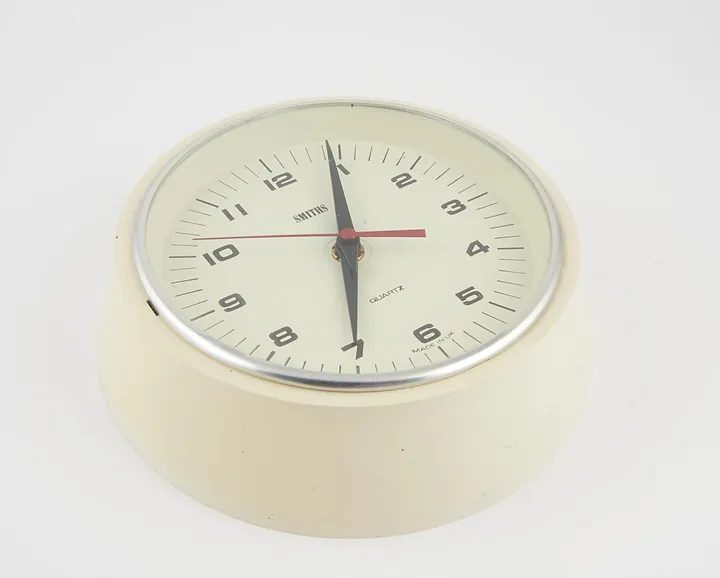
Electric clock by Smiths, England, 1971–1979
Science Museum Group, London
Wristwatches · c. 1950s
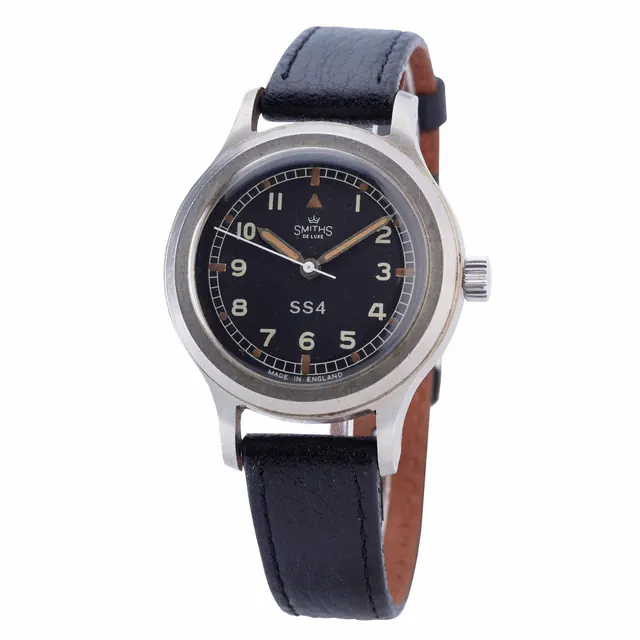
Smiths wristwatch, ref. SS4, Military, circa 1950s
Antiquorum auction archive, Geneva
Wristwatches · 1955
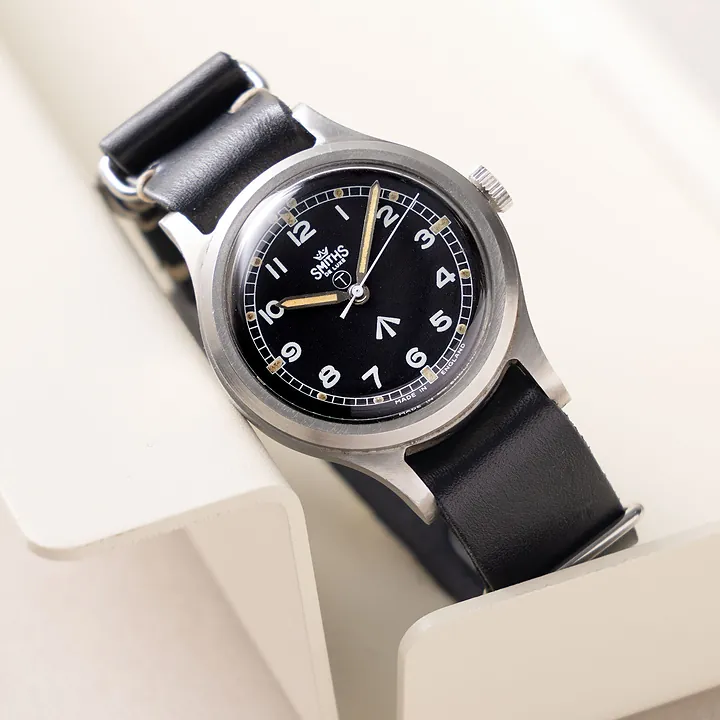
Smiths "Deluxe" ref 6B/542 Military Watch for the British RAF, 1955
Bulang & Sons (dealer), Copenhagen
Wristwatches · 1968
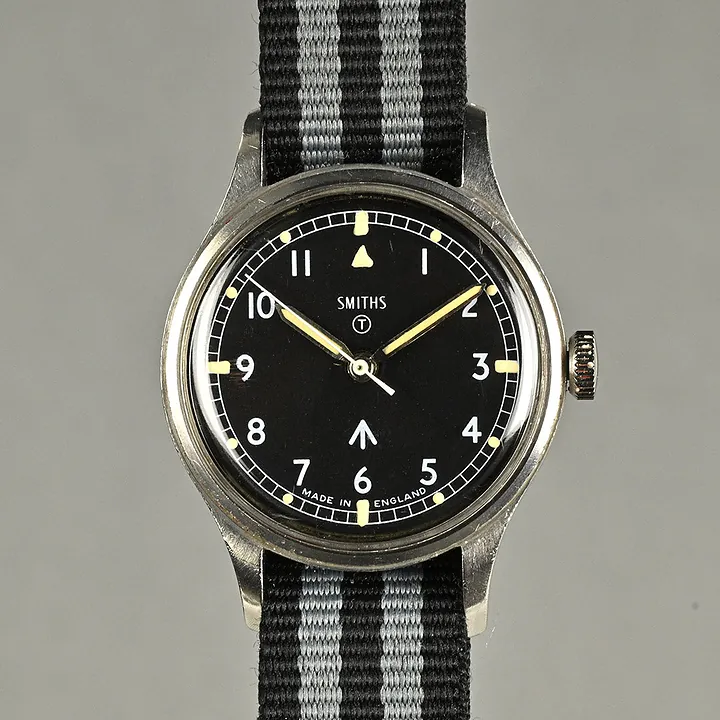
Smiths W10 British Army Military Watch, ref. W10/6645-99-961-4045, 1968
Vintage Watch Specialist (dealer), United Kingdom
Wristwatches · 1953
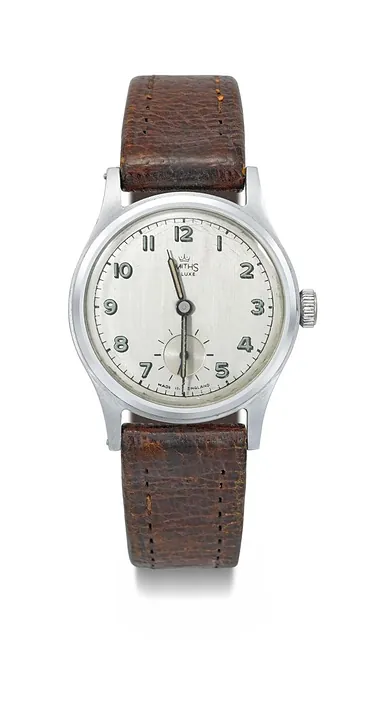
Wristwatch by Smiths English Clocks Limited, England, 1953
Science Museum Group, London
Wristwatches · 1959
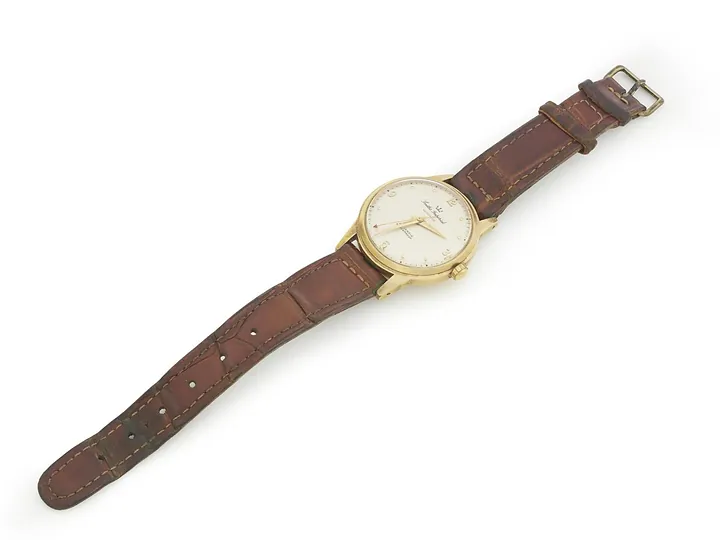
Wristwatch by Smiths Clocks & Watches Ltd, England, 1959
Science Museum Group, London
Wristwatches · 1958
Wrist Watch - Harwood, England, 1958
Museums Victoria, Melbourne
Wristwatches · c. 1957
Wrist Watch - Timex, Great Britain, c. 1957
Museums Victoria, Melbourne