
Wristwatches · Wristwatch
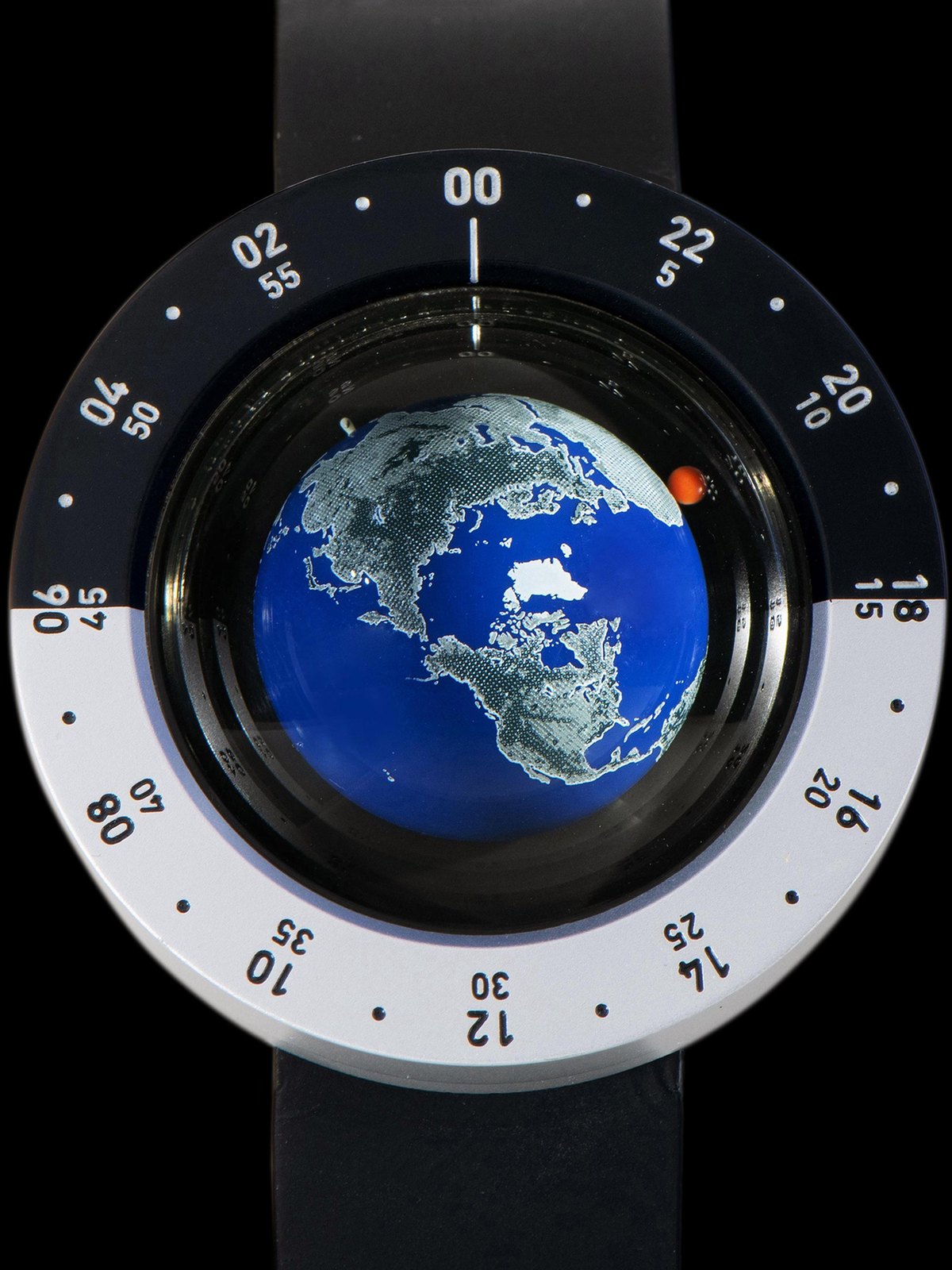
Seiko "Think The Earth" Quartz Watch (Ref. WN-2) Blue, 2008
- Maker / attribution
- Seiko (maker)
- Date
- 2008
- Historical period
- Mechanical Renaissance (1990 – 2010)
- Country of origin
- Japan
- Object type
- Wristwatch
- Stock no.
- SKOTTEWM2B
- Credit line
- Dealer listing, Craft & Tailored (SKOTTEWM2B)
- Catalogue title (original)
- 2008 Seiko "Think The Earth" Quartz Watch (Ref. WN-2) Blue W/ Box & Papers (English)
View the source record (dealer listing) ↗ (opens another website in a new tab)Suggest a correction
Record summary
Catalogued by Craft & Tailored (dealer), Los Angeles (stock number SKOTTEWM2B), this is a wristwatch by Seiko, made in Japan, dated 2008. The Atlas places it in the Mechanical Renaissance period (1990 – 2010) of its Wristwatches collection. The record is illustrated with 6 photographs.
Assembled from the source record's structured fields. Dates and attributions are given as the source states them; where a field is missing the Atlas leaves it blank rather than estimating.
Catalogue description
Dealer description — Craft & Tailored
Created in 2001 through a collaboration between Seiko and the Japanese NPO Think the Earth Project, the Think the Earth WN-2 is one of the most unconventional and imaginative watch designs of the modern era. Conceived as a literal “wearable piece of the planet,” the WN-2 was designed to shift the wearer’s perspective toward a broader, global scale by blending horology, industrial design, and environmental philosophy into a single object. At the center of the watch sits a miniature 1/580 million scale model of the Earth’s northern hemisphere beneath a domed Hardlex crystal. The globe rotates once every 24 hours, mirroring the Earth’s actual rotation, while time is displayed via a silver hook-shaped hour indicator and a small orange minute marker along a 24-hour scale. Further adding to its uniquely functional design, the watch’s removable titanium and aluminum core module can also be placed into a display stand and used as a standalone desk clock. Equal parts timepiece, conversation piece, and design object, the Think the Earth WN-2 remains unlike anything else produced in modern watchmaking. SPECS Stock # SKOTTEWM2B Brand Seiko Style "Think The Earth" Model WN-2 Serial 87XXXX Size Men's Material Titanium / Aluminum / Stainless Steel Dial Blue "Earth" Millimeters 45 Strap Seiko Black Strap W/ Stainless Steel Deployant Clasp CASE & BRACELET The titanium and aluminum outer case remains in relatively untouched condition, showing no notable wear or signs of use. The Hardlex crystal is free of blemishes. The internal case module is also in excellent condition, with only minor wear present on the case back. The watch comes supplied on its original black strap, which is in lightly worn condition, and its original stainless steel deployant clasp. DIAL & HANDS The dial, comprised of a domed 1/580 million scale model of Earth's northern hemisphere, is in perfect condition. The red dot hour hand and white prong minutes hand are original and in perfect condition. ACCESSORIES The watch is a complete set, with its original box, instruction booklets, and desk clock display. PLEASE NOTE: This set is missing its secondary silver bezel. The watch is keeping time, and it just received a new battery.
Historical context
Mechanical Renaissance (1990 – 2010)
Mechanical watches return as cultural objects; independent watchmaking flourishes.
Mechanical watches returned as cultural and luxury objects. Complications, tourbillons and new materials proliferated; independent watchmakers such as George Daniels, F.P. Journe and Philippe Dufour revived artisanal watchmaking; collecting vintage watches became a major field.
Read the period in the timelineMore wristwatches from this periodEarlier: Quartz Revolution
Atlas type guide
Quartz, digital and electronic watches
Electronic watches arrived in three steps. The Hamilton Electric 500 (1957) was the first battery-powered wristwatch, still with a balance; Bulova's Accutron (1960) used a tuning fork. On 25 December 1969 Seiko released the Astron 35SQ, the first quartz wristwatch, closely followed by the Swiss Beta 21 group. In 1972 Hamilton's Pulsar introduced the LED digital watch, and LCD displays soon made digital watches cheap.
The 'Quartz Crisis' that followed devastated the Swiss mechanical industry, which lost two-thirds of its workforce between 1970 and 1984 before recovering with the Swatch (1983) and the luxury mechanical revival. Solar, radio-controlled, kinetic and connected smartwatches continue the electronic line.
What to look for
- Battery hatch in the case back and calibre markings with 'Quartz' or a crystal frequency.
- Display technology: LED (red, push-button) versus LCD (always-on).
- Tuning-fork hum and a smoothly sweeping seconds hand on Accutrons.
- Model and reference numbers, often printed on the back.
Dating clues
- Electric balance watches: from 1957.
- Tuning-fork watches: 1960–c. 1977.
- Quartz analogue: from December 1969; LED digital: 1972–c. 1978; LCD from 1973.
General guidance written by the Atlas editors about this kind of object. It is not a statement about this particular piece; for that, rely on the source record above and on physical examination.
Read next:Seiko calibre 35A (Astron)
Related records
Wristwatches · 1967
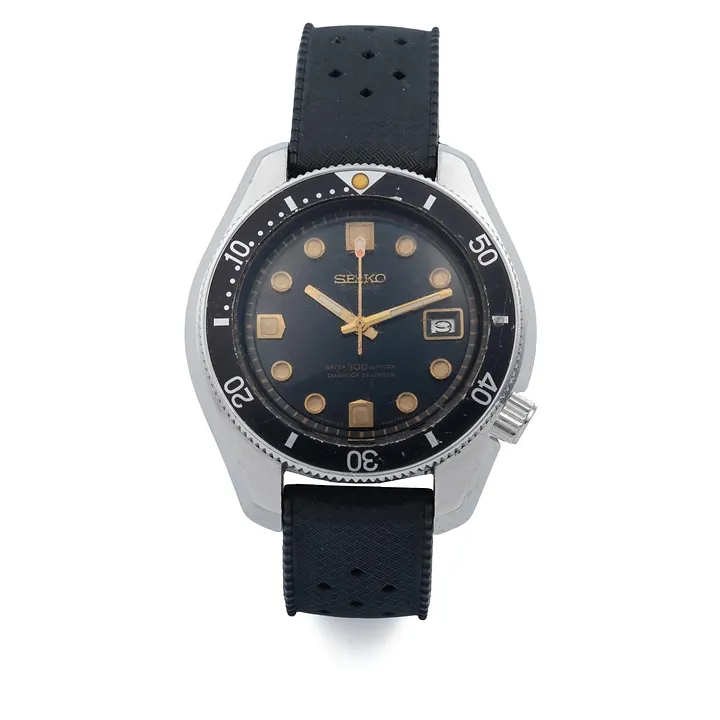
Seiko 300 M, ref. 6215-7000, 1967
Antiquorum auction archive, Geneva
Wristwatches · 1967
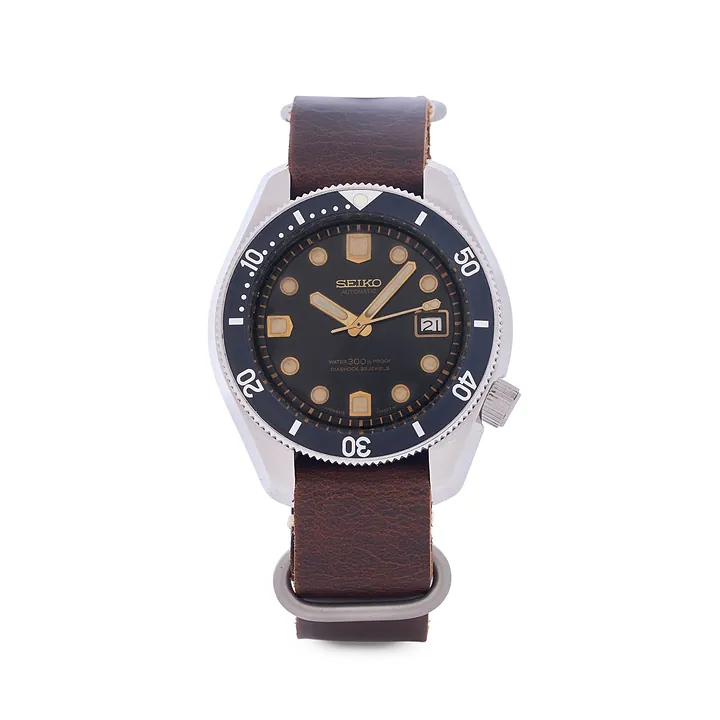
Seiko 300 Meter Diver, ref. 6215-7000, 1967
Antiquorum auction archive, Geneva
Wristwatches · c. 1968
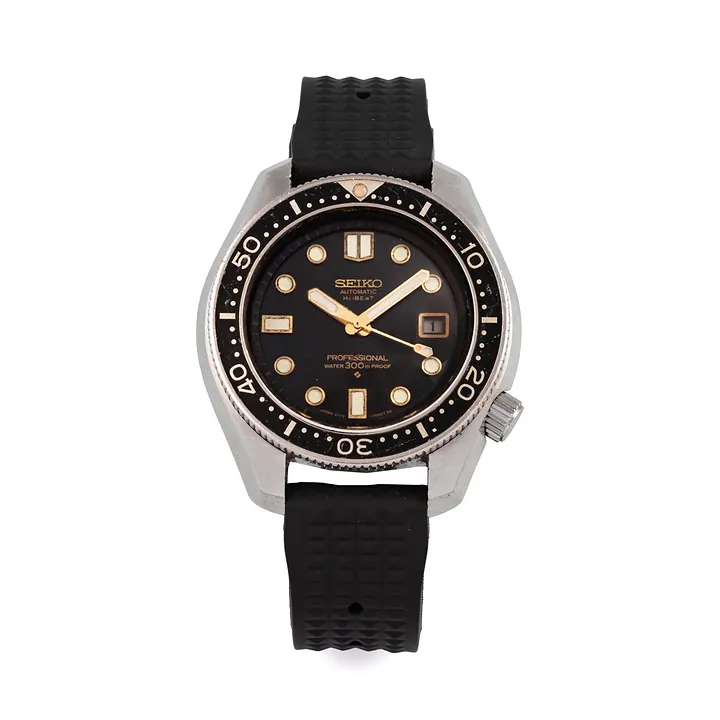
Seiko Hi-Beat, ref. 6159-7000, c. 1968
Antiquorum auction archive, Geneva
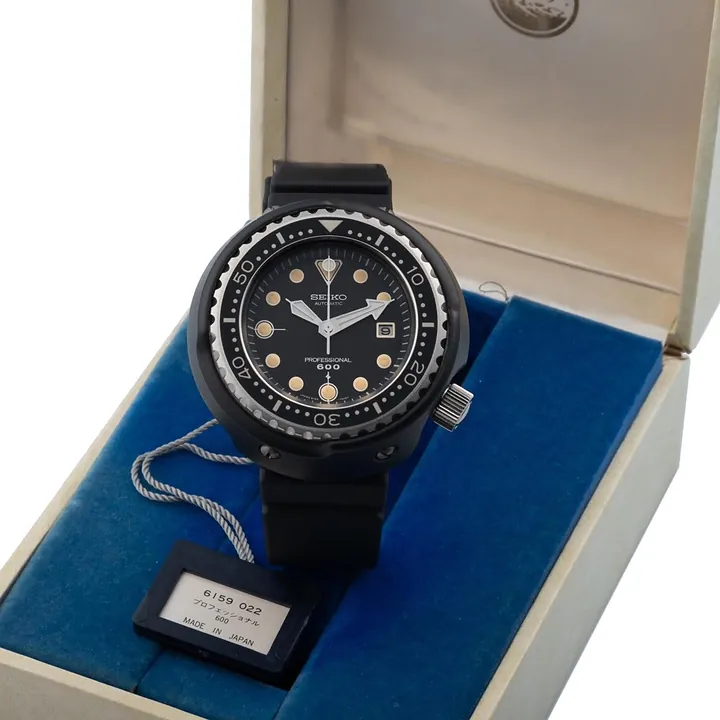
Wristwatches · 1975
Seiko Tuna Professional 600, ref. 6159-7010, 1975
Antiquorum auction archive, Geneva
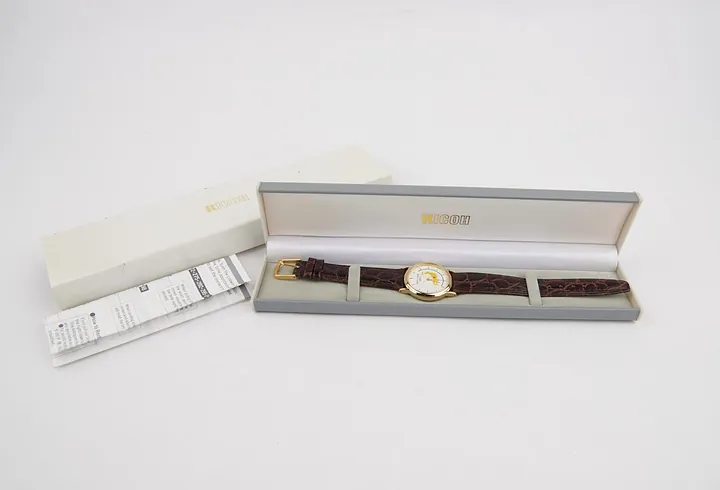
Wristwatches · 1990–1996
Wristwatch by Ricoh Elemex Corporation, Japan, 1990–1996
Science Museum Group, London
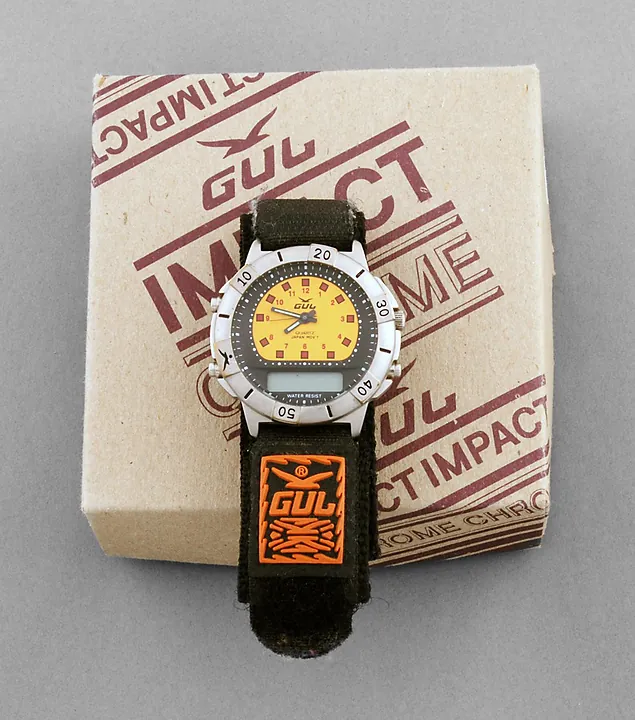
Wristwatches · 1990
Wristwatch, Japan, 1990
Blekinge Museum
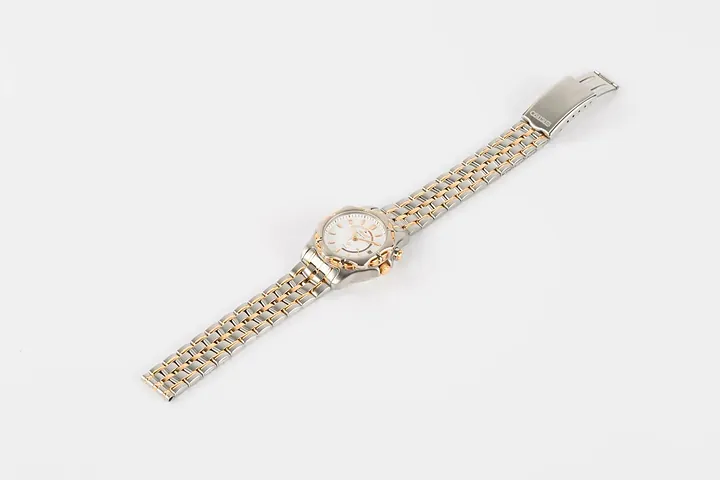
Wristwatches · 1995
Wristwatch, Japan, 1995 (no. 57932)
German Clock Museum
Wristwatches · 1995
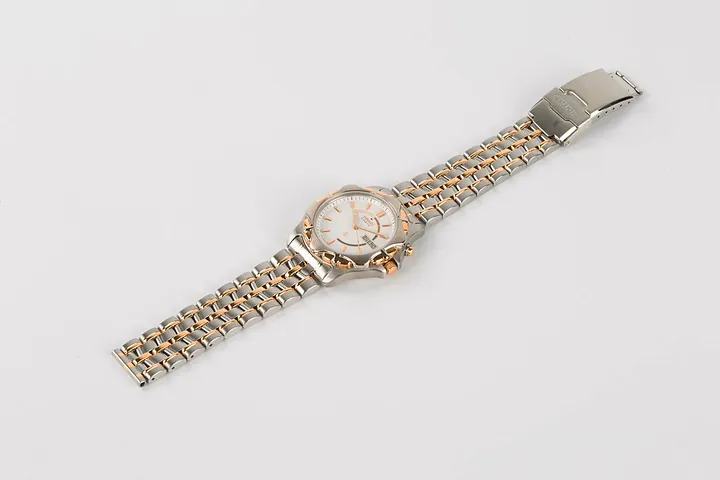
Wristwatch, Japan, 1995 (no. 57933)
German Clock Museum