
Wristwatches · Wristwatch
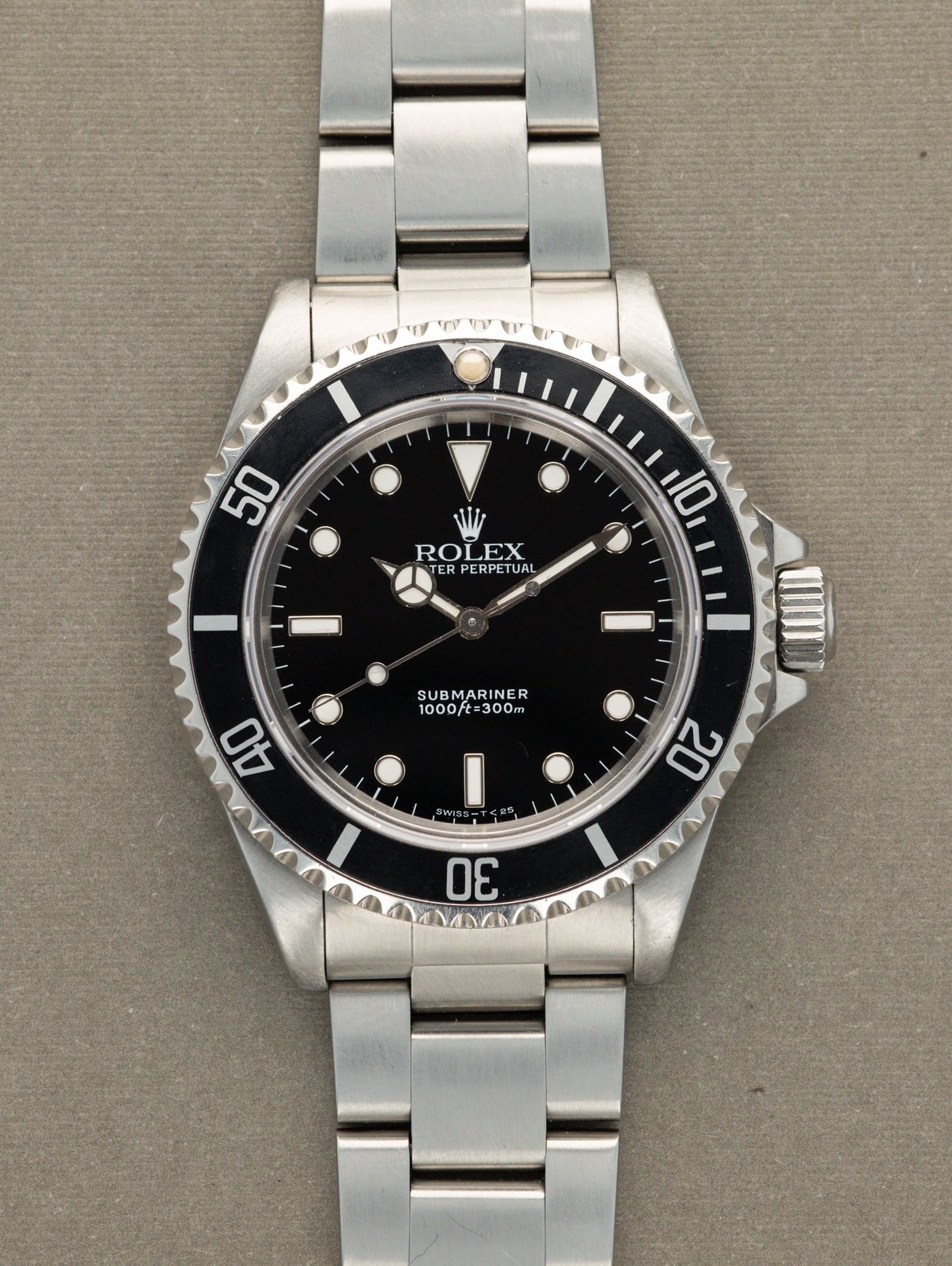
Rolex Submariner ref. 14060, Tritium Dial
- Maker / attribution
- Rolex (maker)
- Date
- c. 1996
- Historical period
- Mechanical Renaissance (1990 – 2010)
- Country of origin
- Switzerland
- Object type
- Wristwatch
- Stock no.
- OC2382
- Credit line
- Dealer listing, Oliver & Clarke (OC2382)
- Catalogue title (original)
- Rolex Submariner Ref. 14060 - Tritium Dial (English)
View the source record (dealer listing) ↗ (opens another website in a new tab)Suggest a correction
Record summary
Catalogued by Oliver & Clarke (dealer), United Kingdom (stock number OC2382), this is a wristwatch by Rolex, made in Switzerland, dated c. 1996. The Atlas places it in the Mechanical Renaissance period (1990 – 2010) of its Wristwatches collection. The record is illustrated with 6 photographs.
Assembled from the source record's structured fields. Dates and attributions are given as the source states them; where a field is missing the Atlas leaves it blank rather than estimating.
Catalogue description
Dealer description — Oliver & Clarke
The Rolex Submariner is a true icon — and the word "icon" does get thrown around an awful lot. If you were to ask ten people at random to draw you their idea of what a watch looks like, there is a significant chance that they would draw or describe something that looks like a Rolex Submariner. It’s the dive watch of reference, and good/bad/indifferent there is no escaping it. Throughout its 70-year production, there have been countless small changes made to the model, particularly in the first decade or so, with the R eference 14060 representing a very important time in the history of the model. The 14060 replaced the much-loved 5513 and like so many other references, this model underwent a series of changes over its roughly 22-year production run and is typically broken down into three different variants, each with their own appeal. The early pieces Tritium indices and handsets, whereas models produced after 1997-1998 introduced Luminova units. The third variant showed up around 2001 and actually features an updated Reference number, 14060M, but is generally regarded as part of the 14060 lineage. It is debated what the "M" actually stands for, but it is widely agreed that it's presence denoted the updated new Cal. 3130 movement within. The 14060 that we have here is from the very end of the Tritium era dating to circa 1996. It comes to us with a previously polished case that shows normal signs of wear throughout and retains thick and symmetrical lugs. There are some small blemishes present on the left case profile and on the bottom right lug profile. The bezel shows very faint polishing — more-likely 'sleeve polish' and shows normal signs of wear. The black aluminum insert shows very light wear and is in the early stages of fading to a deep navy blue, which is visible in sunlight. The pip has started changing to an attractive custard tone. The glossy black dial with its applied Tritium-filled white gold indices is virtually-flawless and shows no signs of 'stippling' or 'matting.' The correct Tritium handset matches perfectly to the naked eye and under UV inspection. It comes fitted to a robust solid-link Oyster bracelet with a fliplock clasp with diving extension. These early 14060s in particular are fantastic daily wearers — perhaps even perfect. The updated sapphire crystal and deep glossy black dial combined with more traditional features like the drilled lug holes, the Tritium elements, and the aluminum bezel inserts, amount to something that has a foot in the worlds of both modern and vintage. The very definition of neo-vintage. And of course, those classic, versatile case proportions with the symmetrical dial layout that only the Submariner has is an icon for good reason.
Historical context
Mechanical Renaissance (1990 – 2010)
Mechanical watches return as cultural objects; independent watchmaking flourishes.
Mechanical watches returned as cultural and luxury objects. Complications, tourbillons and new materials proliferated; independent watchmakers such as George Daniels, F.P. Journe and Philippe Dufour revived artisanal watchmaking; collecting vintage watches became a major field.
Read the period in the timelineMore wristwatches from this periodEarlier: Quartz Revolution
Atlas type guide
Dive and water-resistant watches
Keeping water and dust out of a wristwatch was a long-standing challenge. Rolex's screw-down Oyster case (1926) and Omega's Marine (1932) were landmarks; in the early 1950s Blancpain's Fifty Fathoms and Rolex's Submariner defined the professional dive watch with rotating bezels for timing dives, luminous dials and high water resistance. The ISO 6425 standard (1982) later codified what a 'diver's watch' must do.
Dive watches became icons of post-war design and exploration, and their evolution — helium escape valves, ceramic bezels, saturation-diving depth ratings — records the history of underwater work.
What to look for
- Unidirectional or bidirectional rotating bezel with minute markings.
- Screw-down crown and case back; depth rating printed on the dial.
- Luminous hands and markers (radium before c. 1960, tritium c. 1960–1998, then Super-LumiNova).
- Reference numbers on the case between the lugs or inside the back.
Dating clues
- Screw-down Oyster cases: from 1926.
- Professional dive watches: from 1953.
- Tritium 'T' marks on dials: c. 1960–1998.
General guidance written by the Atlas editors about this kind of object. It is not a statement about this particular piece; for that, rely on the source record above and on physical examination.
Related records

Movements & Components · c. 1970s
Rolex watch movement, c. 1970s
Antiquorum auction archive, Geneva

Pocket Watches · 1982
Fake Rolex watch, gold coloured metal, possibly made in Taiwan, 1982; part of a casual outfit, UK, 1982-84.
Victoria and Albert Museum, London

Wristwatches · c. 1920s
Rolex wristwatch, c. 1920s
Antiquorum auction archive, Geneva

Wristwatches · c. 1920s
Rolex wristwatch, ref. 6194, c. 1920s
Antiquorum auction archive, Geneva

Wristwatches · 2008
Wristwatch by Breitling?, 2008
Museum Rotterdam

Wristwatches · c. 1990s
Audemars Piguet Bamboo, c. 1990s
Antiquorum auction archive, Geneva

Wristwatches · c. 1990
Audemars Piguet Huitieme Perpetual Calendar, ref. 25696PT, c. 1990
Antiquorum auction archive, Geneva

Wristwatches · c. 1990
Breitling Chronomat, ref. b13050.1, c. 1990
Antiquorum auction archive, Geneva