
Wristwatches · Wristwatch
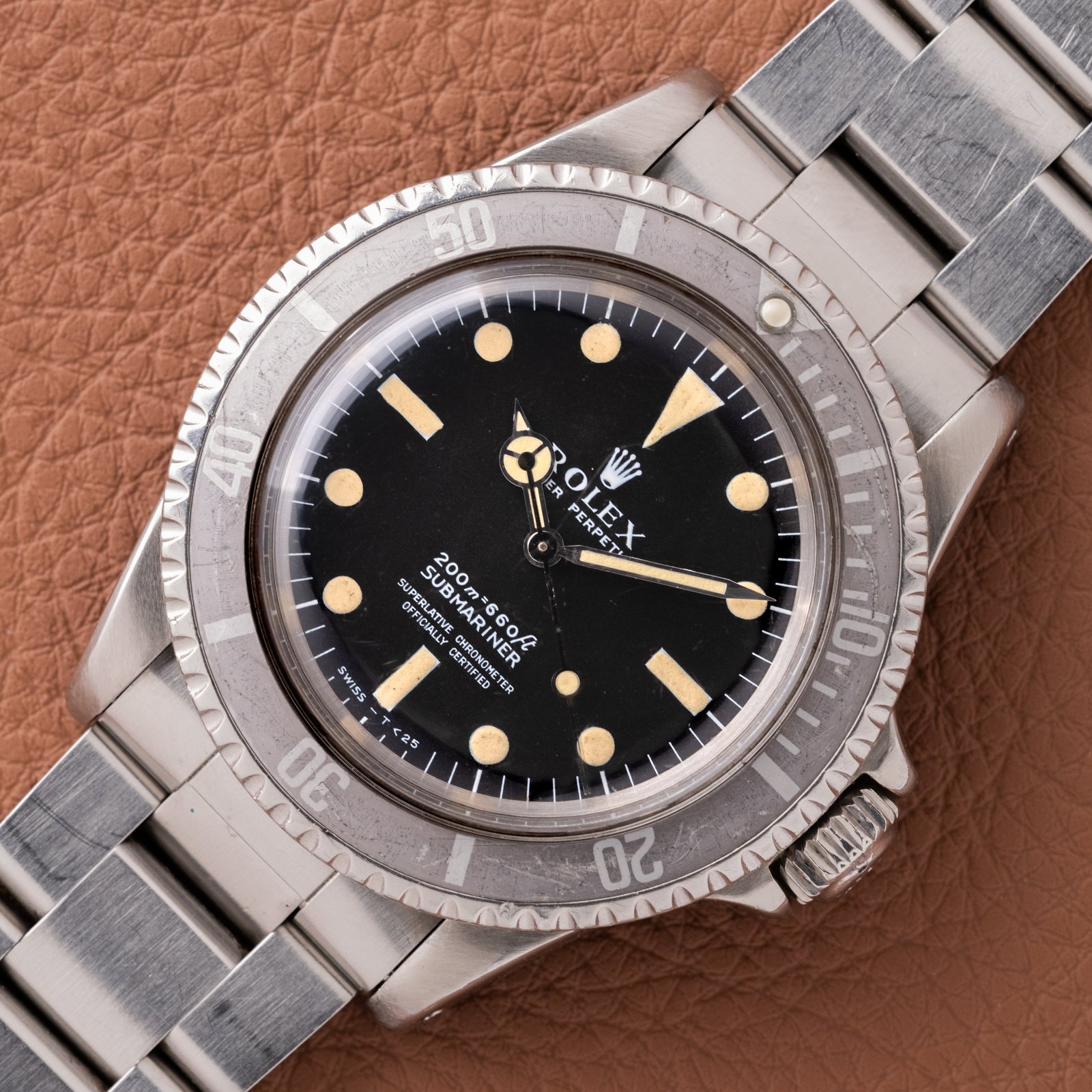
Rolex Submariner Meters First Ghost Bezel (Ref. 5512), 1968
- Maker / attribution
- Rolex (maker)
- Date
- 1968
- Historical period
- Modern Mechanical Horology (1945 – 1969)
- Country of origin
- Switzerland
- Object type
- Wristwatch
- Dimensions
- Case 40 mm
- Stock no.
- Product 8731741028535
- Credit line
- Dealer listing, Huntington Company (product 8731741028535)
- Catalogue title (original)
- 1968 Rolex Submariner Meters First Ghost Bezel (Ref. 5512) (English)
View the source record (dealer listing) ↗ (opens another website in a new tab)Suggest a correction
Record summary
Catalogued by Huntington Company (dealer) (stock number Product 8731741028535), this is a wristwatch by Rolex, made in Switzerland, dated 1968. The Atlas places it in the Modern Mechanical Horology period (1945 – 1969) of its Wristwatches collection. Recorded dimensions: Case 40 mm. The record is illustrated with 6 photographs.
Assembled from the source record's structured fields. Dates and attributions are given as the source states them; where a field is missing the Atlas leaves it blank rather than estimating.
Catalogue description
Dealer description — Huntington Company
History and Significance Before the Submariner became a luxury object, it was simply a tool watch, and few references capture that era better than the 5512. Introduced in 1959, the reference brought crown guards to the Submariner and established a case design that would influence Rolex dive watches for decades. By 1968, it still retained the matte dial, painted luminous markers, acrylic crystal, and relatively slender proportions that collectors now immediately associate with vintage Rolex. This example has the desirable meters-first dial, with the depth rating printed as “200m = 660ft.” It is a small typographical difference, but one that immediately places the watch within an earlier period of Submariner production. The tritium hour plots have aged into a beautiful creamy tone, bringing warmth to the otherwise stark black dial and giving the watch exactly the sort of natural aging we hope to find after nearly sixty years. And then there is the bezel. The original black appearance has faded dramatically into an incredible ghost tone, moving through shades of charcoal and grey depending on the light. On a vintage Submariner, the bezel occupies such a large portion of the watch visually that this kind of fading can completely change its personality. Paired with the creamy lume, it gives this 5512 a combination of colors that could only have developed through decades of age and exposure. The case has been polished during its life and the Oyster bracelet is a later-generation replacement, both of which we think are important to state clearly. But this is not a 5512 we would buy because it checks every originality box. We would buy it because the two things you stare at every time you wear it, that meters-first dial and extraordinary ghost bezel, are exceptionally attractive. Writer's Thoughts This bezel has reached that wonderful stage where the even fade changes the whole look of the watch. It has washed into a soft ghost grey that changes noticeably under different lighting, and against the warm creamy tritium it looks phenomenal. The lume deserves just as much attention. The hour plots have aged into a rich cream rather than remaining stark white, and that warmth carries through the dial beautifully. Put the creamy lume, meters-first printing, and ghost insert together and you have the exact visual combination that makes an early Submariner so difficult to replicate with anything modern. This 1968 Rolex has been polished, and its Oyster bracelet is from a later generation. We don't think either point should be buried in the condition section. This isn't a watch we're presenting as an untouched time capsule. It is a vintage Submariner that has lived a life and happens to have developed an absolutely fantastic face along the way. Our Promise Every watch is thoroughly vetted, carefully described with complete transparency, and guaranteed authentic. Each piece is offered in honest condition, ensuring collectors receive a timepiece that reflects both originality and integrity. Specifications Brand: Rolex Model: Submariner Year: 1968 Case Material: Stainless steel Case Size: 40mm Dial: Black meters-first matte dial with creamy tritium lume Movement: Automatic Strap/Bracelet: Later-generation Rolex Oyster bracelet Buckle/Clasp: Rolex Oyster clasp Contents: Watch only Condition Case: Stainless steel case has been polished previously and shows surface wear consistent with age and use. The case retains attractive overall proportions despite the prior refinishing. Dial: Black meters-first matte dial presents beautifully, with the tritium hour plots having aged to a particularly attractive creamy tone. The combination of the warm lume and matte surface gives the dial excellent vintage character. Hands: Hands professionally color-matched to the same cream patina as the dial lume. Crystal: Acrylic crystal presents well overall with light signs of use consistent with age. Strap/Bracelet: Fitted with a later-generation Rolex Oyster bracelet showing normal surface wear from use. Buckle/Clasp: Rolex Oyster clasp presents well with wear consistent with the bracelet.
Historical context
Modern Mechanical Horology (1945 – 1969)
Tool watches for divers, pilots and astronauts; electric watches anticipate the electronic age.
The classic era of the mechanical wristwatch: dive watches, chronographs for motor racing and space flight, GMT watches for jet travel, slim dress watches, automatic calendars, and the rise of Japanese manufacturers alongside Swiss, American, German and Soviet industries.
Read the period in the timelineMore wristwatches from this periodEarlier: Golden Age of Mechanical Watchmaking
Atlas type guide
Dive and water-resistant watches
Keeping water and dust out of a wristwatch was a long-standing challenge. Rolex's screw-down Oyster case (1926) and Omega's Marine (1932) were landmarks; in the early 1950s Blancpain's Fifty Fathoms and Rolex's Submariner defined the professional dive watch with rotating bezels for timing dives, luminous dials and high water resistance. The ISO 6425 standard (1982) later codified what a 'diver's watch' must do.
Dive watches became icons of post-war design and exploration, and their evolution — helium escape valves, ceramic bezels, saturation-diving depth ratings — records the history of underwater work.
What to look for
- Unidirectional or bidirectional rotating bezel with minute markings.
- Screw-down crown and case back; depth rating printed on the dial.
- Luminous hands and markers (radium before c. 1960, tritium c. 1960–1998, then Super-LumiNova).
- Reference numbers on the case between the lugs or inside the back.
Dating clues
- Screw-down Oyster cases: from 1926.
- Professional dive watches: from 1953.
- Tritium 'T' marks on dials: c. 1960–1998.
General guidance written by the Atlas editors about this kind of object. It is not a statement about this particular piece; for that, rely on the source record above and on physical examination.
Related records

Movements & Components · c. 1970s
Rolex watch movement, c. 1970s
Antiquorum auction archive, Geneva

Pocket Watches · 1982
Fake Rolex watch, gold coloured metal, possibly made in Taiwan, 1982; part of a casual outfit, UK, 1982-84.
Victoria and Albert Museum, London

Wristwatches · c. 1920s
Rolex wristwatch, c. 1920s
Antiquorum auction archive, Geneva

Wristwatches · c. 1920s
Rolex wristwatch, ref. 6194, c. 1920s
Antiquorum auction archive, Geneva

Wristwatches · 1945
Wristwatch by Eterna, 1945
Museum Rotterdam

Wristwatches · c. 1945
Breitling Premier, ref. 790, c. 1945
Antiquorum auction archive, Geneva

Wristwatches · c. 1945
Universal Genève Uni-Compax, ref. 22492, c. 1945
Antiquorum auction archive, Geneva

Wristwatches · c. 1950s
Baume & Mercier wristwatch, c. 1950s
Antiquorum auction archive, Geneva