
Wristwatches · Wristwatch
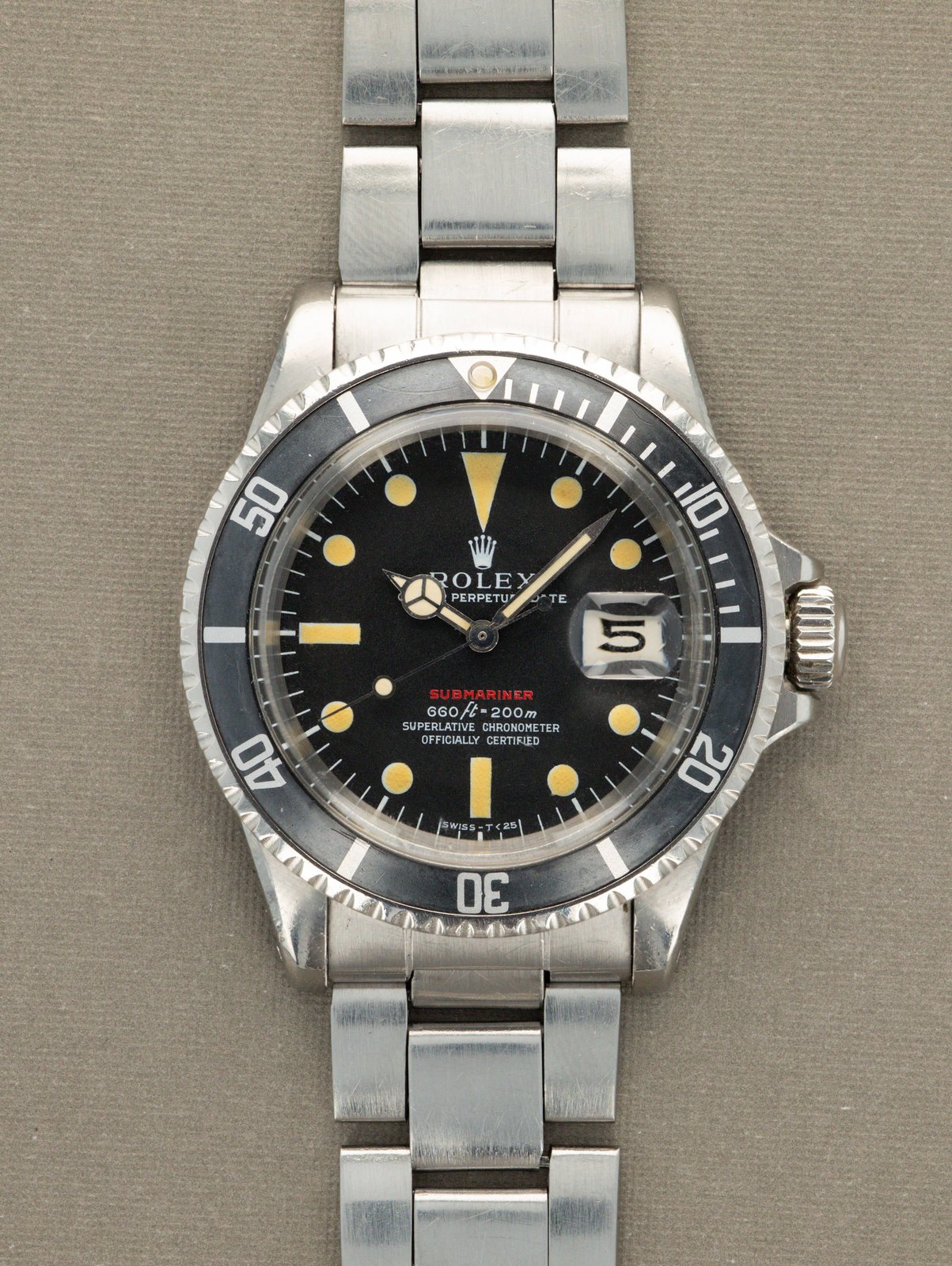
Rolex Submariner Date ref. 1680, 'Red Sub'
- Maker / attribution
- Rolex (maker)
- Date
- c. 1969
- Historical period
- Quartz Revolution (1969 – 1990)
- Country of origin
- Switzerland
- Object type
- Wristwatch
- Stock no.
- OC2762
- Credit line
- Dealer listing, Oliver & Clarke (OC2762)
- Catalogue title (original)
- Rolex Submariner Date Ref. 1680 - 'Red Sub' Unpolished W/ Box & Papers (English)
View the source record (dealer listing) ↗ (opens another website in a new tab)Suggest a correction
Record summary
Catalogued by Oliver & Clarke (dealer), United Kingdom (stock number OC2762), this is a wristwatch by Rolex, made in Switzerland, dated c. 1969. The Atlas places it in the Quartz Revolution period (1969 – 1990) of its Wristwatches collection. The record is illustrated with 6 photographs.
Assembled from the source record's structured fields. Dates and attributions are given as the source states them; where a field is missing the Atlas leaves it blank rather than estimating.
Catalogue description
Dealer description — Oliver & Clarke
The Rolex Submariner is a true icon — and the word "icon" does get thrown around an awful lot. If you were to ask ten people at random to draw you their idea of what a watch looks like, there is a significant chance that they would draw or describe something that looks like a Rolex Submariner. It’s the dive watch of reference, and good/bad/indifferent there is no escaping it. Throughout its 70-year production, there have been countless small changes made to the model, particularly in the first decade or so, with the 1680 representing a true landmark in the history of the model. The Ref. 1680 was the first Submariner to feature a date and enjoyed a long production run spanning close to 15 years. Why would a dive watch need a date? Well, this was the first step in marketing a tool watch beyond the diving community and crowd - because you definitely do not need to know the date underwater! The 1680 started a shift to civilian friendly models, and to this day, the Submariner Date outsells and outnumbers its 'no-date' sibling something like 10-1. Purity aside, this does make sense for most buyers. It utilizes the iconic Rolex cyclops married with the date function, yet remains clean and functional as ever. The piece that we have here, however, is no run of the mill Ref. 1680... This piece features a line of text on the dial that reads: “Submariner” in red, rather than the usual white. It has since become known to collectors as the "Red Sub." The example that we have here dates to circa 1969 and comes to us in strong overall condition. The case remains unpolished, with thick lugs at all four corners and visible chamfers. It shows honest signs of wear from a previous life, with some scattered impressions and blemishes. Inside, the correct 'MK4' dial is beautifully preserved and in superb condition, with a clean matte surface and deeply patinated Tritium plots. The handset matches the dial nicely, as well as the Tritium pip in the bezel insert. The insert itself is period-correct and has developed an attractive mid-fade, resulting in something of a charcoal color. It comes fitted to a correct Oyster bracelet with a fliplock clasp. Last but not least, while it would be enough to enjoy this piece on its own, this piece is accompanied by its inner box, green vinyl folder, COSC hangtag, punched guarantee booklet dated 4/5/1971, purchase invoice dated 4/5/1971, and punched papers. 'Red Subs' were amongst the first collectible Rolexes. Their popularity over the last three decades or so needs no explanation and shows no signs of softening, and fantastic examples like the one we have here do not surface all that often.
Historical context
Quartz Revolution (1969 – 1990)
Seiko's Astron begins mass quartz timekeeping; traditional industries contract sharply.
Quartz and digital watches transformed the market after 1969. Swiss employment collapsed, Japanese and Hong Kong production soared, and the Swatch (1983) helped the Swiss industry recover; mechanical watches survived as luxury goods.
Read the period in the timelineMore wristwatches from this periodEarlier: Modern Mechanical Horology
Atlas type guide
Dive and water-resistant watches
Keeping water and dust out of a wristwatch was a long-standing challenge. Rolex's screw-down Oyster case (1926) and Omega's Marine (1932) were landmarks; in the early 1950s Blancpain's Fifty Fathoms and Rolex's Submariner defined the professional dive watch with rotating bezels for timing dives, luminous dials and high water resistance. The ISO 6425 standard (1982) later codified what a 'diver's watch' must do.
Dive watches became icons of post-war design and exploration, and their evolution — helium escape valves, ceramic bezels, saturation-diving depth ratings — records the history of underwater work.
What to look for
- Unidirectional or bidirectional rotating bezel with minute markings.
- Screw-down crown and case back; depth rating printed on the dial.
- Luminous hands and markers (radium before c. 1960, tritium c. 1960–1998, then Super-LumiNova).
- Reference numbers on the case between the lugs or inside the back.
Dating clues
- Screw-down Oyster cases: from 1926.
- Professional dive watches: from 1953.
- Tritium 'T' marks on dials: c. 1960–1998.
General guidance written by the Atlas editors about this kind of object. It is not a statement about this particular piece; for that, rely on the source record above and on physical examination.
Related records

Movements & Components · c. 1970s
Rolex watch movement, c. 1970s
Antiquorum auction archive, Geneva

Pocket Watches · 1982
Fake Rolex watch, gold coloured metal, possibly made in Taiwan, 1982; part of a casual outfit, UK, 1982-84.
Victoria and Albert Museum, London

Wristwatches · c. 1920s
Rolex wristwatch, c. 1920s
Antiquorum auction archive, Geneva

Wristwatches · c. 1920s
Rolex wristwatch, ref. 6194, c. 1920s
Antiquorum auction archive, Geneva

Wristwatches · 1970
Wristwatch by Heno, Switzerland, 1970
Museum Rotterdam

Wristwatches · 1960–1986
'Tri-Compax' calendar chronograph wristwatch in gold case, by Universal, Geneva, Switzerland, 1960–1986.
Science Museum Group, London

Wristwatches · 1969–1970
Beta 21 Quartz wristwatch movement, made in Switzerland, 1970.
Science Museum Group, London

Wristwatches · c. 1969
Omega Speedmaster Moonwatch, ref. 145022-69st, c. 1969
Antiquorum auction archive, Geneva