
Wristwatches · Wristwatch
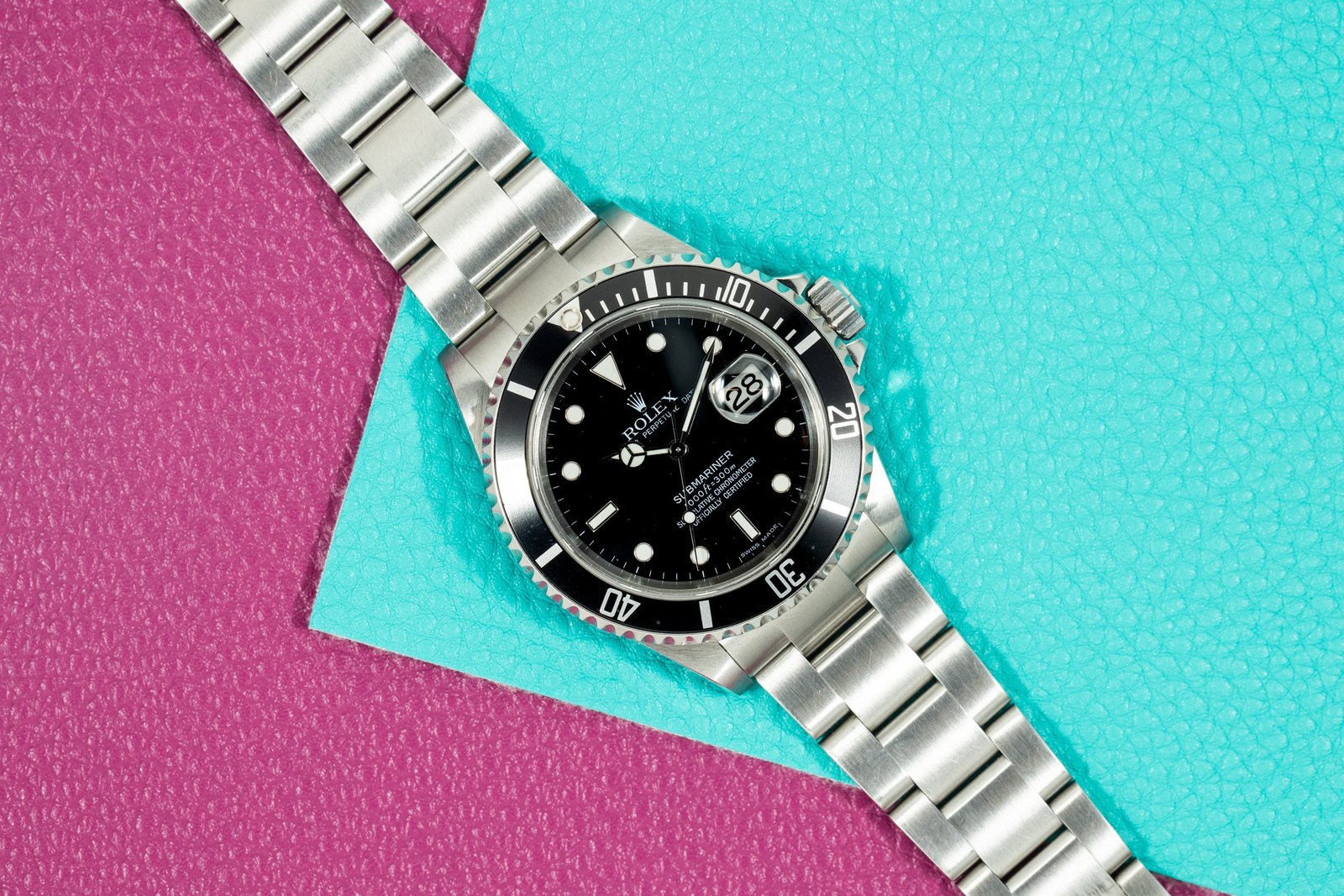
Rolex Submariner Date, c. 2007
- Maker / attribution
- Rolex (maker)
- Date
- c. 2007
- Historical period
- Mechanical Renaissance (1990 – 2010)
- Country of origin
- Switzerland
- Object type
- Wristwatch
- Dimensions
- Case 39 mm
- Stock no.
- 40920166
- Credit line
- Dealer listing, Analog/Shift (40920166)
- Catalogue title (original)
- Rolex Submariner Date (English)
View the source record (dealer listing) ↗ (opens another website in a new tab)Suggest a correction
Record summary
Catalogued by Analog/Shift (dealer), New York (stock number 40920166), this is a wristwatch by Rolex, made in Switzerland, dated c. 2007. The Atlas places it in the Mechanical Renaissance period (1990 – 2010) of its Wristwatches collection. Recorded dimensions: Case 39 mm. The record is illustrated with 6 photographs.
Assembled from the source record's structured fields. Dates and attributions are given as the source states them; where a field is missing the Atlas leaves it blank rather than estimating.
Catalogue description
Dealer description — Analog/Shift
Why We Love It As a successor to the iconic Reference 1680, the 16610 embodies the spirit of the original Submariner Date with function-first design, and legendary build quality. Early 16610 models utilized Tritium luminous material, while later references moved to Luminova, making it a truly significant transitional piece. The 16610 is also the last reference Submariner Date to use the classically proportioned tapered 39mm Oyster case. This particular Z-serial example dates to circa 2007 and features an outstanding case showing a factory service center refinish, Luminova dial and handset, and a solid link Oyster bracelet with solid end links and Fliplock clasp. It also comes comes its with inner and outer boxes, completed papers dated November 2007 and an RSC card dated 2013. This is a phenomenal example of one of the last pre-Maxi case model Submariners, ready to wear and enjoy! The Submariner Story Rolex first debuted the Submariner at the 1954 Basel Spring Fair. It shared the stage with already-established offerings: the Explorer, the Turn-O-Graph, and a ladies' Oyster Perpetual with a chronometer certification. Compared to these other watches, the Submariner - with its oversized crown and chunky dive-timing bezel looked slightly out-of-place, and yet would become one of Rolex's most enduring models. Rolex's quest to produce a waterproof wristwatch has its roots in the First World War, when a need arose for soldiers to have a watch that could withstand the wet, dusty conditions on the battlefield. Rolex's Oyster case of 1926 represented the culmination of a decade of development. It gained notoriety in 1927, when Mercedes Gleitze became the first British woman to swim across the English Channel. She took with her an early Rolex Oyster, in what may have been the very first example of sports marketing by a luxury brand. A series of advertisements followed this feat, featuring smiling flappers dunking their Rolex Oysters in fish tanks. The Submariner hit the market at a time when oceanographer and explorer Jacques Cousteau exposed the world to the wonders of undersea exploration. With the advent of SCUBA (Self Contained Underwater Breathing Apparatus) in the late 1950s, skin-diving as a sport became accessible to amateurs. Since a mechanical timepiece was an essential piece of equipmeny for divers in a pre-digital world, the race was on amongst Swiss manufactures to produce a professional grade timepiece. Rolex was fortunate in that René Jeanneret, one of the company's directors, was a skin-diving enthusiast, giving Rolex a unique insight into the development of their diving watch. The resulting watch was an overnight success, and has been in continuous production ever since. The Oyster Perpetual Submariner, in all of its forms, is an icon amongst icons, a pinnacle of horological design, and a statement piece aspired to and worn by people the world over.
Historical context
Mechanical Renaissance (1990 – 2010)
Mechanical watches return as cultural objects; independent watchmaking flourishes.
Mechanical watches returned as cultural and luxury objects. Complications, tourbillons and new materials proliferated; independent watchmakers such as George Daniels, F.P. Journe and Philippe Dufour revived artisanal watchmaking; collecting vintage watches became a major field.
Read the period in the timelineMore wristwatches from this periodEarlier: Quartz Revolution
Atlas type guide
Dive and water-resistant watches
Keeping water and dust out of a wristwatch was a long-standing challenge. Rolex's screw-down Oyster case (1926) and Omega's Marine (1932) were landmarks; in the early 1950s Blancpain's Fifty Fathoms and Rolex's Submariner defined the professional dive watch with rotating bezels for timing dives, luminous dials and high water resistance. The ISO 6425 standard (1982) later codified what a 'diver's watch' must do.
Dive watches became icons of post-war design and exploration, and their evolution — helium escape valves, ceramic bezels, saturation-diving depth ratings — records the history of underwater work.
What to look for
- Unidirectional or bidirectional rotating bezel with minute markings.
- Screw-down crown and case back; depth rating printed on the dial.
- Luminous hands and markers (radium before c. 1960, tritium c. 1960–1998, then Super-LumiNova).
- Reference numbers on the case between the lugs or inside the back.
Dating clues
- Screw-down Oyster cases: from 1926.
- Professional dive watches: from 1953.
- Tritium 'T' marks on dials: c. 1960–1998.
General guidance written by the Atlas editors about this kind of object. It is not a statement about this particular piece; for that, rely on the source record above and on physical examination.
Related records

Movements & Components · c. 1970s
Rolex watch movement, c. 1970s
Antiquorum auction archive, Geneva

Pocket Watches · 1982
Fake Rolex watch, gold coloured metal, possibly made in Taiwan, 1982; part of a casual outfit, UK, 1982-84.
Victoria and Albert Museum, London

Wristwatches · c. 1920s
Rolex wristwatch, c. 1920s
Antiquorum auction archive, Geneva

Wristwatches · c. 1920s
Rolex wristwatch, ref. 6194, c. 1920s
Antiquorum auction archive, Geneva

Wristwatches · 2008
Wristwatch by Breitling?, 2008
Museum Rotterdam

Wristwatches · c. 1990s
Audemars Piguet Bamboo, c. 1990s
Antiquorum auction archive, Geneva

Wristwatches · c. 1990
Audemars Piguet Huitieme Perpetual Calendar, ref. 25696PT, c. 1990
Antiquorum auction archive, Geneva

Wristwatches · c. 1990
Breitling Chronomat, ref. b13050.1, c. 1990
Antiquorum auction archive, Geneva