
Wristwatches · Wristwatch
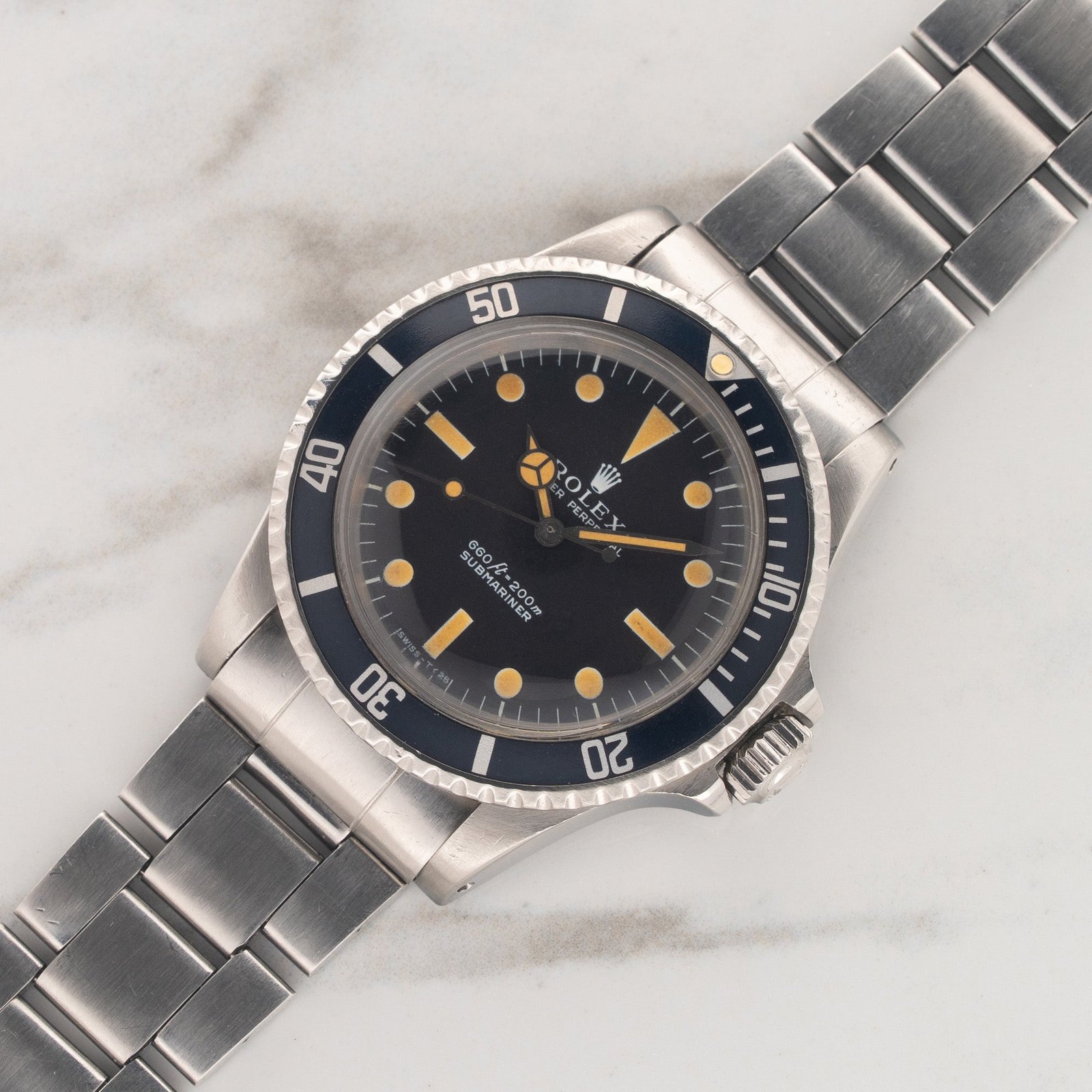
Rolex Submariner 5513 with Striking "Pumpkin" Patina
- Maker / attribution
- Rolex (maker)
- Date
- c. 1975
- Historical period
- Quartz Revolution (1969 – 1990)
- Country of origin
- Switzerland
- Object type
- Wristwatch
- Stock no.
- Product 10230973858068
- Credit line
- Dealer listing, Collectors Corner NY (product 10230973858068)
- Catalogue title (original)
- Rolex Submariner 5513 w/Striking "Pumpkin" Patina (English)
View the source record (dealer listing) ↗ (opens another website in a new tab)Suggest a correction
Record summary
Catalogued by Collectors Corner NY (dealer), New York (stock number Product 10230973858068), this is a wristwatch by Rolex, made in Switzerland, dated c. 1975. The Atlas places it in the Quartz Revolution period (1969 – 1990) of its Wristwatches collection. The record is illustrated with 6 photographs.
Assembled from the source record's structured fields. Dates and attributions are given as the source states them; where a field is missing the Atlas leaves it blank rather than estimating.
Catalogue description
Dealer description — Collectors Corner NY
The Rolex Submariner was first introduced by Rolex in 1953 and is notable for being one of the first watches specifically designed for diving. Beyond its technical capabilities, the Submariner has become an icon in the world of watches, with a timeless design that has remained largely unchanged since its introduction. It is widely regarded as one of the most important and influential Rolex watches of all time, and has become a symbol of Rolex's reputation for quality, durability, and precision. The Sub has been worn by everyone from professional divers and military personnel to Hollywood celebrities and heads of state, cementing its place in the pantheon of iconic watches. The 5513 was the longest running Sub ref., crossing 3 decades from '62 until '90. Many collectors agree that the simplicity of its "two line" dial is among the purest iterations of the model. This 367X serial example, circa 1975 offers remarkable patina, making it stand out from the pack. The matte dial dial has taken a stunning bright "pumpkin" patina which is a color we don't see often and that collectors hunt for. The hands have been color matched to the dial, as has the pip. The insert itself is very well preserved and has taken a gorgeous navy tone in direct light. The case has seen some polishing but the lugs remain thick. The folded link bracelet is not dated and correct. It retains 11 links, displays medium stretch and will fit an approximate 7.5 inch wrist. We have resources for rebuilding it to like new if the new owner so chooses. For anyone looking for a striking looking Sub, this piece has just come back from a full service and hits all the notes one could hope for.
Historical context
Quartz Revolution (1969 – 1990)
Seiko's Astron begins mass quartz timekeeping; traditional industries contract sharply.
Quartz and digital watches transformed the market after 1969. Swiss employment collapsed, Japanese and Hong Kong production soared, and the Swatch (1983) helped the Swiss industry recover; mechanical watches survived as luxury goods.
Read the period in the timelineMore wristwatches from this periodEarlier: Modern Mechanical Horology
Atlas type guide
Dive and water-resistant watches
Keeping water and dust out of a wristwatch was a long-standing challenge. Rolex's screw-down Oyster case (1926) and Omega's Marine (1932) were landmarks; in the early 1950s Blancpain's Fifty Fathoms and Rolex's Submariner defined the professional dive watch with rotating bezels for timing dives, luminous dials and high water resistance. The ISO 6425 standard (1982) later codified what a 'diver's watch' must do.
Dive watches became icons of post-war design and exploration, and their evolution — helium escape valves, ceramic bezels, saturation-diving depth ratings — records the history of underwater work.
What to look for
- Unidirectional or bidirectional rotating bezel with minute markings.
- Screw-down crown and case back; depth rating printed on the dial.
- Luminous hands and markers (radium before c. 1960, tritium c. 1960–1998, then Super-LumiNova).
- Reference numbers on the case between the lugs or inside the back.
Dating clues
- Screw-down Oyster cases: from 1926.
- Professional dive watches: from 1953.
- Tritium 'T' marks on dials: c. 1960–1998.
General guidance written by the Atlas editors about this kind of object. It is not a statement about this particular piece; for that, rely on the source record above and on physical examination.
Related records

Movements & Components · c. 1970s
Rolex watch movement, c. 1970s
Antiquorum auction archive, Geneva

Pocket Watches · 1982
Fake Rolex watch, gold coloured metal, possibly made in Taiwan, 1982; part of a casual outfit, UK, 1982-84.
Victoria and Albert Museum, London

Wristwatches · c. 1920s
Rolex wristwatch, c. 1920s
Antiquorum auction archive, Geneva

Wristwatches · c. 1920s
Rolex wristwatch, ref. 6194, c. 1920s
Antiquorum auction archive, Geneva

Wristwatches · 1970
Wristwatch by Heno, Switzerland, 1970
Museum Rotterdam

Wristwatches · 1960–1986
'Tri-Compax' calendar chronograph wristwatch in gold case, by Universal, Geneva, Switzerland, 1960–1986.
Science Museum Group, London

Wristwatches · 1969–1970
Beta 21 Quartz wristwatch movement, made in Switzerland, 1970.
Science Museum Group, London

Wristwatches · c. 1969
Omega Speedmaster Moonwatch, ref. 145022-69st, c. 1969
Antiquorum auction archive, Geneva