
Wristwatches · Wristwatch
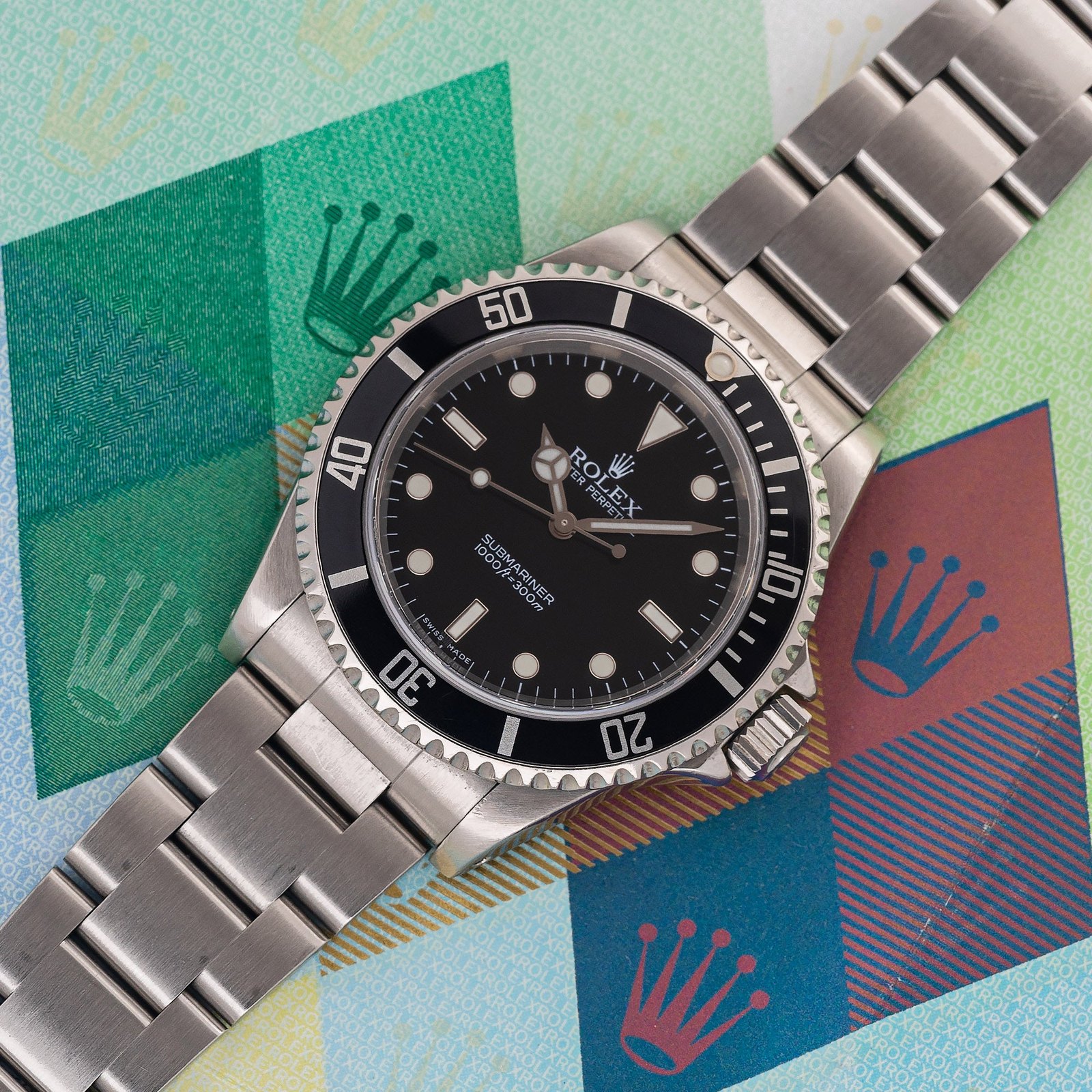
Rolex Submariner 14060M "Two Line"
- Maker / attribution
- Rolex (maker)
- Date
- c. 2007
- Historical period
- Mechanical Renaissance (1990 – 2010)
- Country of origin
- Switzerland
- Object type
- Wristwatch
- Stock no.
- Product 9549508411668
- Credit line
- Dealer listing, Collectors Corner NY (product 9549508411668)
- Catalogue title (original)
- Rolex Submariner 14060M "Two Line" - Box/Papers & RSC Documentation (English)
View the source record (dealer listing) ↗ (opens another website in a new tab)Suggest a correction
Record summary
Catalogued by Collectors Corner NY (dealer), New York (stock number Product 9549508411668), this is a wristwatch by Rolex, made in Switzerland, dated c. 2007. The Atlas places it in the Mechanical Renaissance period (1990 – 2010) of its Wristwatches collection. The record is illustrated with 6 photographs.
Assembled from the source record's structured fields. Dates and attributions are given as the source states them; where a field is missing the Atlas leaves it blank rather than estimating.
Catalogue description
Dealer description — Collectors Corner NY
The Rolex Submariner was first introduced by Rolex in 1953 and is notable for being one of the first watches specifically designed for diving. Beyond its technical capabilities, the Submariner has become an icon in the world of watches, with a timeless design that has remained largely unchanged since its introduction. It is widely regarded as one of the most important and influential watches of all time, and has become a symbol of Rolex's reputation for quality, durability, and precision. The Sub has been worn by everyone from professional divers and military personnel to Hollywood celebrities and heads of state, cementing its place in the pantheon of iconic watches. This particular ref. 14060M, circa 2007, is one of the last produced "two line" dial variants before the "four line" dial was introduced in 2007. The "two line" dial is our favorite for its vintage aesthetic which harks back to the simplicity of the ref. 5513. This "last of the run" example also features drilled lugs and the non-engraved rehaut which many would argue adds to its vintage appeal. The 14060M really brings everything loved about the vintage Submariner into the modern age with what is now a truly collectible piece. Some collectors might also prefer this reference over the 14060 as the movement was upgraded to COSC certification with the 3130 and the dial/hands were updated to luminova from tritium. This piece on offer remains in excellent shape with a strong case/bracelet and comes with all of the non-replaceable parts to a full set a collector could ask for. (Note that the non-serialized wax hang tag and booklets are not included but can be sourced at the next owner's request to make this truly complete). If you've been looking for the perfect daily driver, this reference is one of our top recommendations. Explore more of our vintage Rolex watches .
Historical context
Mechanical Renaissance (1990 – 2010)
Mechanical watches return as cultural objects; independent watchmaking flourishes.
Mechanical watches returned as cultural and luxury objects. Complications, tourbillons and new materials proliferated; independent watchmakers such as George Daniels, F.P. Journe and Philippe Dufour revived artisanal watchmaking; collecting vintage watches became a major field.
Read the period in the timelineMore wristwatches from this periodEarlier: Quartz Revolution
Atlas type guide
Dive and water-resistant watches
Keeping water and dust out of a wristwatch was a long-standing challenge. Rolex's screw-down Oyster case (1926) and Omega's Marine (1932) were landmarks; in the early 1950s Blancpain's Fifty Fathoms and Rolex's Submariner defined the professional dive watch with rotating bezels for timing dives, luminous dials and high water resistance. The ISO 6425 standard (1982) later codified what a 'diver's watch' must do.
Dive watches became icons of post-war design and exploration, and their evolution — helium escape valves, ceramic bezels, saturation-diving depth ratings — records the history of underwater work.
What to look for
- Unidirectional or bidirectional rotating bezel with minute markings.
- Screw-down crown and case back; depth rating printed on the dial.
- Luminous hands and markers (radium before c. 1960, tritium c. 1960–1998, then Super-LumiNova).
- Reference numbers on the case between the lugs or inside the back.
Dating clues
- Screw-down Oyster cases: from 1926.
- Professional dive watches: from 1953.
- Tritium 'T' marks on dials: c. 1960–1998.
General guidance written by the Atlas editors about this kind of object. It is not a statement about this particular piece; for that, rely on the source record above and on physical examination.
Related records

Movements & Components · c. 1970s
Rolex watch movement, c. 1970s
Antiquorum auction archive, Geneva

Pocket Watches · 1982
Fake Rolex watch, gold coloured metal, possibly made in Taiwan, 1982; part of a casual outfit, UK, 1982-84.
Victoria and Albert Museum, London

Wristwatches · c. 1920s
Rolex wristwatch, c. 1920s
Antiquorum auction archive, Geneva

Wristwatches · c. 1920s
Rolex wristwatch, ref. 6194, c. 1920s
Antiquorum auction archive, Geneva

Wristwatches · 2008
Wristwatch by Breitling?, 2008
Museum Rotterdam

Wristwatches · c. 1990s
Audemars Piguet Bamboo, c. 1990s
Antiquorum auction archive, Geneva

Wristwatches · c. 1990
Audemars Piguet Huitieme Perpetual Calendar, ref. 25696PT, c. 1990
Antiquorum auction archive, Geneva

Wristwatches · c. 1990
Breitling Chronomat, ref. b13050.1, c. 1990
Antiquorum auction archive, Geneva