
Wristwatches · Wristwatch
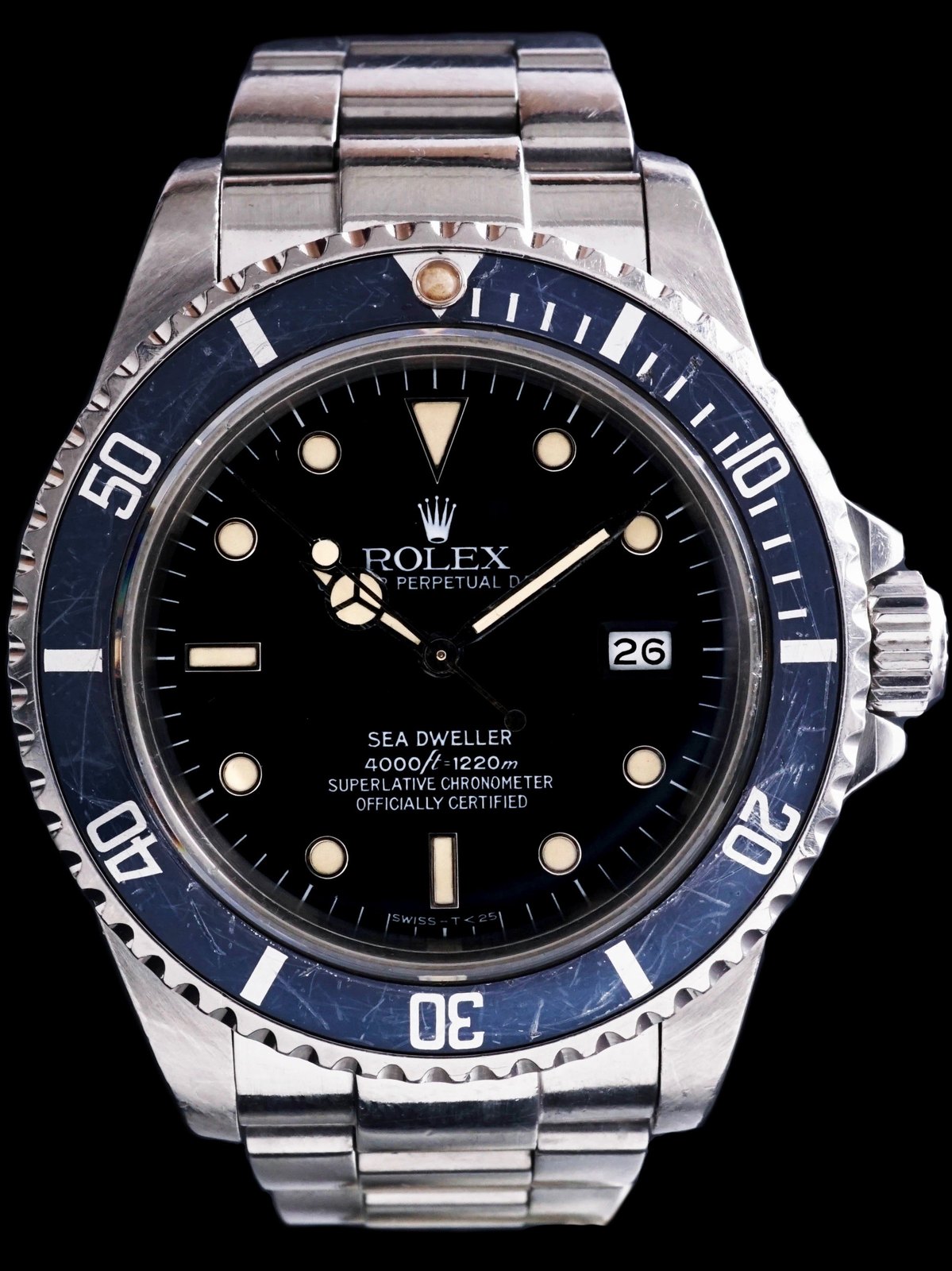
Rolex Sea-Dweller (Ref. 16660) "Spider Dial", 1984
- Maker / attribution
- Rolex (maker)
- Date
- 1984
- Historical period
- Quartz Revolution (1969 – 1990)
- Country of origin
- Switzerland
- Object type
- Wristwatch
- Stock no.
- RLXSD1666084-4
- Credit line
- Dealer listing, Craft & Tailored (RLXSD1666084-4)
- Catalogue title (original)
- 1984 Rolex Sea-Dweller (Ref. 16660) "Spider Dial" (English)
View the source record (dealer listing) ↗ (opens another website in a new tab)Suggest a correction
Record summary
Catalogued by Craft & Tailored (dealer), Los Angeles (stock number RLXSD1666084-4), this is a wristwatch by Rolex, made in Switzerland, dated 1984. The Atlas places it in the Quartz Revolution period (1969 – 1990) of its Wristwatches collection. The record is illustrated with 6 photographs.
Assembled from the source record's structured fields. Dates and attributions are given as the source states them; where a field is missing the Atlas leaves it blank rather than estimating.
Catalogue description
Dealer description — Craft & Tailored
The Rolex Sea-Dweller Ref. 16660 aka the "Triple Six" is an early and rare transitional piece. The perfect blend of vintage and modern Rolex design. The mid '80s were an interesting time for Rolex as Rolex started offering the sapphire crystals as a standard on many of the sports models and on the dress model line of timepieces. Other innovative and modern advancements to the timepieces offered extra durability and increased functionality as seen with the Ref 16660 Sea-Dweller. Rolex implemented major changes to the Sea-Dweller starting in 1981. The sapphire crystal became standard starting with the Ref. 16660 and major developments were implemented into the model which included a uni-directional bezel as opposed to the bi-directional bezel found in previous examples, a larger and more reliable helium escape valve was added, and we see the introduction of the first solid end link (SEL) bracelets with the Ref. 93160 bracelets with attached 592 end links becoming standard around 1981-1982. The Sea-Dweller also received a new movement, the Cal. 3035 which allowed for Quick-Set date function. The ref. 16660 had an increased tested depth rating of 1220m as opposed to the previous 610m found in the Ref. 1665. We also see the incorporation of the updated dials sometimes referred to as the "Bicchierini Dial" which is a gloss black dial as opposed the matte black dials and the lume plots also have white gold surrounds adding increased legibility of the dial and a more finished overall look which is now the standard dial format even to this day. In the early 1980's Rolex was working very closely with the Compagnie Maritime d' Expertises Company (COMEX) to develop a tool watch to accompany the company's divers who started to work at deeper depths as a result of increasing mixed gas diving standards of early 1980's and the Ref. 16660 is a perfect example of the two company's partnership to achieve a tool watch to meet specific needs. This specific example would make a great vintage piece that has some of the more modern technical elements most vintage Rolex Submariners lack. The sapphire crystal and Trip-Lock crown being two of the elements that would make this piece a great vintage daily driver. The dial retains tritium lume which has taken on a wonderful patina seen on the early Rolex gloss dials which add to the overall collectability and originality of this piece. Stock # RLXSD1666084-4 Brand Rolex Style Sea-Dweller Model 16660 Serial 83XXXXX Size Men's Material SS Dial Glossy Black Millimeters 40 Bracelet Rolex 93160 Oyster Bracelet W/ 592 Solid End Pieces CASE & BRACELET The previously lightly polished case retains thick lugs showing honest wear. The bezel insert has faded to a wonderful blue/grey coloration showing some wear and the tritium pearl has darkened into a charming golden coloration. The original Rolex 93160 Oyster Bracelet with 592 SEL is in good overall condition showing minor wear and light stretch. DIAL & HANDS The glossy "spider dial" is in superb condition. The faint spidering creates is a gorgeous effect in direct light. The white gold surround lume plots have aged to an excellent yellow coloration, showing no degradation under U.V. light inspection. The original tritium hands match the dial perfectly and exhibit no lume loss under U.V. light inspection. The date wheel is era correct with open 6's and 9's. ACCESSORIES
Historical context
Quartz Revolution (1969 – 1990)
Seiko's Astron begins mass quartz timekeeping; traditional industries contract sharply.
Quartz and digital watches transformed the market after 1969. Swiss employment collapsed, Japanese and Hong Kong production soared, and the Swatch (1983) helped the Swiss industry recover; mechanical watches survived as luxury goods.
Read the period in the timelineMore wristwatches from this periodEarlier: Modern Mechanical Horology
Atlas type guide
Dive and water-resistant watches
Keeping water and dust out of a wristwatch was a long-standing challenge. Rolex's screw-down Oyster case (1926) and Omega's Marine (1932) were landmarks; in the early 1950s Blancpain's Fifty Fathoms and Rolex's Submariner defined the professional dive watch with rotating bezels for timing dives, luminous dials and high water resistance. The ISO 6425 standard (1982) later codified what a 'diver's watch' must do.
Dive watches became icons of post-war design and exploration, and their evolution — helium escape valves, ceramic bezels, saturation-diving depth ratings — records the history of underwater work.
What to look for
- Unidirectional or bidirectional rotating bezel with minute markings.
- Screw-down crown and case back; depth rating printed on the dial.
- Luminous hands and markers (radium before c. 1960, tritium c. 1960–1998, then Super-LumiNova).
- Reference numbers on the case between the lugs or inside the back.
Dating clues
- Screw-down Oyster cases: from 1926.
- Professional dive watches: from 1953.
- Tritium 'T' marks on dials: c. 1960–1998.
General guidance written by the Atlas editors about this kind of object. It is not a statement about this particular piece; for that, rely on the source record above and on physical examination.
Related records

Movements & Components · c. 1970s
Rolex watch movement, c. 1970s
Antiquorum auction archive, Geneva

Pocket Watches · 1982
Fake Rolex watch, gold coloured metal, possibly made in Taiwan, 1982; part of a casual outfit, UK, 1982-84.
Victoria and Albert Museum, London

Wristwatches · c. 1920s
Rolex wristwatch, c. 1920s
Antiquorum auction archive, Geneva

Wristwatches · c. 1920s
Rolex wristwatch, ref. 6194, c. 1920s
Antiquorum auction archive, Geneva

Wristwatches · 1970
Wristwatch by Heno, Switzerland, 1970
Museum Rotterdam

Wristwatches · 1960–1986
'Tri-Compax' calendar chronograph wristwatch in gold case, by Universal, Geneva, Switzerland, 1960–1986.
Science Museum Group, London

Wristwatches · 1969–1970
Beta 21 Quartz wristwatch movement, made in Switzerland, 1970.
Science Museum Group, London

Wristwatches · c. 1969
Omega Speedmaster Moonwatch, ref. 145022-69st, c. 1969
Antiquorum auction archive, Geneva