
Wristwatches · Wristwatch
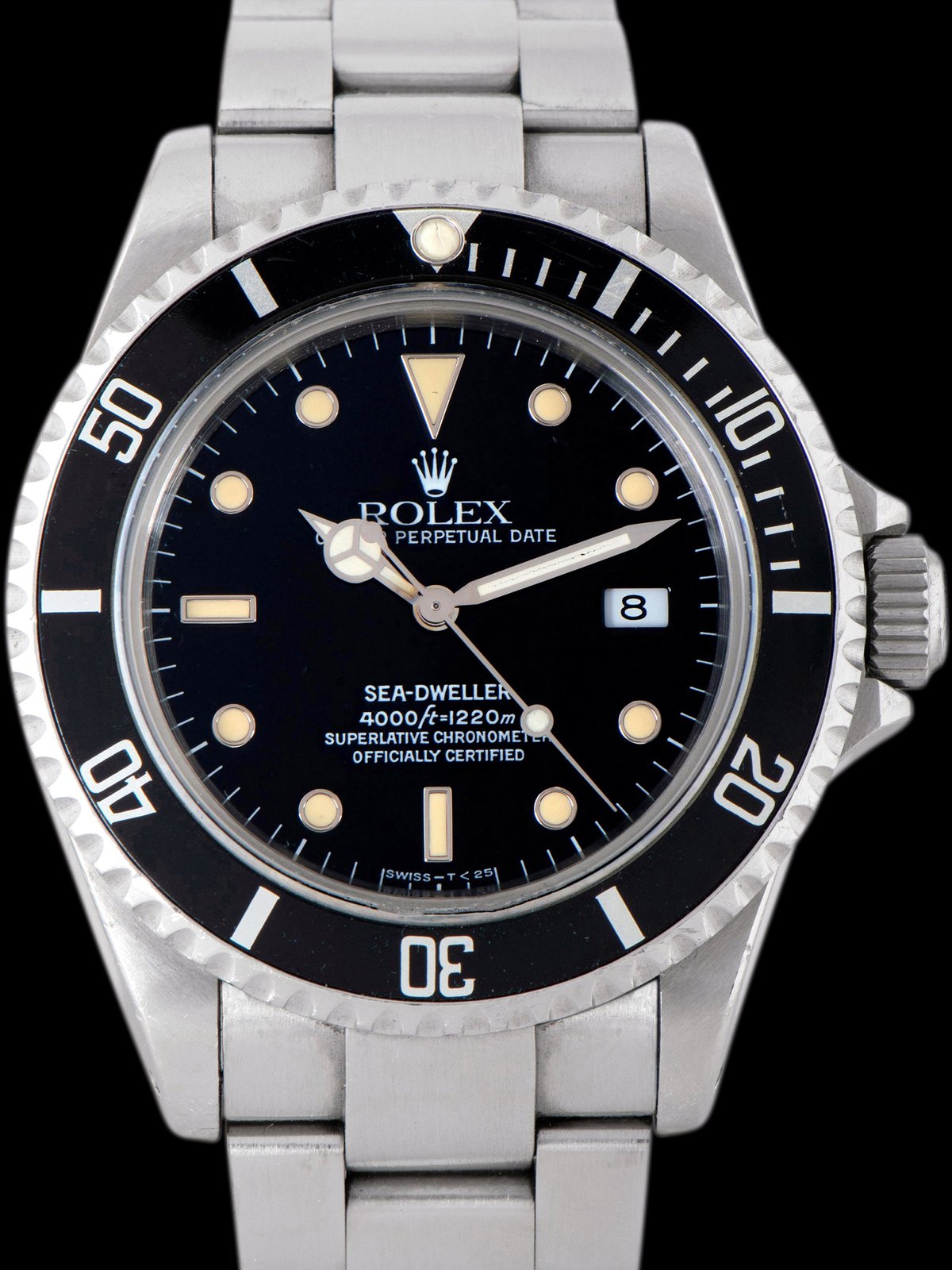
Rolex Sea-Dweller (Ref. 16600) 'Creamy Patina', 1991
- Maker / attribution
- Rolex (maker)
- Date
- 1991
- Historical period
- Mechanical Renaissance (1990 – 2010)
- Country of origin
- Switzerland
- Object type
- Wristwatch
- Stock no.
- RLXSD16600-9
- Credit line
- Dealer listing, Craft & Tailored (RLXSD16600-9)
- Catalogue title (original)
- 1991 Rolex Sea-Dweller (Ref. 16600) 'Creamy Patina' W/ Box & Papers (English)
View the source record (dealer listing) ↗ (opens another website in a new tab)Suggest a correction
Record summary
Catalogued by Craft & Tailored (dealer), Los Angeles (stock number RLXSD16600-9), this is a wristwatch by Rolex, made in Switzerland, dated 1991. The Atlas places it in the Mechanical Renaissance period (1990 – 2010) of its Wristwatches collection. The record is illustrated with 6 photographs.
Assembled from the source record's structured fields. Dates and attributions are given as the source states them; where a field is missing the Atlas leaves it blank rather than estimating.
Catalogue description
Dealer description — Craft & Tailored
There is pretty steep competition between Rolex models when referring to the historical significance between them; however, the Sea-Dweller is undoubtedly one of the most important watches ever created. First introduced in 1967 with the reference 1665, the Sea-Dweller featured innovative patented technology that helped further human exploration to parts otherwise considered impossible to reach. In collaboration with Comex and utilized in the famed SeaLab missions, the Sea-Dweller built upon the existing Rolex Submariner platform to increase the depth rating of the watch to an impressive 2000ft. This impressive increase in possible depth was the result of bulking up the case, but more importantly, the invention and development of the Helium Escape Valve or HEV, which allowed for helium molecules to transfer in and out of the watch case without damaging the watch. Helium gas was essential in the breathing gas mixture used during the experimental saturation diving missions at the time; however, due to helium being such a small gas particle, it was able to enter watches during the missions, but without a method for the gas to escape would cause the watches to catastrophically fail upon decompression. The invention of the HEV was revolutionary as it allowed the helium gas watches to "escape" during decompression, thus making the watch able to reach unheard-of depths at the time. The Rolex ref. 16600 is the third version of the Sea-Dweller and was introduced in 1988, directly succeeding the very transitional ref. 16660 "Triple 6" model, and was replaced in 2008. The ref. 16600 boasts an incredible depth rating of 4000ft or 1220m, utilizes a sapphire crystal and a unidirectional click-spring bezel, employs the Rolex in-house cal. 3135 with quick-set date functionality, and features the improved 93160 Oyster bracelet with solid end pieces. SPECS Stock # RLXSD16600-9 Brand Rolex Style Sea-Dweller Model 16600 Serial N4XXXXX Size Men's Material Stainless Steel Dial Glossy Black Millimeters 40 Bracelet Rolex Oyster 93160 Bracelet W/ Solid End Pieces CASE & BRACELET The robust case is in excellent condition and has been potentially polished once previously, as the original case dimensions, finishing, and chamfers remain present. The case exhibits honest signs of use, but no notable elements of damage. The bezel insert remains deep black in coloration with minimal signs of use and retains its tritium pearl, which features a nice creamy patina and shows a small surface crack. The case back retains all of its original factory black enamel and exhibits minimal wear. The original Rolex 93160 Oyster bracelet with 592B solid end pieces retains 11 links along with the integrated diver's extension, which exhibit only minor stretch from use. The bracelet will fit up to a 7-inch wrist. The bracelet also comes with two additional links. DIAL & HANDS The glossy black dial with white gold surround markers is flawless, showing no damage or age. The tritium lume plots feature a creamy-golden patina with no degradation present under UV light inspection. The original tritium hands have also achieved a creamy patina, but they are a few shades lighter than the dial, under UV light inspection the minute hand exhibits some cracking and remains stable, while the hour and second hands display no degradation. ACCESSORIES
Historical context
Mechanical Renaissance (1990 – 2010)
Mechanical watches return as cultural objects; independent watchmaking flourishes.
Mechanical watches returned as cultural and luxury objects. Complications, tourbillons and new materials proliferated; independent watchmakers such as George Daniels, F.P. Journe and Philippe Dufour revived artisanal watchmaking; collecting vintage watches became a major field.
Read the period in the timelineMore wristwatches from this periodEarlier: Quartz Revolution
Atlas type guide
Dive and water-resistant watches
Keeping water and dust out of a wristwatch was a long-standing challenge. Rolex's screw-down Oyster case (1926) and Omega's Marine (1932) were landmarks; in the early 1950s Blancpain's Fifty Fathoms and Rolex's Submariner defined the professional dive watch with rotating bezels for timing dives, luminous dials and high water resistance. The ISO 6425 standard (1982) later codified what a 'diver's watch' must do.
Dive watches became icons of post-war design and exploration, and their evolution — helium escape valves, ceramic bezels, saturation-diving depth ratings — records the history of underwater work.
What to look for
- Unidirectional or bidirectional rotating bezel with minute markings.
- Screw-down crown and case back; depth rating printed on the dial.
- Luminous hands and markers (radium before c. 1960, tritium c. 1960–1998, then Super-LumiNova).
- Reference numbers on the case between the lugs or inside the back.
Dating clues
- Screw-down Oyster cases: from 1926.
- Professional dive watches: from 1953.
- Tritium 'T' marks on dials: c. 1960–1998.
General guidance written by the Atlas editors about this kind of object. It is not a statement about this particular piece; for that, rely on the source record above and on physical examination.
Related records

Movements & Components · c. 1970s
Rolex watch movement, c. 1970s
Antiquorum auction archive, Geneva

Pocket Watches · 1982
Fake Rolex watch, gold coloured metal, possibly made in Taiwan, 1982; part of a casual outfit, UK, 1982-84.
Victoria and Albert Museum, London

Wristwatches · c. 1920s
Rolex wristwatch, c. 1920s
Antiquorum auction archive, Geneva

Wristwatches · c. 1920s
Rolex wristwatch, ref. 6194, c. 1920s
Antiquorum auction archive, Geneva

Wristwatches · 2008
Wristwatch by Breitling?, 2008
Museum Rotterdam

Wristwatches · c. 1990s
Audemars Piguet Bamboo, c. 1990s
Antiquorum auction archive, Geneva

Wristwatches · c. 1990
Audemars Piguet Huitieme Perpetual Calendar, ref. 25696PT, c. 1990
Antiquorum auction archive, Geneva

Wristwatches · c. 1990
Breitling Chronomat, ref. b13050.1, c. 1990
Antiquorum auction archive, Geneva