
Wristwatches · Wristwatch
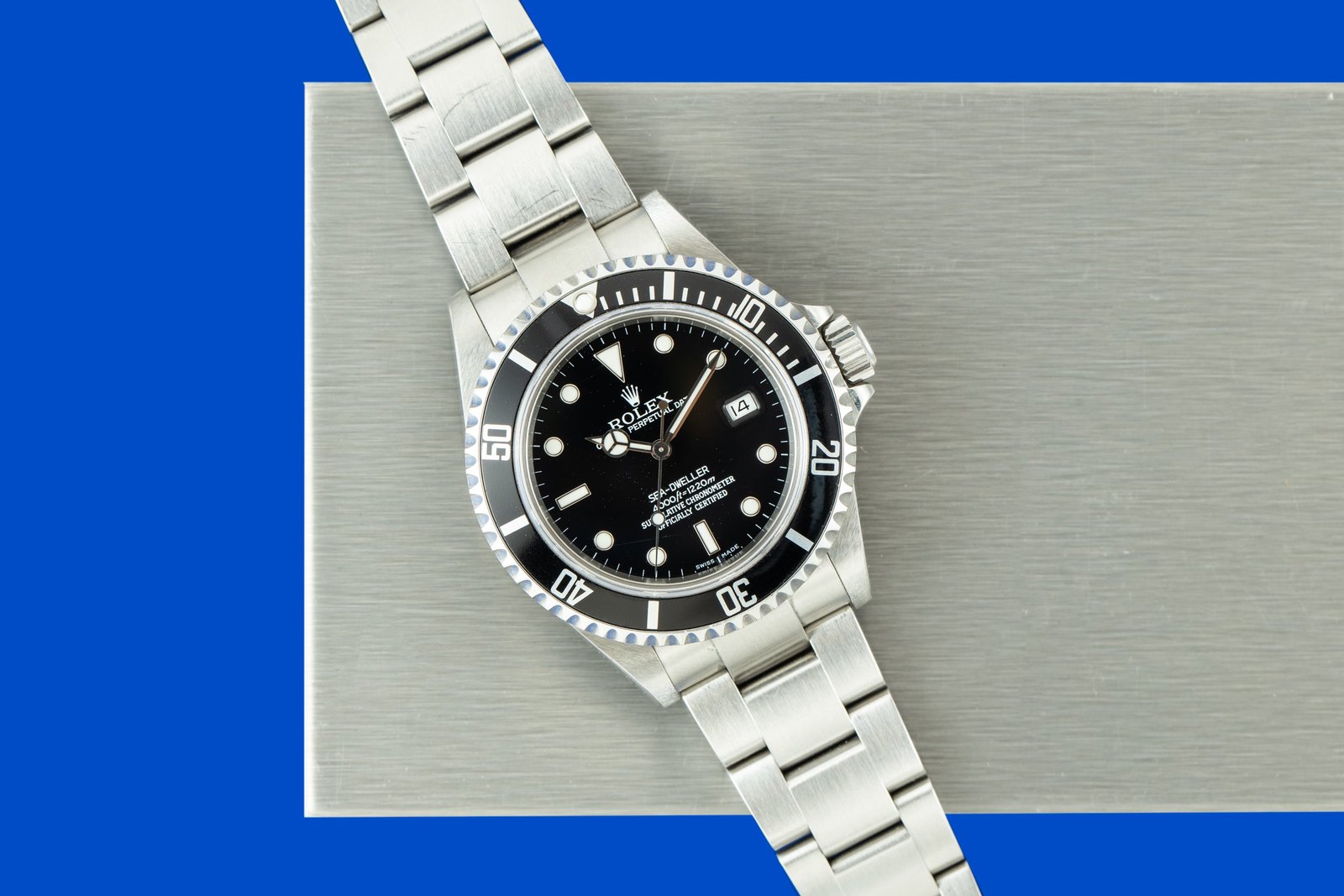
Rolex Sea-Dweller, c. 2005
- Maker / attribution
- Rolex (maker)
- Date
- c. 2005
- Historical period
- Mechanical Renaissance (1990 – 2010)
- Country of origin
- Switzerland
- Object type
- Wristwatch
- Stock no.
- 40920023
- Credit line
- Dealer listing, Analog/Shift (40920023)
- Catalogue title (original)
- Rolex Sea-Dweller (English)
View the source record (dealer listing) ↗ (opens another website in a new tab)Suggest a correction
Record summary
Catalogued by Analog/Shift (dealer), New York (stock number 40920023), this is a wristwatch by Rolex, made in Switzerland, dated c. 2005. The Atlas places it in the Mechanical Renaissance period (1990 – 2010) of its Wristwatches collection. The record is illustrated with 6 photographs.
Assembled from the source record's structured fields. Dates and attributions are given as the source states them; where a field is missing the Atlas leaves it blank rather than estimating.
Catalogue description
Dealer description — Analog/Shift
Why We Love It In 1978, the original Sea-Dweller (Reference 1665) was replaced by the Reference 16600. This new model boasted an even greater depth rating: an impressive 4000 feet (or 1220 meters). This was possible, in part, due to a larger Helium Escape Valve. Visually, the 16600 stands apart from its predecessor with a glossy dial featuring applied luminous markers. The internals were also upgraded with the Calibre 3035 movement. Rugged, dependable, and beautiful the Reference 16600 is the last 'Dweller with classic Oyster dimensions. This particular example is a Luminova dial execution dating to circa 2005. It is in outstanding near mint condition throughout and comes with completed papers from the same year. The case is unpolished -even the holographic case back sticker remains intact - and the dial and handset are as new. If you're a fan of the classic case proportions but want a robust contemporary Sea-Dweller that can take anything you throw at it, look no further! The Sea-Dweller Story In many ways the development of the Rolex Sea-Dweller mirrors the technological advances that occurred during the 1960s and 1970s. When the Sea-Dweller was introduced in 1967, NASA had launched over fourteen manned space missions and was just two years from putting a man on the Moon. Yet deep sea explorers (in many ways the astronauts of the deep) had only descended to the Marianas Trench once, in 1960. But the divers of COMEX (for whom the Sea-Dweller was originallt designed) pushed the envelope, operating at depths that had never been possible before the introduction of commercial saturation diving in 1965. At the time, the divers at COMEX were already using watches by Rolex, specifically the Submariner Reference 5513. However, since the divers of COMEX employed a new diving technique called saturation diving (in which the divers used a mix of hydrogen, helium and oxygen) the Reference 5513 was poorly designed for the purpose. When not working, the divers would rest in a pressurized chamber, breathing helium-infused air and allowing the built-up helium to leave their bodies. Since saturation diving decreases a diver's decompression interval, the helium molecules left their bodies faster than they left their watches, causing a build-up of pressure that would blow the crystals off their watches. COMEX approached the Manufacture with this problem, and Rolex presented a solution: install a titanium Helium Escape Valve on the case at 9:00, which would allow the helium molecules to escape the watch faster. A waterproof O-Ring secured a spring-loaded piston to the outside of the case, which pressed against the O-Ring when the watch was exposed to increased water pressure. Rolex gave COMEX a few of these special prototype 5513 Submariners with Helium Escape Valves, and the problem was solved. Later, in 1967, when COMEX requested a hundred more, Rolex issued a new Reference number, 5514, and placed the COMEX logo on the dial. These Reference 5514 Submariners proved such a success that Rolex decided to release them to the public in a brand-new Reference: 1665, the Sea-Dweller. This first Reference of Sea-Dweller was equipped with the Calibre 1575 movement and a thicker crystal. Now recreational divers could buy a watch capable of descending to the punishing depth of 2000 feet (or 610 meters) at which the COMEX professionals worked. The Sea-Dweller has continued to evolve, with each generation becoming a more capable and robust tool, in keeping with its original mandate. Today, the Sea-Dweller is a metric by which every other professional grade diving watch is measured – and while very few of them will ever be subjected to the pressures they are capable of withstanding, they prove the old adage. Anything worth doing is worth over doing!
Historical context
Mechanical Renaissance (1990 – 2010)
Mechanical watches return as cultural objects; independent watchmaking flourishes.
Mechanical watches returned as cultural and luxury objects. Complications, tourbillons and new materials proliferated; independent watchmakers such as George Daniels, F.P. Journe and Philippe Dufour revived artisanal watchmaking; collecting vintage watches became a major field.
Read the period in the timelineMore wristwatches from this periodEarlier: Quartz Revolution
Atlas type guide
Dive and water-resistant watches
Keeping water and dust out of a wristwatch was a long-standing challenge. Rolex's screw-down Oyster case (1926) and Omega's Marine (1932) were landmarks; in the early 1950s Blancpain's Fifty Fathoms and Rolex's Submariner defined the professional dive watch with rotating bezels for timing dives, luminous dials and high water resistance. The ISO 6425 standard (1982) later codified what a 'diver's watch' must do.
Dive watches became icons of post-war design and exploration, and their evolution — helium escape valves, ceramic bezels, saturation-diving depth ratings — records the history of underwater work.
What to look for
- Unidirectional or bidirectional rotating bezel with minute markings.
- Screw-down crown and case back; depth rating printed on the dial.
- Luminous hands and markers (radium before c. 1960, tritium c. 1960–1998, then Super-LumiNova).
- Reference numbers on the case between the lugs or inside the back.
Dating clues
- Screw-down Oyster cases: from 1926.
- Professional dive watches: from 1953.
- Tritium 'T' marks on dials: c. 1960–1998.
General guidance written by the Atlas editors about this kind of object. It is not a statement about this particular piece; for that, rely on the source record above and on physical examination.
Related records

Movements & Components · c. 1970s
Rolex watch movement, c. 1970s
Antiquorum auction archive, Geneva

Pocket Watches · 1982
Fake Rolex watch, gold coloured metal, possibly made in Taiwan, 1982; part of a casual outfit, UK, 1982-84.
Victoria and Albert Museum, London

Wristwatches · c. 1920s
Rolex wristwatch, c. 1920s
Antiquorum auction archive, Geneva

Wristwatches · c. 1920s
Rolex wristwatch, ref. 6194, c. 1920s
Antiquorum auction archive, Geneva

Wristwatches · 2008
Wristwatch by Breitling?, 2008
Museum Rotterdam

Wristwatches · c. 1990s
Audemars Piguet Bamboo, c. 1990s
Antiquorum auction archive, Geneva

Wristwatches · c. 1990
Audemars Piguet Huitieme Perpetual Calendar, ref. 25696PT, c. 1990
Antiquorum auction archive, Geneva

Wristwatches · c. 1990
Breitling Chronomat, ref. b13050.1, c. 1990
Antiquorum auction archive, Geneva