
Pocket Watches · Pocket watch
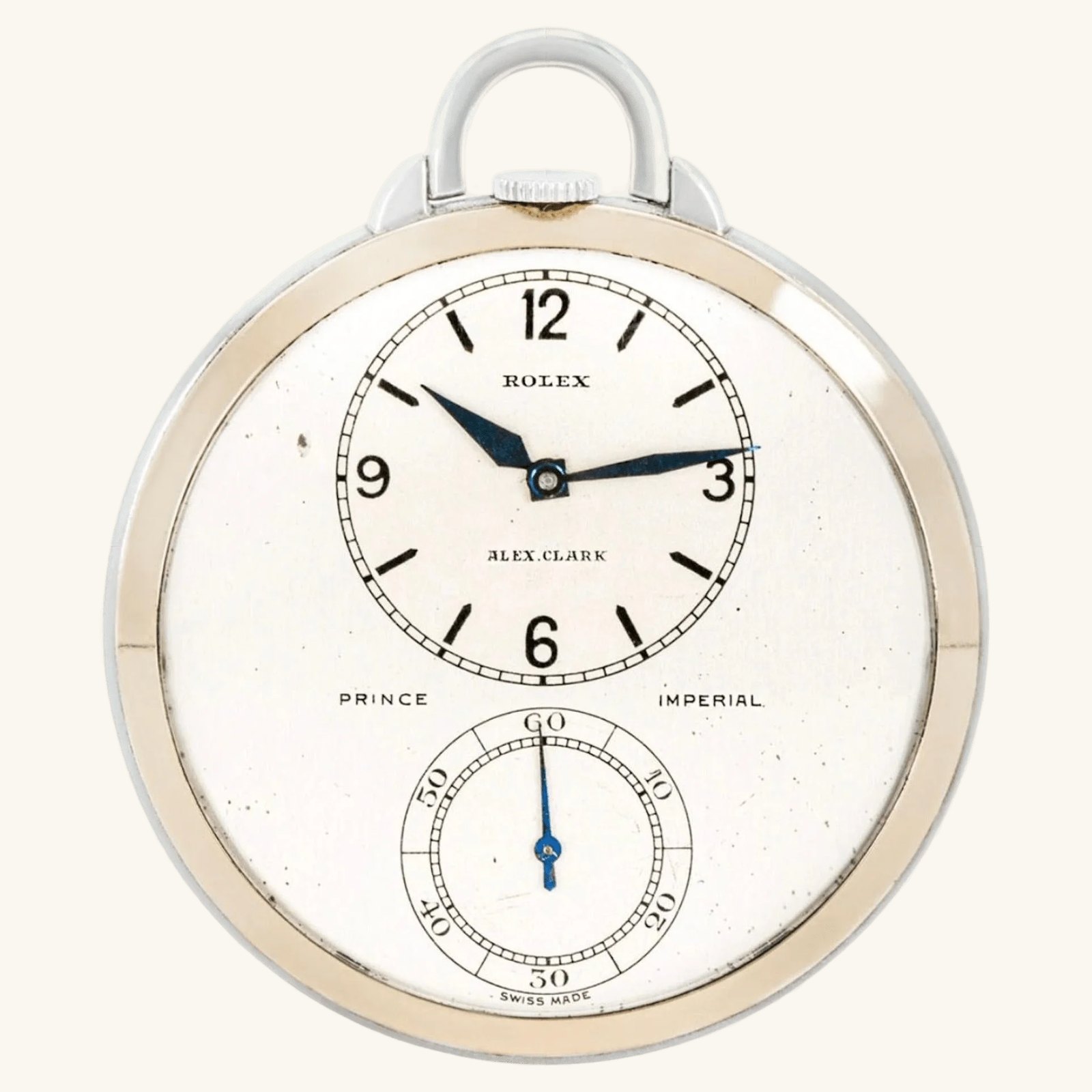
Rolex Prince Imperial Observatory Quality Bi-Colour Gold Dress Pocket Watch, 1931
- Maker / attribution
- Rolex (maker)
- Date
- 1931
- Historical period
- Golden Age of Mechanical Watchmaking (1900 – 1945)
- Country of origin
- Switzerland
- Object type
- Pocket watch
- Materials / technique
- gold
- Dealer
- WatchMuseum.org shop
- Stock no.
- Product 3019
- Credit line
- Dealer listing, WatchMuseum.org shop (product 3019)
- Catalogue title (original)
- Rolex Prince Imperial Observatory Quality Bi-Colour Gold Dress Pocket Watch (English)
View the source record (dealer listing) ↗ (opens another website in a new tab)Suggest a correction
Record summary
Catalogued by WatchMuseum.org shop (stock number Product 3019), this is a pocket watch by Rolex, made in Switzerland, dated 1931. The Atlas places it in the Golden Age of Mechanical Watchmaking period (1900 – 1945) of its Pocket Watches collection. Materials and techniques recorded by the source: gold. The record is illustrated with 6 photographs.
Assembled from the source record's structured fields. Dates and attributions are given as the source states them; where a field is missing the Atlas leaves it blank rather than estimating.
Catalogue description
Dealer description — WatchMuseum.org shop
The Rolex Prince Imperial Observatory Quality Bi-Colour Gold Dress Pocket Watch from 1931 is a stunning example of horological craftsmanship and timeless elegance. This exquisite timepiece, fashioned from 9ct bi-colour gold, features Glasgow import hallmarks that authenticate its creation year. Its satin silver dial, adorned with a sophisticated two-tone effect, proudly bears the Rolex Prince Imperial signature along with the name of its retailer, Alex Clark. The watch’s design is both functional and aesthetically pleasing, with an offset dial at twelve o’clock showcasing Arabic numerals and batons, complemented by a subsidiary seconds dial at six o’clock. The original blued steel arrow-like hands, along with a matching seconds hand, add a touch of sophistication to the overall design. The 9ct bi-colour gold case is plain-backed and features a snap-back mechanism that is fully signed, numbered, and British import hallmarked. Inside, the watch boasts a keyless lever escapement with a patent protective cap over the balance and escapement, and a nickel ¾ plate movement signed with multiple accolades, including “Rolex Observatory” and “17 Rubies.” This meticulously maintained movement, complete with gold train wheels, ensures the watch’s excellent condition. Retailed by The Alex Clarke Co Ltd, a notable Rolex agent with stores in Scotland and Shanghai, this pocket watch also comes with its original box, a rare find that enhances its historical value. With its round 44 mm diameter case, this Swiss-made masterpiece from the early 1930s is not just a timekeeper but a collector’s dream, encapsulating the essence of Rolex’s enduring legacy. Introducing the exquisite Rolex Prince Imperial pocket watch, crafted from 9ct bi-colour gold and featuring Glasgow import hallmarks for the year 1931. The beautifully designed satin silver dial has a two-tone effect and is signed Rolex Prince Imperial, with the name of the retailer, Alex Clark, also present. An offset dial at twelve o’clock features Arabic numerals and batons, while the subsidiary seconds dial is located at six o’clock. The original blued steel arrow-like hands are paired with a perfectly matching seconds hand, adding to the sophistication of the watch. The 9ct bi-colour gold case is plain-backed and has a snap-back case that is fully signed, numbered, and British import hallmarked. The mechanism of the watch is just as impressive, boasting a keyless lever escapement with a patent protective cap over the balance and escapement. The nickel ¾ plate movement is signed “Rolex Observatory, Rolex Hairspring Observatory Quality, Timex 6 positions, 17 Rubies, Swiss Made, Brevetes Francais, S.G.D.G,” and has gold train wheels. It is in excellent condition, making it a true collector’s item. This watch was retailed by The Alex Clarke Co Ltd, a well-known retail agent of Rolex with stores in Scotland and Shanghai. The watch also comes with its original box, which is rare to find, adding to its historical significance. Don’t miss the opportunity to own a timeless masterpiece like this Rolex Prince Imperial pocket watch. Creator: Rolex Case Material: Gold,10k Gold,White Gold,Yellow Gold Case Shape: Round Case Dimensions: Diameter: 44 mm (1.74 in) Place of Origin: Switzerland Period: 1930-1939 Date of Manufacture: 1931 Condition: Excellent. In original box.
Historical context
Golden Age of Mechanical Watchmaking (1900 – 1945)
The wristwatch displaces the pocket watch; waterproof cases, self-winding and grand complications.
The pocket watch reached technical maturity and then began to give way to the wristwatch after the First World War. Complicated watches for collectors such as Henry Graves Jr. and James Ward Packard, railroad watches, and slim Art Deco dress watches are characteristic.
Read the period in the timelineMore pocket watches from this periodEarlier: Industrial Revolution
Atlas type guide
Pocket chronometers and precision watches
A pocket chronometer is a watch built to observatory standards, traditionally with a detent escapement like a marine chronometer. English makers such as John Arnold and Thomas Earnshaw made the first pocket chronometers in the 1780s. In the nineteenth century the term increasingly referred to any watch that had passed official rating trials at observatories in Kew, Neuchâtel, Geneva or Besançon, and the Swiss lever chronometer became dominant.
Tourbillon and karrusel watches belong to the same world of precision. Breguet patented the tourbillon in 1801 to average out positional errors; Bahne Bonniksen's karrusel (1892) was a cheaper English alternative. Rating certificates (bulletins de marche) that accompany such watches are historical documents in their own right.
What to look for
- Detent escapement (no pallets; a fine spring detent locks the escape wheel).
- Observatory certificates, competition results or 'Chronometer' marking on the dial.
- Tourbillon carriage visible through an aperture or on the movement.
- Fine finishing: jewelled holes in gold chatons, diamond endstones.
Dating clues
- English pocket chronometers: c. 1780–1900.
- Observatory trials at Neuchâtel from 1866, Geneva from 1873, Kew from 1884.
- Karrusels: 1892–c. 1915.
General guidance written by the Atlas editors about this kind of object. It is not a statement about this particular piece; for that, rely on the source record above and on physical examination.
Related records

Movements & Components · c. 1970s
Rolex watch movement, c. 1970s
Antiquorum auction archive, Geneva

Pocket Watches · 1982
Fake Rolex watch, gold coloured metal, possibly made in Taiwan, 1982; part of a casual outfit, UK, 1982-84.
Victoria and Albert Museum, London

Wristwatches · c. 1920s
Rolex wristwatch, c. 1920s
Antiquorum auction archive, Geneva

Wristwatches · c. 1920s
Rolex wristwatch, ref. 6194, c. 1920s
Antiquorum auction archive, Geneva

Pocket Watches · c. 1900
Patek Philippe Chronometro Gondolo, c. 1900
Antiquorum auction archive, Geneva
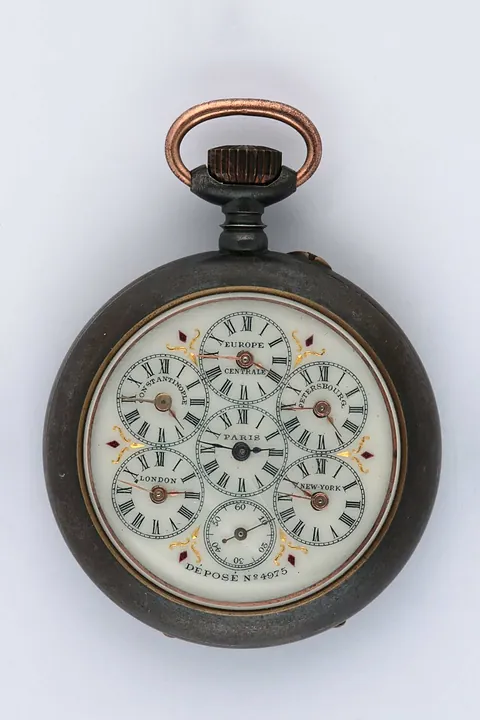
Pocket Watches · c. 1900
Pocket watch by A. Sandoz-Boucherin, Switzerland, c. 1900
German Clock Museum
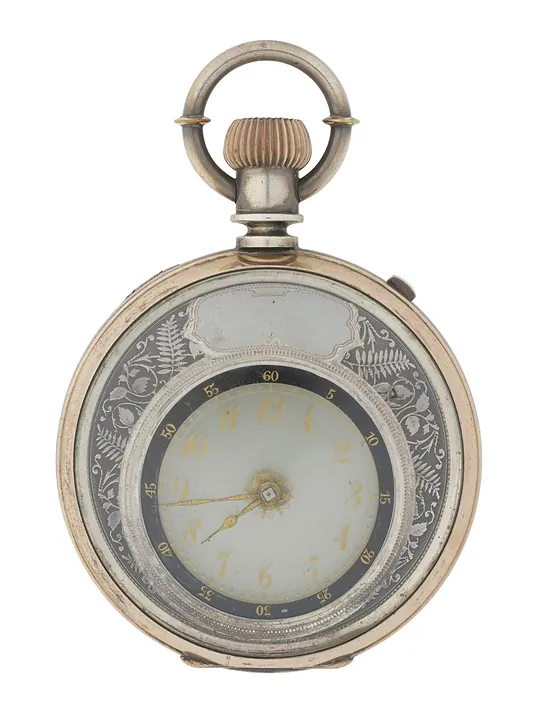
Pocket Watches · 1900
Pocket watch by Armand Schwob & Frère, Switzerland, 1900
Science Museum Group, London
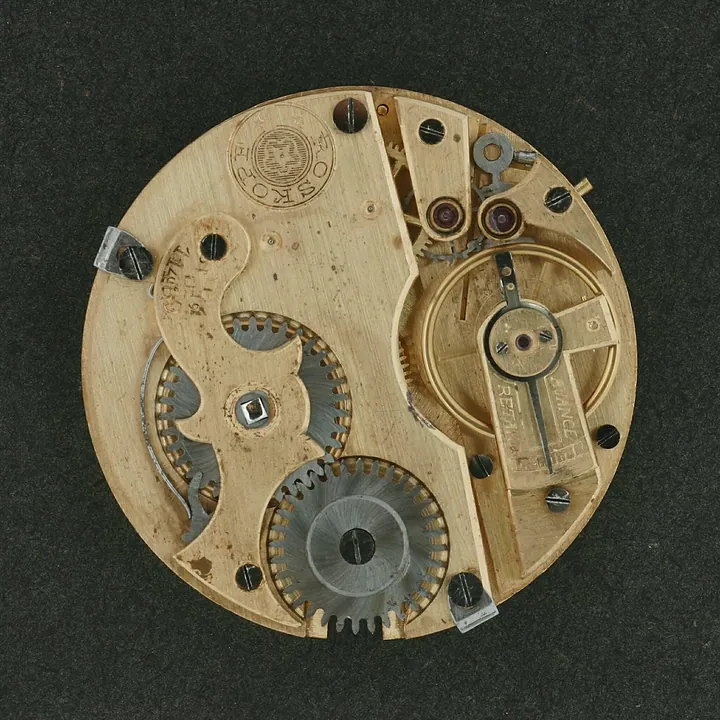
Pocket Watches · c. 1900
Pocket watch by Vve. Chs. Léon Schmid und Cie, Switzerland, c. 1900
German Clock Museum