
Wristwatches · Wristwatch
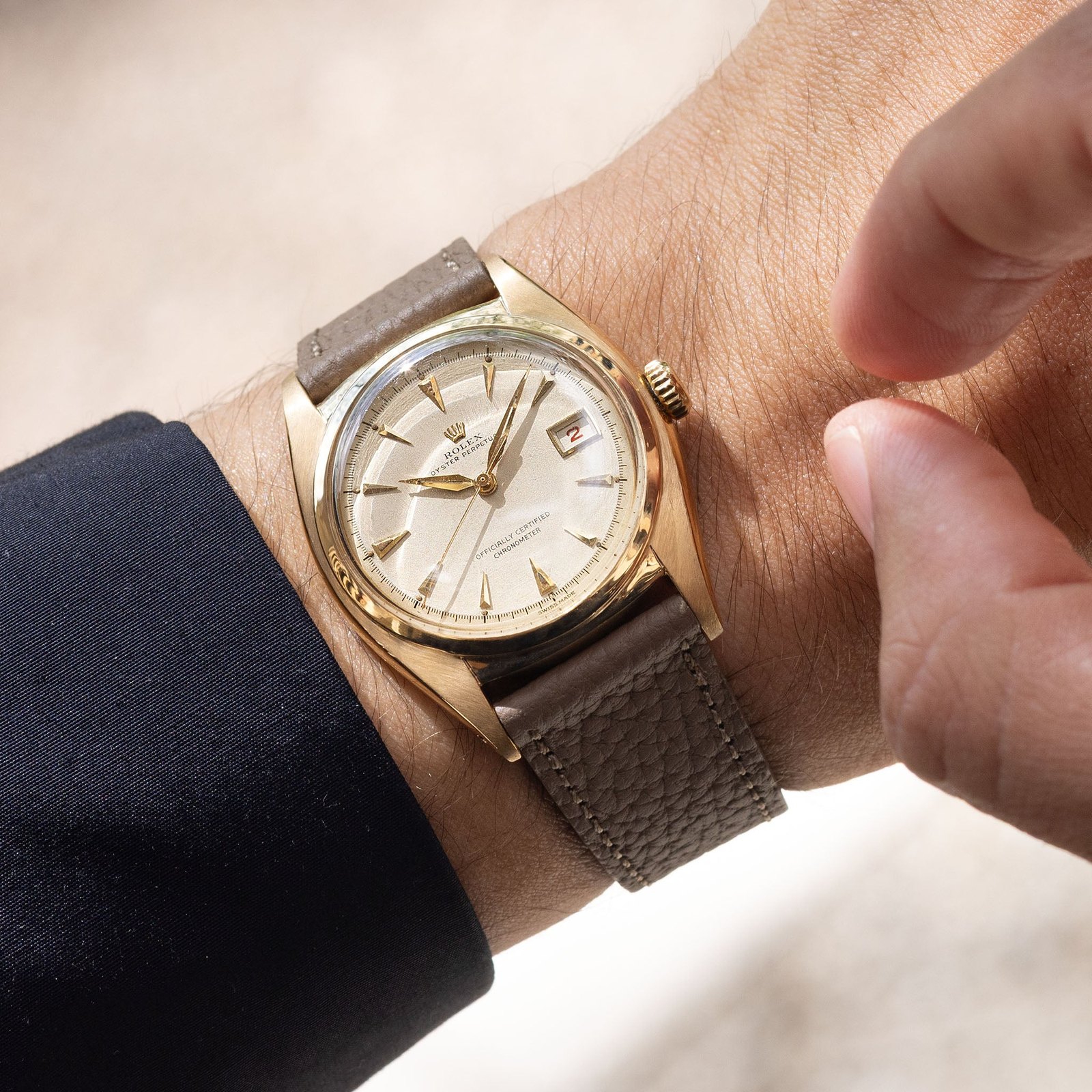
Rolex Oyster Perpetual ref. 6104 "Ovettone" Cream Dial in 18k yellow gold, 1951
- Maker / attribution
- Rolex (maker)
- Date
- 1951
- Historical period
- Modern Mechanical Horology (1945 – 1969)
- Country of origin
- Switzerland
- Object type
- Wristwatch
- Materials / technique
- 18k yellow gold
- Dimensions
- Case 36 mm
- Stock no.
- W-3355
- Credit line
- Dealer listing, Bulang & Sons (W-3355)
- Catalogue title (original)
- Rolex Oyster Perpetual ref. 6104 "Ovettone" Cream Dial in 18k yellow gold (English)
View the source record (dealer listing) ↗ (opens another website in a new tab)Suggest a correction
Record summary
Catalogued by Bulang & Sons (dealer), Copenhagen (stock number W-3355), this is a wristwatch by Rolex, made in Switzerland, dated 1951. The Atlas places it in the Modern Mechanical Horology period (1945 – 1969) of its Wristwatches collection. Materials and techniques recorded by the source: 18k yellow gold. Recorded dimensions: Case 36 mm. The record is illustrated with 6 photographs.
Assembled from the source record's structured fields. Dates and attributions are given as the source states them; where a field is missing the Atlas leaves it blank rather than estimating.
Catalogue description
Dealer description — Bulang & Sons
Widely regarded as one of the most iconic and instantly recognizable timepieces ever made, the Rolex Datejust is often the first watch that comes to mind when thinking of timeless luxury and classic design. First introduced in 1945, the Rolex Datejust has remained a constant presence in the brand’s lineup—and for good reason. As the first wristwatch to feature a date window that changed automatically at midnight, it redefined how a calendar complication should function. Over the decades, the Datejust has not only become a cornerstone of Rolex’s design legacy but also holds the title of the brand’s best-selling model. Though it has remained in continuous production, the Datejust has seen numerous updates and design evolutions, each adding to its enduring appeal. On offer here is the rarely seen reference 6104, produced from approximately 1950 to 1953. Its sibling reference, the 6105, is differentiated by a machined, finely reeded bezel, whereas the 6104 features a smooth bezel. The very earliest Datejust examples, like this ref. 6104 from 1950—are significantly different from the more common Datejust models such as the 16xx and 16xxx series that most collectors are familiar with. For example, these early pieces did not yet have "Datejust" printed on the dial. Rolex began adding that designation somewhere during the production run of the 6104 and 6105 references. This particular example features a beautiful 18k yellow gold case with a smooth bezel. The case back showcases the distinctive Ovettone style—characterized by a more rounded and higher-profile design, necessary to accommodate Rolex’s early self-winding movements. As a result, the watch sits higher on the wrist and offers more presence than its 36mm size would suggest. The nickname Ovettone , coined by Italian collectors, loosely translates to “big egg,” a nod to its unique case shape. The dial is a soft eggshell/cream tone, signed "Swiss Made," and features a crisp minute track, the “Officially Certified Chronometer” text and "Oyster Perpetual" (note: no "Datejust" text). Elegant gold hands complete the design. One charming detail is the applied gold coronet logo, with a distinct cut-off at the bottom—a typical design trait from that period. At this early stage in the Datejust’s history, Rolex had not yet introduced the cyclops magnifier on the crystal. This gives the watch a clean and modern look, especially with its striking red date numerals in a sleek, mid-century font. We’ve paired this rare piece with a fine leather strap from our own Bulang and Sons collection, offering a perfect balance of vintage charm and refined elegance. This rare and refined early Rolex has been fully serviced by our watchmaker and is ready for the next chapter in its long and distinguished story. We've done a little write-up about these early Oysters over here —take a peek! This one is truly for the discerning connoisseur collector. If you're someone who appreciates the rare and remarkable, this piece is calling your name. Specifications: Rolex Oyster Perpetual Reference 6104 36mm 18K yellow gold case “Ovettone” style ”pré Datejust “ Smooth integrated 18K gold bezel Serial 752xxx dating to 1951 Cream dial “OCC” with black text and red date Bulang & Sons leather strap Fully serviced by our watchmaker
Historical context
Modern Mechanical Horology (1945 – 1969)
Tool watches for divers, pilots and astronauts; electric watches anticipate the electronic age.
The classic era of the mechanical wristwatch: dive watches, chronographs for motor racing and space flight, GMT watches for jet travel, slim dress watches, automatic calendars, and the rise of Japanese manufacturers alongside Swiss, American, German and Soviet industries.
Read the period in the timelineMore wristwatches from this periodEarlier: Golden Age of Mechanical Watchmaking
Atlas type guide
Dive and water-resistant watches
Keeping water and dust out of a wristwatch was a long-standing challenge. Rolex's screw-down Oyster case (1926) and Omega's Marine (1932) were landmarks; in the early 1950s Blancpain's Fifty Fathoms and Rolex's Submariner defined the professional dive watch with rotating bezels for timing dives, luminous dials and high water resistance. The ISO 6425 standard (1982) later codified what a 'diver's watch' must do.
Dive watches became icons of post-war design and exploration, and their evolution — helium escape valves, ceramic bezels, saturation-diving depth ratings — records the history of underwater work.
What to look for
- Unidirectional or bidirectional rotating bezel with minute markings.
- Screw-down crown and case back; depth rating printed on the dial.
- Luminous hands and markers (radium before c. 1960, tritium c. 1960–1998, then Super-LumiNova).
- Reference numbers on the case between the lugs or inside the back.
Dating clues
- Screw-down Oyster cases: from 1926.
- Professional dive watches: from 1953.
- Tritium 'T' marks on dials: c. 1960–1998.
General guidance written by the Atlas editors about this kind of object. It is not a statement about this particular piece; for that, rely on the source record above and on physical examination.
Related records

Movements & Components · c. 1970s
Rolex watch movement, c. 1970s
Antiquorum auction archive, Geneva

Pocket Watches · 1982
Fake Rolex watch, gold coloured metal, possibly made in Taiwan, 1982; part of a casual outfit, UK, 1982-84.
Victoria and Albert Museum, London

Wristwatches · c. 1920s
Rolex wristwatch, c. 1920s
Antiquorum auction archive, Geneva

Wristwatches · c. 1920s
Rolex wristwatch, ref. 6194, c. 1920s
Antiquorum auction archive, Geneva

Wristwatches · 1945
Wristwatch by Eterna, 1945
Museum Rotterdam

Wristwatches · c. 1945
Breitling Premier, ref. 790, c. 1945
Antiquorum auction archive, Geneva

Wristwatches · c. 1945
Universal Genève Uni-Compax, ref. 22492, c. 1945
Antiquorum auction archive, Geneva

Wristwatches · c. 1950s
Baume & Mercier wristwatch, c. 1950s
Antiquorum auction archive, Geneva