
Wristwatches · Wristwatch
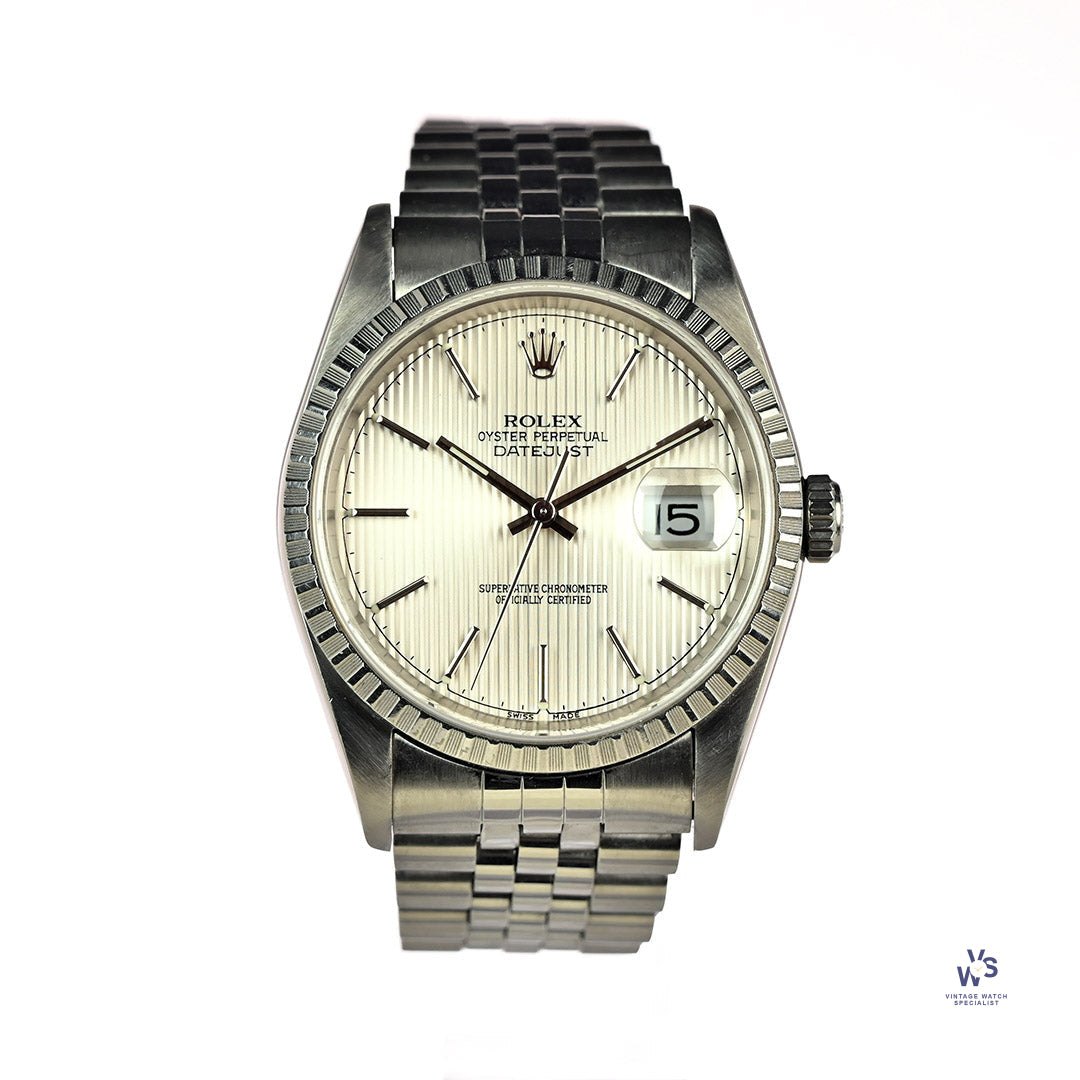
Rolex Oyster Datejust, ref. 16220, 2006
- Maker / attribution
- Rolex (maker)
- Date
- 2006
- Historical period
- Mechanical Renaissance (1990 – 2010)
- Country of origin
- Switzerland
- Object type
- Wristwatch
- Dimensions
- Case 36 mm
- Stock no.
- vws3026
- Credit line
- Dealer listing, Vintage Watch Specialist (vws3026)
- Catalogue title (original)
- Rolex Oyster Datejust - Model Ref: 16220 - Box and Papers - 2006 (English)
View the source record (dealer listing) ↗ (opens another website in a new tab)Suggest a correction
Record summary
Catalogued by Vintage Watch Specialist (dealer), United Kingdom (stock number vws3026), this is a wristwatch by Rolex, made in Switzerland, dated 2006. The Atlas places it in the Mechanical Renaissance period (1990 – 2010) of its Wristwatches collection. Recorded dimensions: Case 36 mm. The record is illustrated with 6 photographs.
Assembled from the source record's structured fields. Dates and attributions are given as the source states them; where a field is missing the Atlas leaves it blank rather than estimating.
Catalogue description
Dealer description — Vintage Watch Specialist
A Stunning Rolex Oyster Perpetual Datejust, Model Reference: 16220 with a Beautiful Textured Silver Dial, Engine Turned Bezel and Jubilee Bracelet, Sold with Box and Papers The Rolex 16220 is a model from the iconic Datejust series, a lineage that represents one of the cornerstones of the Rolex portfolio. The Datejust itself has a storied history, having been introduced in 1945 to commemorate Rolex’s 40th anniversary. It was groundbreaking for being the first wristwatch to display the date through an aperture on the dial, alongside its timekeeping functions. This innovation solidified Rolex's reputation for combining functionality with luxury. The specific model number 16220 denotes a particular variation within the Datejust range that emerged in the late 1980s and continued production into the early 2000s What's on Offer This Rolex Datejust 16220 is in exemplary pre-owned condition and is offered for sale complete with its original box and papers. The silver pin-stripe textured dial is beautiful and boasts applied baton hour markers with luminous pips and elegant stick hands with luminous inserts. A subtle date aperture sits underneath a magnified glass at 3 o'clock. The dial is encapsulated underneath acrylic crystal and framed by an engine-turned stainless steel bezel which is also in superb condition. The watch is paired with its original Oyster Steel Jubilee bracelet, also in nice pre-owned shape. At 36mm, this watch is mid-sized making it perfect for both men and women and for everyday wear as well as more formal occasions. The watch is sold with its original box and papers - the full package! It has been well taken care of and is running well and keeping excellent time. You simply cannot go wrong with the elegance and understated style of the Datejust, an excellent and discerning choice.
Historical context
Mechanical Renaissance (1990 – 2010)
Mechanical watches return as cultural objects; independent watchmaking flourishes.
Mechanical watches returned as cultural and luxury objects. Complications, tourbillons and new materials proliferated; independent watchmakers such as George Daniels, F.P. Journe and Philippe Dufour revived artisanal watchmaking; collecting vintage watches became a major field.
Read the period in the timelineMore wristwatches from this periodEarlier: Quartz Revolution
Atlas type guide
Dive and water-resistant watches
Keeping water and dust out of a wristwatch was a long-standing challenge. Rolex's screw-down Oyster case (1926) and Omega's Marine (1932) were landmarks; in the early 1950s Blancpain's Fifty Fathoms and Rolex's Submariner defined the professional dive watch with rotating bezels for timing dives, luminous dials and high water resistance. The ISO 6425 standard (1982) later codified what a 'diver's watch' must do.
Dive watches became icons of post-war design and exploration, and their evolution — helium escape valves, ceramic bezels, saturation-diving depth ratings — records the history of underwater work.
What to look for
- Unidirectional or bidirectional rotating bezel with minute markings.
- Screw-down crown and case back; depth rating printed on the dial.
- Luminous hands and markers (radium before c. 1960, tritium c. 1960–1998, then Super-LumiNova).
- Reference numbers on the case between the lugs or inside the back.
Dating clues
- Screw-down Oyster cases: from 1926.
- Professional dive watches: from 1953.
- Tritium 'T' marks on dials: c. 1960–1998.
General guidance written by the Atlas editors about this kind of object. It is not a statement about this particular piece; for that, rely on the source record above and on physical examination.
Related records

Movements & Components · c. 1970s
Rolex watch movement, c. 1970s
Antiquorum auction archive, Geneva

Pocket Watches · 1982
Fake Rolex watch, gold coloured metal, possibly made in Taiwan, 1982; part of a casual outfit, UK, 1982-84.
Victoria and Albert Museum, London

Wristwatches · c. 1920s
Rolex wristwatch, c. 1920s
Antiquorum auction archive, Geneva

Wristwatches · c. 1920s
Rolex wristwatch, ref. 6194, c. 1920s
Antiquorum auction archive, Geneva

Wristwatches · 2008
Wristwatch by Breitling?, 2008
Museum Rotterdam

Wristwatches · c. 1990s
Audemars Piguet Bamboo, c. 1990s
Antiquorum auction archive, Geneva

Wristwatches · c. 1990
Audemars Piguet Huitieme Perpetual Calendar, ref. 25696PT, c. 1990
Antiquorum auction archive, Geneva

Wristwatches · c. 1990
Breitling Chronomat, ref. b13050.1, c. 1990
Antiquorum auction archive, Geneva