
Wristwatches · Wristwatch
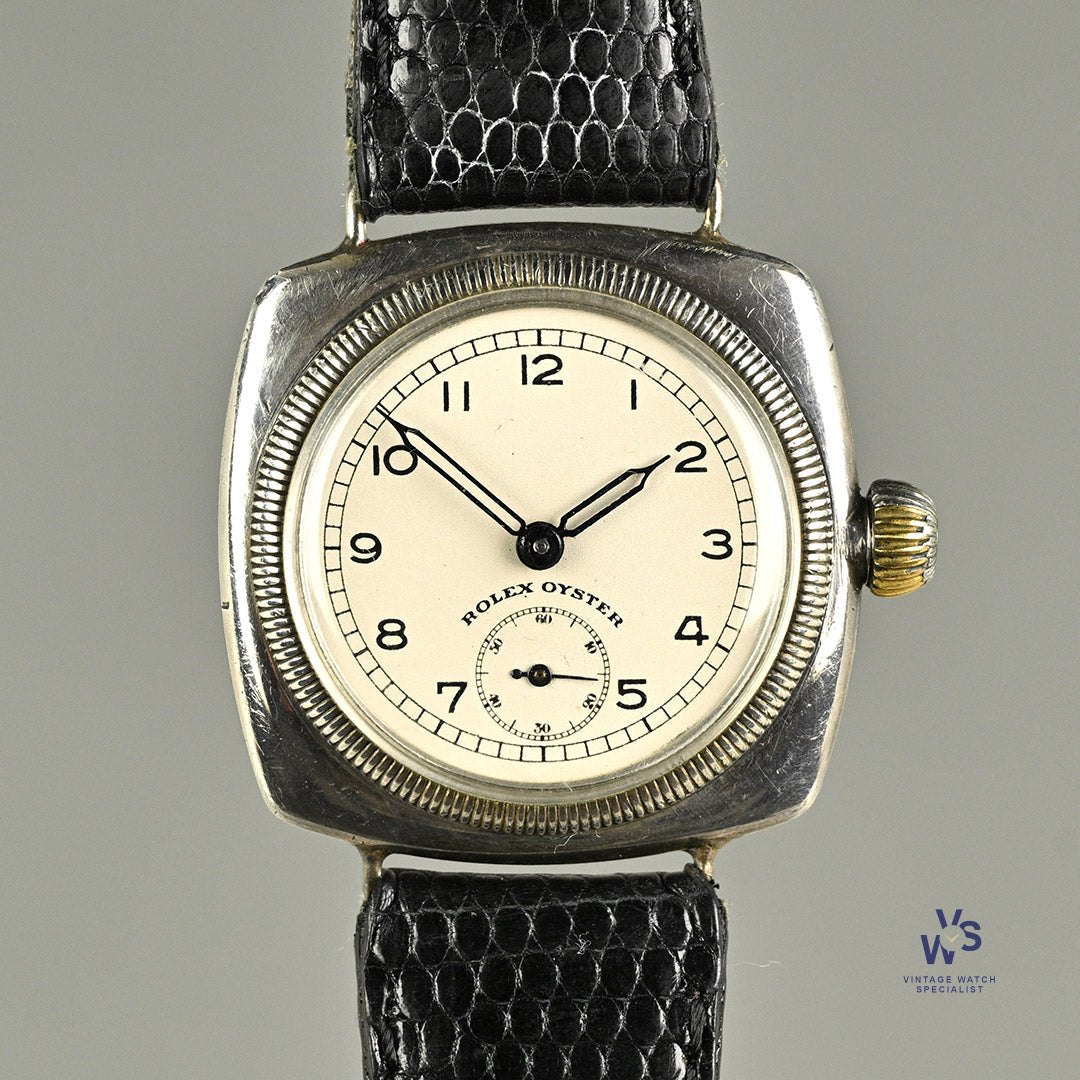
Rolex Oyster Cushion Cased Silver Wristwatch, circa 1925
- Maker / attribution
- Rolex (maker)
- Date
- c. 1925
- Historical period
- Golden Age of Mechanical Watchmaking (1900 – 1945)
- Country of origin
- Switzerland
- Object type
- Wristwatch
- Materials / technique
- silver
- Dimensions
- Case 32 mm
- Stock no.
- vws4362cs
- Credit line
- Dealer listing, Vintage Watch Specialist (vws4362cs)
- Catalogue title (original)
- Rolex Oyster Cushion Cased Silver Wristwatch - c.1925 (English)
View the source record (dealer listing) ↗ (opens another website in a new tab)Suggest a correction
Record summary
Catalogued by Vintage Watch Specialist (dealer), United Kingdom (stock number vws4362cs), this is a wristwatch by Rolex, made in Switzerland, dated c. 1925. The Atlas places it in the Golden Age of Mechanical Watchmaking period (1900 – 1945) of its Wristwatches collection. Materials and techniques recorded by the source: silver. Recorded dimensions: Case 32 mm. The record is illustrated with 6 photographs.
Assembled from the source record's structured fields. Dates and attributions are given as the source states them; where a field is missing the Atlas leaves it blank rather than estimating.
Catalogue description
Dealer description — Vintage Watch Specialist
Rolex Oyster Cushion Cased Silver Watch - Rolex Extra Prima movement adjusted to 6 positions in various climates - 15j - Gt Britain Patent Introduced in 1926, the Oyster was Rolex's answer to a problem that had dogged the wristwatch since its invention: how to keep dust and moisture out of a case that had to be opened to be wound. Its three-part construction, with a screw-down bezel, case back and crown, effectively sealed and protected the movement against the elements. The cushion-shaped examples that followed in the late 1920s and 1930s are the earliest expressions of that idea, and they set the template for every Oyster that came after. What's On Offer We are delighted to offer this Rolex Oyster in a silver cushion case, dating from circa 1925. At 32mm across, it is small by modern standards, but the silver cushion case has a pleasing density on the wrist. A finely reeded bezel frames the dial, and slender wire lugs carry a black leather strap. The case shows some minor scratches and surface marks consistent with its age, yet they give the watch an honest vintage look. The dial has developed a soft cream patina, complemented by black Arabic numerals and a railroad minute track around the perimeter. A small seconds subdial sits at 6 o’clock, beneath the gently arched “Rolex Oyster” signature. The syringe-style hands have lost their original luminous material, leaving them skeletonised. Should you wish, we can restore them using original radium or tritium lume. The original brass crown has partially faded over time, lending a subtle warmth that contrasts beautifully with the silver case. Inside is a 15-jewel manual-wind movement, marked Extra Prima, Rolex's highest grade of the period. As indicated by an engraving on the movement, it holds up to modern chronometer certification standards and was rigorously adjusted and tested in 6 different physical orientations. This has carried through to today, as the watch is in working order and runs well. The inside case back also carries the British patent number and the year 1925.
Historical context
Golden Age of Mechanical Watchmaking (1900 – 1945)
The wristwatch displaces the pocket watch; waterproof cases, self-winding and grand complications.
The wristwatch overtook the pocket watch. Military use in the First World War, aviation, water-resistant cases (1926), automatic winding (1923–31), rectangular Art Deco designs and early chronographs and calendars defined the period.
Read the period in the timelineMore wristwatches from this periodEarlier: Industrial Revolution
Atlas type guide
Dive and water-resistant watches
Keeping water and dust out of a wristwatch was a long-standing challenge. Rolex's screw-down Oyster case (1926) and Omega's Marine (1932) were landmarks; in the early 1950s Blancpain's Fifty Fathoms and Rolex's Submariner defined the professional dive watch with rotating bezels for timing dives, luminous dials and high water resistance. The ISO 6425 standard (1982) later codified what a 'diver's watch' must do.
Dive watches became icons of post-war design and exploration, and their evolution — helium escape valves, ceramic bezels, saturation-diving depth ratings — records the history of underwater work.
What to look for
- Unidirectional or bidirectional rotating bezel with minute markings.
- Screw-down crown and case back; depth rating printed on the dial.
- Luminous hands and markers (radium before c. 1960, tritium c. 1960–1998, then Super-LumiNova).
- Reference numbers on the case between the lugs or inside the back.
Dating clues
- Screw-down Oyster cases: from 1926.
- Professional dive watches: from 1953.
- Tritium 'T' marks on dials: c. 1960–1998.
General guidance written by the Atlas editors about this kind of object. It is not a statement about this particular piece; for that, rely on the source record above and on physical examination.
Related records

Movements & Components · c. 1970s
Rolex watch movement, c. 1970s
Antiquorum auction archive, Geneva

Pocket Watches · 1982
Fake Rolex watch, gold coloured metal, possibly made in Taiwan, 1982; part of a casual outfit, UK, 1982-84.
Victoria and Albert Museum, London

Wristwatches · c. 1920s
Rolex wristwatch, c. 1920s
Antiquorum auction archive, Geneva

Wristwatches · c. 1920s
Rolex wristwatch, ref. 6194, c. 1920s
Antiquorum auction archive, Geneva

Wristwatches · 1931
Rolex 'Oyster Perpetual' rotor self-winding wrist-watch, lever escapement, in steel case with glass in back, Montres Rolex SA, Geneva, Switzerland, 1931
Science Museum Group, London

Wristwatches · 1900–1999
Wristwatch by Certina, Switzerland, 1900–1999
Nordic Museum Foundation
Wristwatches · 1900–1999
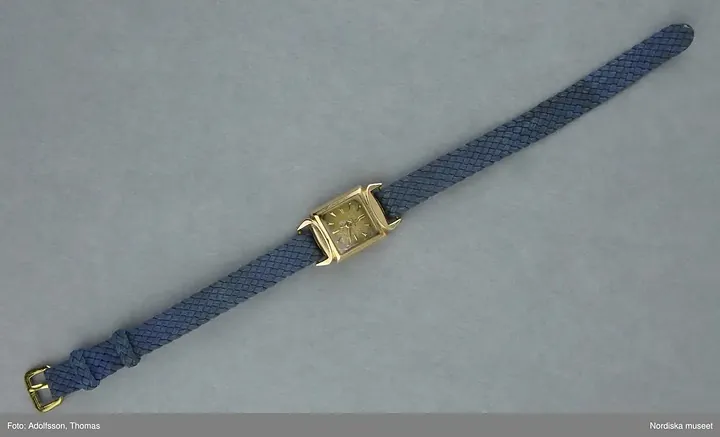
Wristwatch by Omega, Västerås, 1900–1999
Nordic Museum Foundation
Wristwatches · 1900–1999
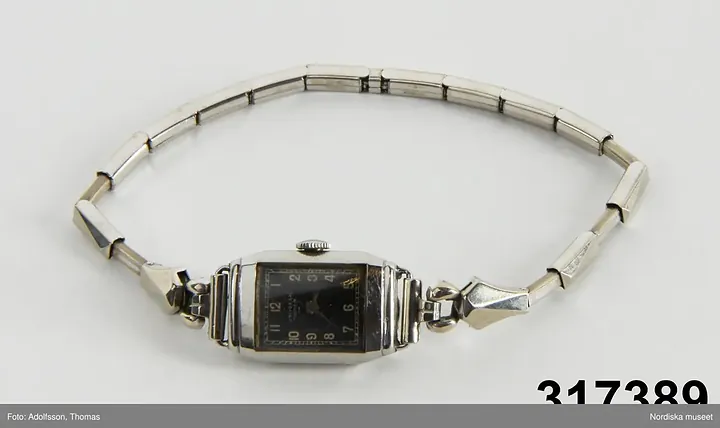
Wristwatch by Universal, Switzerland, 1900–1999
Nordic Museum Foundation