
Wristwatches · Wristwatch
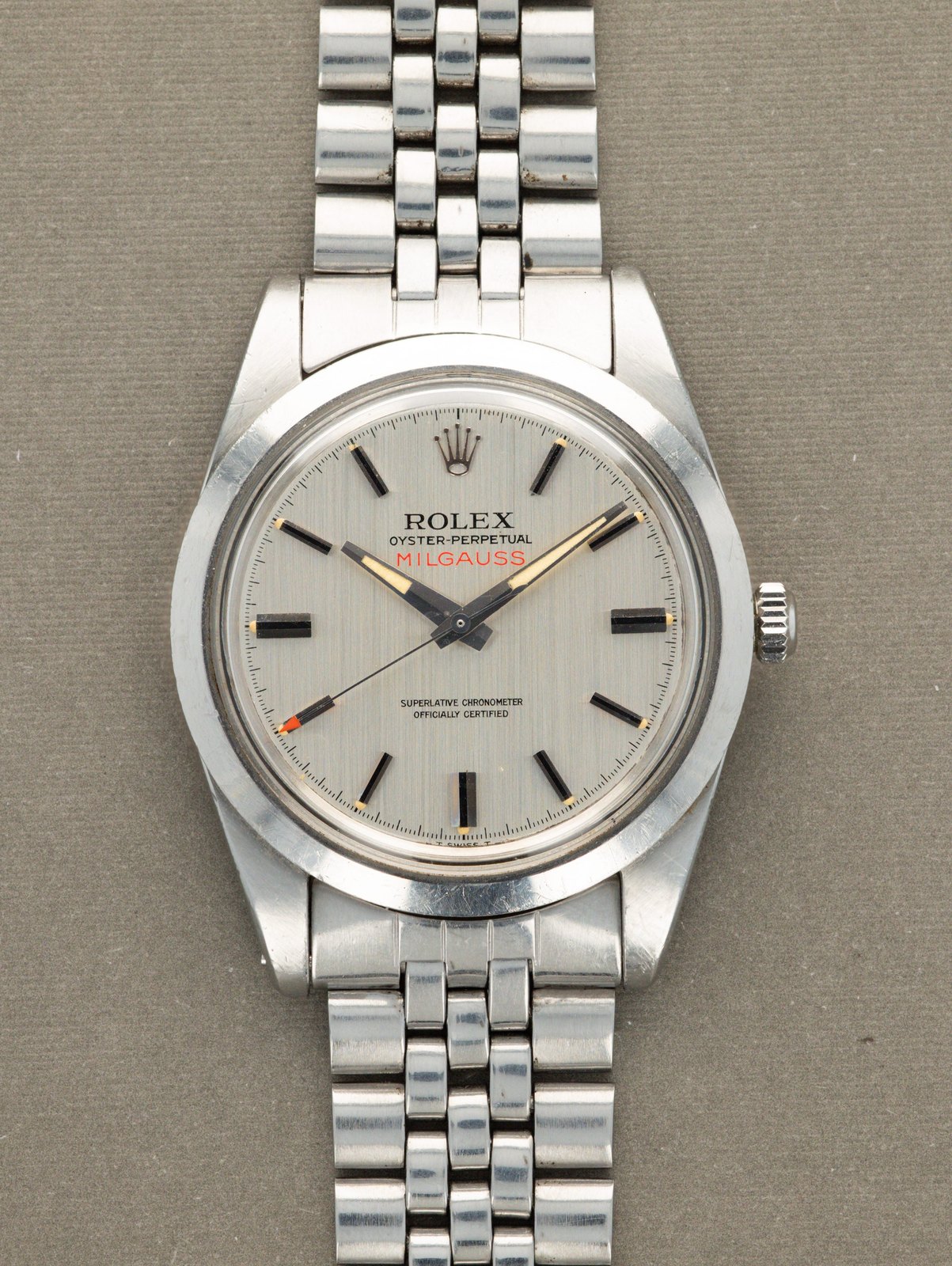
Rolex Milgauss ref. 1019, Brushed Silver Dial
- Maker / attribution
- Rolex (maker)
- Date
- c. 1970
- Historical period
- Quartz Revolution (1969 – 1990)
- Country of origin
- Switzerland
- Object type
- Wristwatch
- Materials / technique
- silver
- Stock no.
- OC2387
- Credit line
- Dealer listing, Oliver & Clarke (OC2387)
- Catalogue title (original)
- Rolex Milgauss Ref. 1019 - Brushed Silver Dial (English)
View the source record (dealer listing) ↗ (opens another website in a new tab)Suggest a correction
Record summary
Catalogued by Oliver & Clarke (dealer), United Kingdom (stock number OC2387), this is a wristwatch by Rolex, made in Switzerland, dated c. 1970. The Atlas places it in the Quartz Revolution period (1969 – 1990) of its Wristwatches collection. Materials and techniques recorded by the source: silver. The record is illustrated with 6 photographs.
Assembled from the source record's structured fields. Dates and attributions are given as the source states them; where a field is missing the Atlas leaves it blank rather than estimating.
Catalogue description
Dealer description — Oliver & Clarke
A Rolex for… nuclear scientists! Sounds crazy? Well, it’s the truth. First introduced in 1954, the Milgauss was named so because of its anti-magnetic resistance properties up to to one thousand gauss. A 'gauss' is a measure of magnetic activity, and as many watch enthusiasts can tell you, in the modern era of cellphones, computers, charging pads, etc., magnetism is the enemy of accurate timekeeping. So how do nuclear scientists a la Doc Brown factor into this equation? Well, during the post WWII years - there was a massive rise in nuclear studies for energy and arms and scientists who relied on their precision instrument watches needed a watch with anti-magnetic properties to resist the day-to-day exposure to these highly magnetic forces. Rolex along with a few other brands was happy to answer their call. The first two generations of the Milgauss, the Reference 6543 and 6541, were not a commercial success and are exceedingly rare as a result. The Ref. 6541 in particular is an amazing and highly desirable piece to behold, with standout features like a 'honeycomb' dial, a pop of red text on the dial (and in most cases on the rotating timing bezel), the striking 'lightning bolt' seconds hand (see what we did there?), and dare we say perfect case proportions. The DNA of the modern Milgauss was born here. After just a few short years of production, Rolex took the model back to the drawing board, threw most of the old watch away, and introduced the Ref. 1019 in 1960. In retrospect, this is a very un-Rolex thing to do, but the idea of the Milgauss and its name was preserved. The Ref. 1019 was also available with two dial options: a matte black, or a brushed silver. The example that we have here dates to circa 1970 and is a hell of a looker. It comes to us in fantastic overall condition, with a very likely-unpolished case that shows normal, honest wear from age and use, an unpolished bezel that shows matching wear, and fitted to a period-correct Jubilee bracelet — which, we think, pairs beautifully with the dial inside. This piece houses one of two dial variants: a vertically brushed silver unit with applied indices and a pop of red with the "Milgauss" text. Like the case, the condition is fantastic, showing some faint edge wear and minor lume-loss on the 11 o'clock plot, with a beautifully matching handset. The Milgauss is and always has been an underrated model next to it's other siblings from Rolexes 'Professional' line. And while vintage References like the one we have here no doubt have a cult following, they present great value when you consider the virtually perfect size and wearing experience, the beautiful dial options, and its relative rarity. This is a fantastic well-rounded example fit for any wrist and any occasion.
Historical context
Quartz Revolution (1969 – 1990)
Seiko's Astron begins mass quartz timekeeping; traditional industries contract sharply.
Quartz and digital watches transformed the market after 1969. Swiss employment collapsed, Japanese and Hong Kong production soared, and the Swatch (1983) helped the Swiss industry recover; mechanical watches survived as luxury goods.
Read the period in the timelineMore wristwatches from this periodEarlier: Modern Mechanical Horology
Atlas type guide
Wristwatches
Bracelet watches were worn by women from the early nineteenth century — Breguet made one for Caroline Murat, Queen of Naples, in 1810–12 — but the wristwatch only became a man's instrument with military use and aviation in the early twentieth century. Between the World Wars it overtook the pocket watch; the 1920s and 1930s brought rectangular Art Deco cases, water-resistant cases and the first automatic winding systems.
After 1945 the wristwatch became a carrier of identity — dress watches, sports and dive watches, chronographs, calendars — produced by Swiss, American, Japanese, German, Soviet and Chinese industries. The quartz revolution after 1969 and the mechanical renaissance since the 1990s, including the rise of independent watchmakers, complete the story.
What to look for
- The reference number (between the lugs or inside the case back) and serial number, the starting point for dating.
- The calibre: its maker and number are often stamped under the dial or on the bridge.
- Originality of dial, hands and crown — refinished ('redial') dials are common.
- Case material marks: 18K/750, 14K/585, stainless steel, gold-filled, plated.
Dating clues
- Wire-lug cases: before c. 1925.
- Water-resistant screw-down cases: from 1926.
- Quartz movements: from 1969; sapphire crystals widespread after c. 1980.
General guidance written by the Atlas editors about this kind of object. It is not a statement about this particular piece; for that, rely on the source record above and on physical examination.
Related records

Movements & Components · c. 1970s
Rolex watch movement, c. 1970s
Antiquorum auction archive, Geneva

Pocket Watches · 1982
Fake Rolex watch, gold coloured metal, possibly made in Taiwan, 1982; part of a casual outfit, UK, 1982-84.
Victoria and Albert Museum, London

Wristwatches · c. 1920s
Rolex wristwatch, c. 1920s
Antiquorum auction archive, Geneva

Wristwatches · c. 1920s
Rolex wristwatch, ref. 6194, c. 1920s
Antiquorum auction archive, Geneva

Wristwatches · 1970
Wristwatch by Heno, Switzerland, 1970
Museum Rotterdam

Wristwatches · 1960–1986
'Tri-Compax' calendar chronograph wristwatch in gold case, by Universal, Geneva, Switzerland, 1960–1986.
Science Museum Group, London

Wristwatches · 1969–1970
Beta 21 Quartz wristwatch movement, made in Switzerland, 1970.
Science Museum Group, London

Wristwatches · c. 1969
Omega Speedmaster Moonwatch, ref. 145022-69st, c. 1969
Antiquorum auction archive, Geneva