
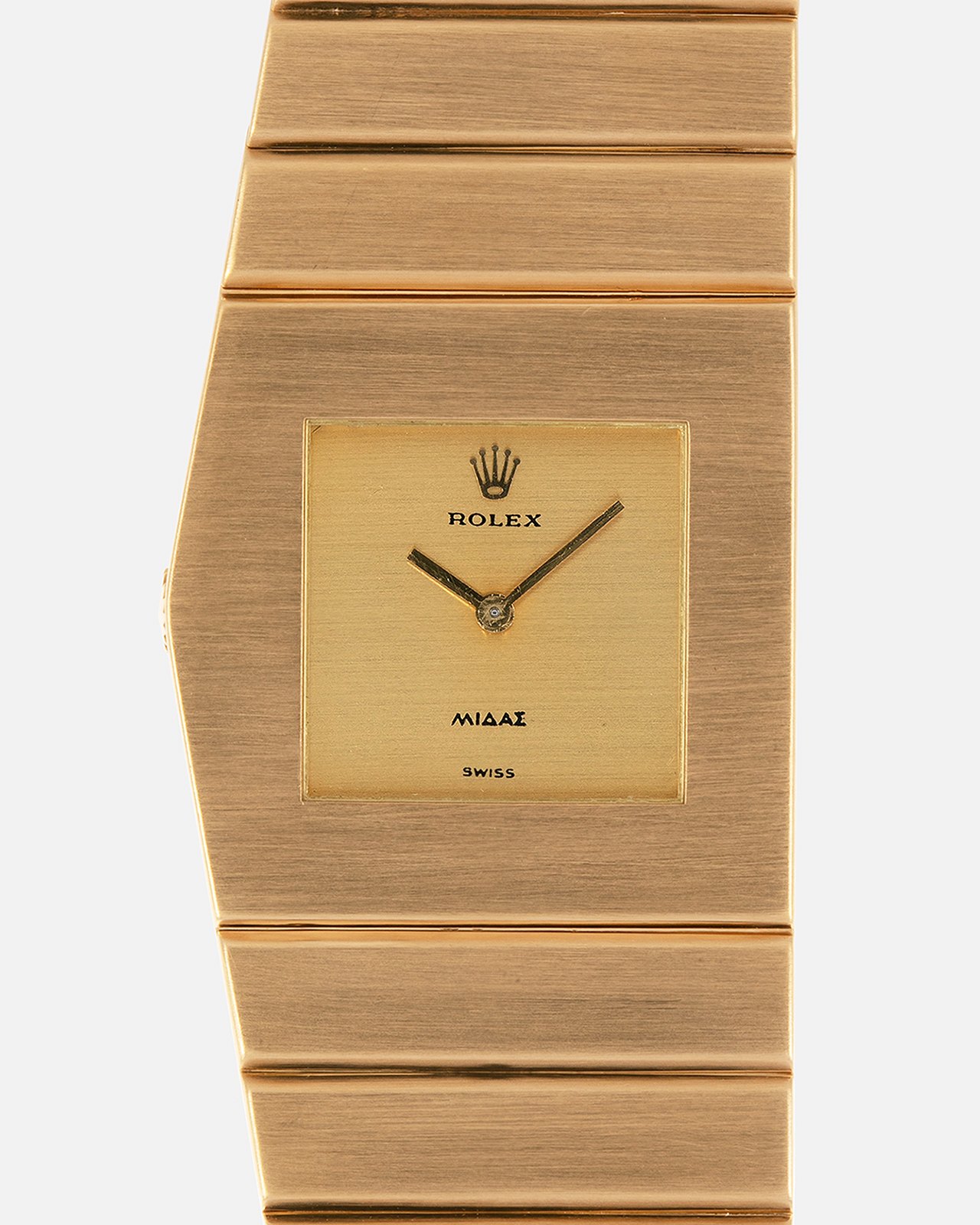
Wristwatches · Wristwatch
Rolex King Midas 3580 Second Series, 1974
- Maker / attribution
- Rolex (maker)
- Date
- 1974
- Historical period
- Quartz Revolution (1969 – 1990)
- Country of origin
- Switzerland
- Object type
- Wristwatch
- Stock no.
- Product 7301755076695
- Credit line
- Dealer listing, S.Song Watches (product 7301755076695)
- Catalogue title (original)
- Rolex King Midas 3580 Second Series (English)
View the source record (dealer listing) ↗ (opens another website in a new tab)Suggest a correction
Record summary
Catalogued by S.Song Watches (dealer), Seattle (stock number Product 7301755076695), this is a wristwatch by Rolex, made in Switzerland, dated 1974. The Atlas places it in the Quartz Revolution period (1969 – 1990) of its Wristwatches collection. The record is illustrated with 6 photographs.
Assembled from the source record's structured fields. Dates and attributions are given as the source states them; where a field is missing the Atlas leaves it blank rather than estimating.
Catalogue description
Dealer description — S.Song Watches
“Mighty,” “opulent,” and “majestic”—these are the words that I think perfectly capture the soul and the sublimity of the Rolex King Midas Ref. 3580. When this stunning piece first arrived at the office, I was completely taken aback—not just by its substantial heft, but also by its striking appearance. It is truly unlike any watch I’ve encountered and handled before and the presence it commands when you put it on your wrist is simply unmatched. Plus, knowing that this design was released by a brand like Rolex—famous for making some of the most iconic tool watches of all time—and that the legendary Gérald Genta had a hand in its creation elevates it to a whole other level. For those who may not know, the Rolex King Midas has three distinct generations throughout its production span. The first series, Ref. 9630, was a limited release, with fewer than 800 pieces produced in total: 144 pieces were made in 18-carat white gold and the rest in 18-carat yellow gold (all from a single block of gold!), plus a very small number featuring diamond dials. The second series, to which our example Ref. 3580 belongs, is not limited but had a shorter production run than the first, making it much rarer. One way to distinguish between the first and second series is by looking at the production number on the underside of the integrated bracelet; the Ref. 3580 is believed to have started with numbers from 800 (ours is #1057), with around 500 pieces produced—mostly in yellow gold and a few in white gold. Additionally, our specific example here is fitted with a minimalist champagne dial which bears the MIDAS (“ΜΙΔAΣ”) marking in Greek at 6:00, signifying it as an early example of the second series, as Rolex gradually transitioned to using “Cellini” dials instead. This change occurred because the King Midas was initially launched as a standalone collection before becoming fully integrated into the Cellini line within the second series. The third series, Ref. 4315, was introduced in 1977 and was only produced until 1979, featuring minor design updates such as a more consistent “Cellini” branding on the dial, a newer movement that is the Cal. 651, a thinner bracelet, as well as a single-fold clasp. This reference marks the final series of the “asymmetrical” case Midas line before Rolex shifted to a more traditional square case design. In the style and approach of the late legendary Gérald Genta—who famously drew inspiration from objects when it came to his watch designs, such as a diving helmet for the Audemars Piguet Royal Oak and a ship’s porthole for the Patek Nautilus—the concept of the King Midas features an unconventional and asymmetrical case design inspired by the silhouette of the Parthenon Temple of Athena in Greece, symbolizing the Temple of the Gods. When viewed from the side, the triangular tip of the pentagonal case resembles the temple's roof, while the grooves of the exquisite bracelet evoke its majestic columns. Continuing on the theme of Greek mythology, the watch is named "King Midas" as a tribute to the mythological legend where everything he touched with his proverbial left hand turned to gold. This is poetically reflected in the saw-toothed crown positioned on the left side of the case, symbolizing the sun's dominance over Mount Olympus, and is flanked by the engraving “KING MIDAS” on each side. Given that this is an early example from the second series, it is powered by the ultra-thin, 17-jeweled, manual-winding Cal. 650, which was developed by Piaget. In contrast, some of the later models in this series were equipped with the newer and updated (at the time) Cal. 651, which also appeared in the subsequent third series of Ref. 4315s. With all that said, while the King Midas may not appeal to everyone, if you have the wrist and taste for it, I wholeheartedly recommend taking a closer look—and, if you can, experiencing it in person; this watch is a real showstopper.
Historical context
Quartz Revolution (1969 – 1990)
Seiko's Astron begins mass quartz timekeeping; traditional industries contract sharply.
Quartz and digital watches transformed the market after 1969. Swiss employment collapsed, Japanese and Hong Kong production soared, and the Swatch (1983) helped the Swiss industry recover; mechanical watches survived as luxury goods.
Read the period in the timelineMore wristwatches from this periodEarlier: Modern Mechanical Horology
Atlas type guide
Wristwatches
Bracelet watches were worn by women from the early nineteenth century — Breguet made one for Caroline Murat, Queen of Naples, in 1810–12 — but the wristwatch only became a man's instrument with military use and aviation in the early twentieth century. Between the World Wars it overtook the pocket watch; the 1920s and 1930s brought rectangular Art Deco cases, water-resistant cases and the first automatic winding systems.
After 1945 the wristwatch became a carrier of identity — dress watches, sports and dive watches, chronographs, calendars — produced by Swiss, American, Japanese, German, Soviet and Chinese industries. The quartz revolution after 1969 and the mechanical renaissance since the 1990s, including the rise of independent watchmakers, complete the story.
What to look for
- The reference number (between the lugs or inside the case back) and serial number, the starting point for dating.
- The calibre: its maker and number are often stamped under the dial or on the bridge.
- Originality of dial, hands and crown — refinished ('redial') dials are common.
- Case material marks: 18K/750, 14K/585, stainless steel, gold-filled, plated.
Dating clues
- Wire-lug cases: before c. 1925.
- Water-resistant screw-down cases: from 1926.
- Quartz movements: from 1969; sapphire crystals widespread after c. 1980.
General guidance written by the Atlas editors about this kind of object. It is not a statement about this particular piece; for that, rely on the source record above and on physical examination.
Related records

Movements & Components · c. 1970s
Rolex watch movement, c. 1970s
Antiquorum auction archive, Geneva

Pocket Watches · 1982
Fake Rolex watch, gold coloured metal, possibly made in Taiwan, 1982; part of a casual outfit, UK, 1982-84.
Victoria and Albert Museum, London

Wristwatches · c. 1920s
Rolex wristwatch, c. 1920s
Antiquorum auction archive, Geneva

Wristwatches · c. 1920s
Rolex wristwatch, ref. 6194, c. 1920s
Antiquorum auction archive, Geneva

Wristwatches · 1970
Wristwatch by Heno, Switzerland, 1970
Museum Rotterdam

Wristwatches · 1960–1986
'Tri-Compax' calendar chronograph wristwatch in gold case, by Universal, Geneva, Switzerland, 1960–1986.
Science Museum Group, London

Wristwatches · 1969–1970
Beta 21 Quartz wristwatch movement, made in Switzerland, 1970.
Science Museum Group, London

Wristwatches · c. 1969
Omega Speedmaster Moonwatch, ref. 145022-69st, c. 1969
Antiquorum auction archive, Geneva