
Wristwatches · Wristwatch
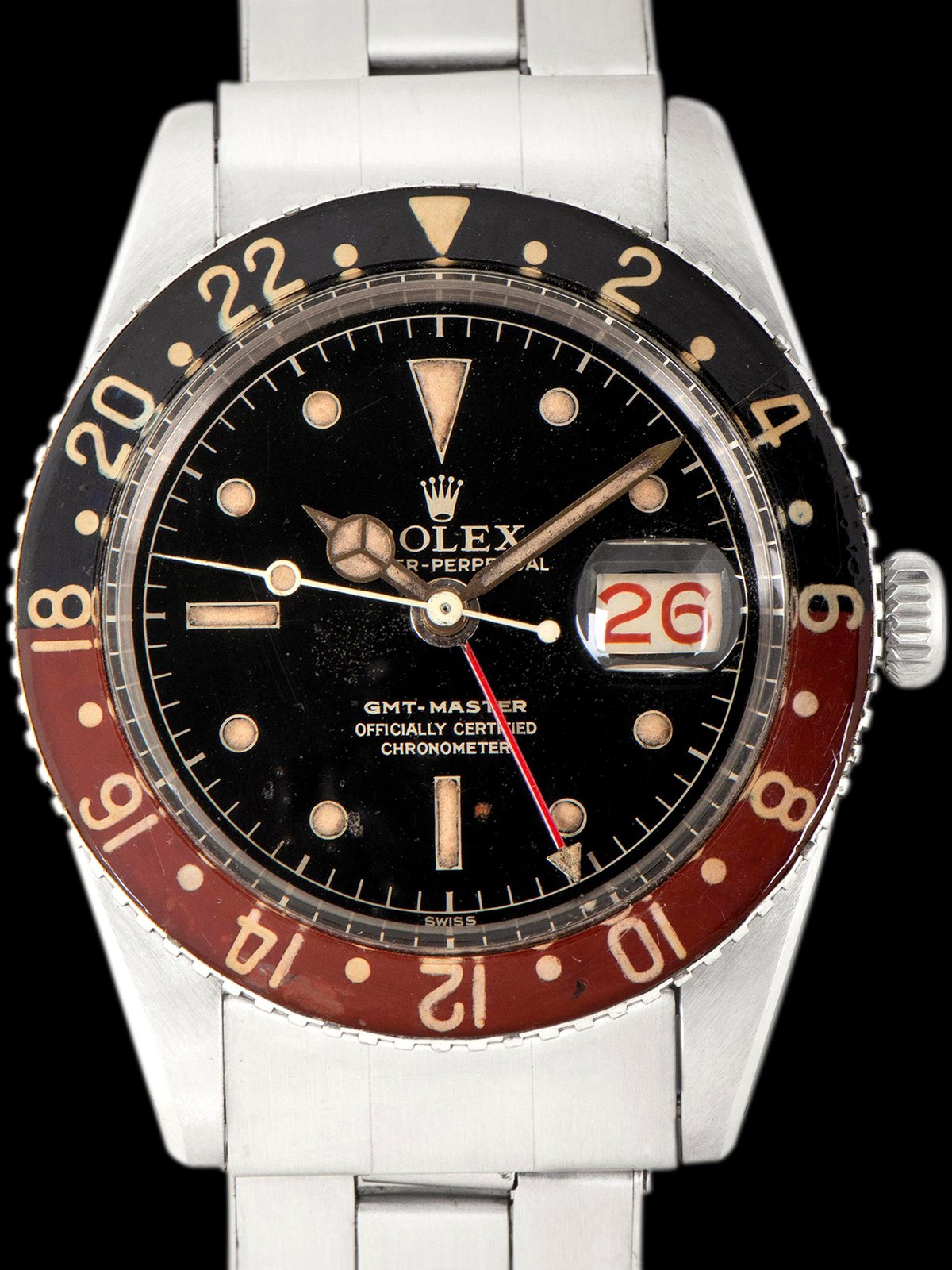
Rolex GMT-Master (Ref. 6542) Gilt "Chapter Ring" Dial, 1958
- Maker / attribution
- Rolex (maker)
- Date
- 1958
- Historical period
- Modern Mechanical Horology (1945 – 1969)
- Country of origin
- Switzerland
- Object type
- Wristwatch
- Dimensions
- Case 38 mm
- Stock no.
- RLXGMT6542
- Credit line
- Dealer listing, Craft & Tailored (RLXGMT6542)
- Catalogue title (original)
- 1958 Rolex GMT-Master (Ref. 6542) Gilt "Chapter Ring" Dial (English)
View the source record (dealer listing) ↗ (opens another website in a new tab)Suggest a correction
Record summary
Catalogued by Craft & Tailored (dealer), Los Angeles (stock number RLXGMT6542), this is a wristwatch by Rolex, made in Switzerland, dated 1958. The Atlas places it in the Modern Mechanical Horology period (1945 – 1969) of its Wristwatches collection. Recorded dimensions: Case 38 mm. The record is illustrated with 6 photographs.
Assembled from the source record's structured fields. Dates and attributions are given as the source states them; where a field is missing the Atlas leaves it blank rather than estimating.
Catalogue description
Dealer description — Craft & Tailored
The Rolex GMT-Master, a symbol of sophistication and versatility, has a storied history that dates back to 1954. It all started when Rolex received a request from Pan American Airways (Pan Am) to develop a technical pilot's watch capable of displaying two time zones simultaneously. With the advent of commercial transcontinental flights, Pan Am needed a watch for their long-haul international flight crews that would enable them to keep track of time in multiple locations. Out of this request, the Rolex GMT-Master was born, with the reference 6542, the very first GMT-Master. Functionality was at the forefront of the original design for the GMT-Master, formed through the recommendations of Pan Am pilots directly, which actually helped the inspiration for the red and blue bezel color scheme that was later affectionately nicknamed the "Pepsi" bezel. Following suit with the other Rolex "sport" models of the time, like the Submariner which was introduced a year prior, the ref. 6542 featured a 38mm case with no crown guards, a rotating bezel, and a screw-down crown. However, the GMT-Master was differentiated by being the first sports model fitted with a date complication as well as the revolutionary additional 24-hour hand. GMT, which stands for Greenwich Mean Time, is the universal time standard that regulates the world's clocks and is the basis for aviation planning and schedules. The Rolex GMT-Master has a fourth 24-hour hand that displays the same time zone as the standard 12-hour hand but on a 24-hour scale. This GMT hand allows wearers to set the watch to GMT or any other time zone and then adjust the offset using the rotating 24-hour bezel to display a second time zone. This remarkable feature makes the Rolex GMT-Master a must-have for anyone who frequently travels across multiple time zones, allowing them to easily and precisely track two time zones. Stock # RLXGMT6542 Brand Rolex Style GMT-Master Model 6542 Serial 47XXXX Size Men's Material Stainless Steel Dial Glossy Black, Gilt "Chapter Ring" Millimeters 38 Bracelet Rolex C+I "USA" Oyster Rivet Bracelet CASE & BRACELET The excellent and early no-crown-guard case was recently professionally polished to display era-correct, factory-like dimensions, angles, and chamfers, showing minimal signs of previous wear. The bakelite "Pepsi" bezel insert appears to be a very early tritium service unit and is in great overall condition, showing honest signs of use and a subtle crack next to 4 o'clock, which is expected. The lume in the bezel has achieved a lovely creamy beige patina that matches the dial nicely and exhibits no degradation under UV light inspection. The inside of the case back is stamped IV. 1958. The watch comes supplied on a later Rolex C+I "USA Made" Oyster rivet bracelet dated to 1964. The bracelet retains 11 links that show light stretch and will fit up to a 7 1/2-inch wrist. DIAL & HANDS The original glossy black "OCC" gilt chapter ring dial is in beautifully preserved condition, retaining the glossy finish throughout with subtle speckling present around the center of the dial and some age spots present between the 5 and 8 o'clock markers. The original radium lume plots remain full and round exhibiting no notable degradation under UV light inspection and feature a charming golden-beige patina. The original radium-lumed gilt hands match the dial perfectly and exhibit no degradation when inspected under UV light. The "roulette" date wheel is original featuring "open" 6's and 9's with alternating red and black numerals. ACCESSORIES None. The watch is keeping time, but the service history is unknown. A movement service can be provided upon request.
Historical context
Modern Mechanical Horology (1945 – 1969)
Tool watches for divers, pilots and astronauts; electric watches anticipate the electronic age.
The classic era of the mechanical wristwatch: dive watches, chronographs for motor racing and space flight, GMT watches for jet travel, slim dress watches, automatic calendars, and the rise of Japanese manufacturers alongside Swiss, American, German and Soviet industries.
Read the period in the timelineMore wristwatches from this periodEarlier: Golden Age of Mechanical Watchmaking
Atlas type guide
Military, pilot and travel watches
The wristwatch owes much of its adoption by men to warfare and aviation. Wristlets — small pocket watches soldered with lugs and worn on a strap — were used in colonial campaigns and became standard equipment in the First World War, with protective grilles over the crystal ('shrapnel guards'). Louis Cartier's Santos (1904), designed for the aviator Alberto Santos-Dumont, is often cited as an early purpose-made pilot's watch.
In the Second World War governments specified watches in detail: the German B-Uhr observation watches, the American A-11, and the British 'W.W.W.' (the 'Dirty Dozen' set of 1945). After the war, jet travel brought GMT and world-time watches, which show two or more time zones at once — Louis Cottier's world-time mechanism and the Rolex GMT-Master (1955) are examples.
What to look for
- Military markings on the case back: broad arrow, issue numbers, 'W.W.W.', 'A.T.P.'
- High-legibility black dials with luminous Arabic numerals; oversized crowns for gloved hands.
- 24-hour hands and rotating 24-hour bezels or city rings on GMT/world-time watches.
- Wire lugs on early wristlets converted from pocket watches.
Dating clues
- Wire-lug wristlets: c. 1900–1925.
- Military specifications of the Second World War: 1939–1945.
- GMT and world-time wristwatches: mainly after 1950.
General guidance written by the Atlas editors about this kind of object. It is not a statement about this particular piece; for that, rely on the source record above and on physical examination.
Related records

Movements & Components · c. 1970s
Rolex watch movement, c. 1970s
Antiquorum auction archive, Geneva

Pocket Watches · 1982
Fake Rolex watch, gold coloured metal, possibly made in Taiwan, 1982; part of a casual outfit, UK, 1982-84.
Victoria and Albert Museum, London

Wristwatches · c. 1920s
Rolex wristwatch, c. 1920s
Antiquorum auction archive, Geneva

Wristwatches · c. 1920s
Rolex wristwatch, ref. 6194, c. 1920s
Antiquorum auction archive, Geneva

Wristwatches · 1945
Wristwatch by Eterna, 1945
Museum Rotterdam

Wristwatches · c. 1945
Breitling Premier, ref. 790, c. 1945
Antiquorum auction archive, Geneva

Wristwatches · c. 1945
Universal Genève Uni-Compax, ref. 22492, c. 1945
Antiquorum auction archive, Geneva

Wristwatches · c. 1950s
Baume & Mercier wristwatch, c. 1950s
Antiquorum auction archive, Geneva