
Wristwatches · Wristwatch
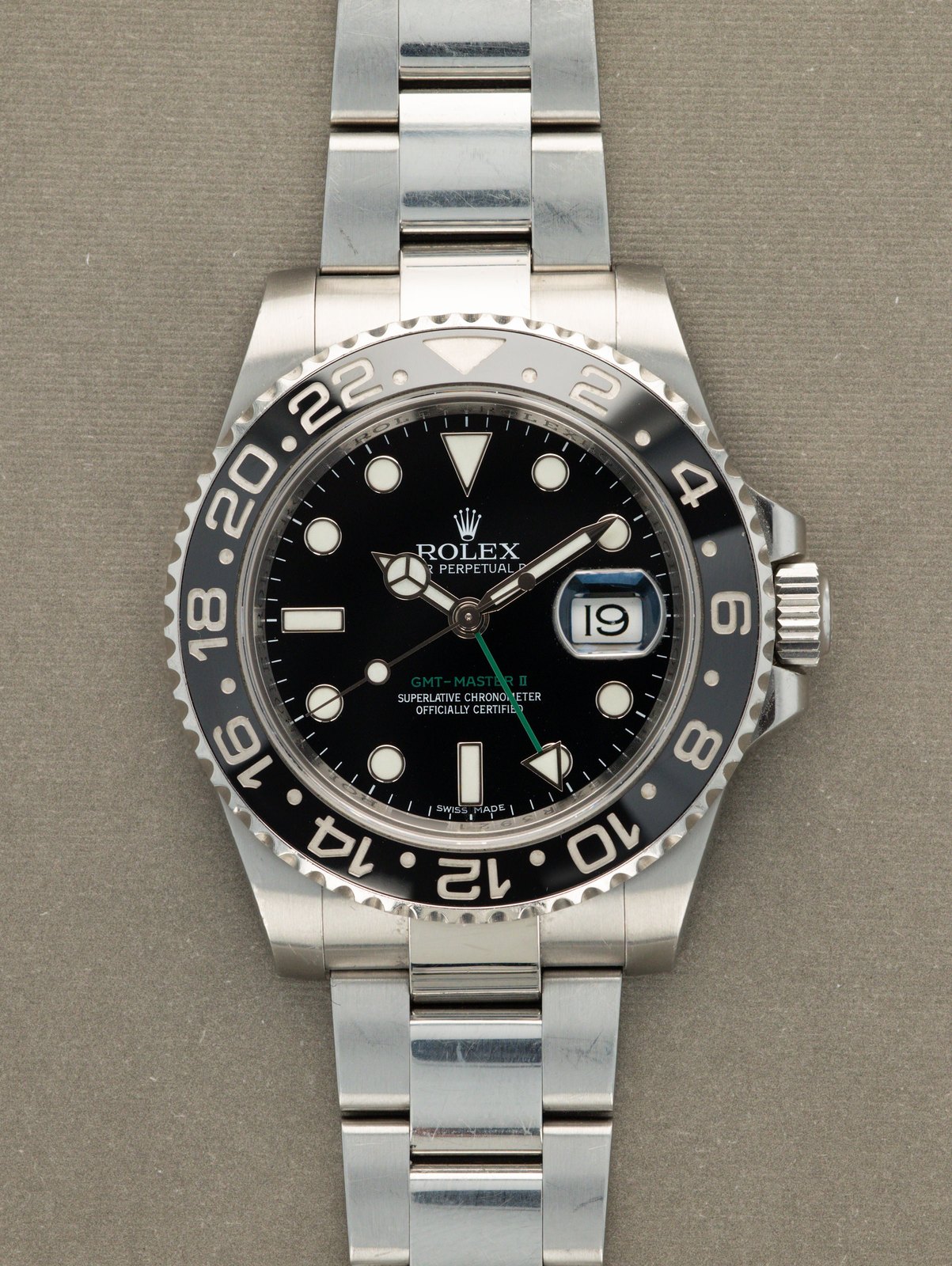
Rolex GMT-Master II ref. 116710LN, 'Ceramic'
- Maker / attribution
- Rolex (maker)
- Date
- c. early 2010s
- Historical period
- Contemporary Horology (2010 – Present)
- Country of origin
- Switzerland
- Object type
- Wristwatch
- Materials / technique
- ceramic
- Dimensions
- Case 40 mm
- Stock no.
- OC2366
- Credit line
- Dealer listing, Oliver & Clarke (OC2366)
- Catalogue title (original)
- Rolex GMT-Master II Ref. 116710LN - 'Ceramic' w/ Box & Card (English)
View the source record (dealer listing) ↗ (opens another website in a new tab)Suggest a correction
Record summary
Catalogued by Oliver & Clarke (dealer), United Kingdom (stock number OC2366), this is a wristwatch by Rolex, made in Switzerland, dated c. early 2010s. The Atlas places it in the Contemporary Horology period (2010 – Present) of its Wristwatches collection. Materials and techniques recorded by the source: ceramic. Recorded dimensions: Case 40 mm. The record is illustrated with 6 photographs.
Assembled from the source record's structured fields. Dates and attributions are given as the source states them; where a field is missing the Atlas leaves it blank rather than estimating.
Catalogue description
Dealer description — Oliver & Clarke
The Rolex GMT-Master is one of the most historic and iconic watches the brand ever produced. Its origin dates back to a commission request by Pan American World Airways in the early 50’s for their fleet of pilots who needed access to different time zones. These pieces would feature a similar design to another watch that Rolex was developing around that time, the Submariner, but would include a fourth hand running on 24-hr time, and a bi-colored bezel insert to represent AM/PM times. Those colors, naturally, would be the PanAm colors: Red & Blue. Thus, in 1953, the Ref. 6542 GMT-Master was born. These early pieces were ultimately, fragile arguably flawed in some ways, and were therefor succeeded by the updated Reference 1675 in 1959. Like many Rolex models, the 1675 underwent many small changes over its 21-year production run, with a slew of dial, bezel, bracelet, and hand variations, and would eventually evolve into the 5-digit GMT-Master and GMT-Master IIs, followed by the first of the 6-digit References in the late 2000s. The introduction of the 6-digit pieces was almost certainly the most thorough update to any previous GMT-Master. These would carry over the movement from the last of the 5-digit Ref. 16710s and introduced: an updated gloss black dial with enlarged 'Maxi' indices, a larger 40mm 'Maxi' or 'Super' case with widened lugs and a more square profile, an updated solid steel Oyster bracelet with polished center links and a matching updated clasp with Rolex's outstanding Easylink extension system, and perhaps most importantly, a black 24hr bezel insert made of ceramic. All of these changes amounted to a very different watch than what fans were used to and was met with some controversy and negative feedback. Of course, any negativity would have been purely subjective and it didn't take long for for some of the negativity to fade after enthusiasts began getting hands-on time and wearing these for awhile (along with ceramic-bezel Submariners). The long requested bracelet updates, the improved durability, and the thoroughly modern and fresh look was eventually praised by many, which largely continues on to this day. The piece that we have here was the very first Reference introduced with the updates mentioned above: the Ref. 116710LN. This piece dates to circa the early 2010s and shows its age with normal signs of wear throughout. By design, the black ceramic bezel insert remains in flawless condition, showing no wear or fade. The dial within features green "GMT-Master II" text on the bottom half with a matching green 24hr hand. The dial and hands also show no signs of wear or patina, with its white gold indices and handset utilizing Rolex's blue-glowing 'Chromalight' lume within. Last but not least, this piece comes fitted to its correct updated Oyster bracelet, which we simply cannot stress enough how incredibly handy and functional Rolex's Easylink system is. Built into the fliplock clasp, a 5mm extension can be effortlessly deployed for when it gets warmer out and your wrist expands. When compared to its more colorful siblings, these black-bezel examples are a bit slept on, and as a result, remain bargains on the secondary market. And , we think, there is something to be said about the fact that these look like a Submariner Date from a few feet away.
Historical context
Contemporary Horology (2010 – Present)
Silicon components, connected watches, optical-lattice research clocks and a thriving independent scene.
Smartwatches became the world's best-selling watches, while mechanical watchmaking focuses on craft, innovation (silicon components, new escapements) and independent makers.
Read the period in the timelineMore wristwatches from this periodEarlier: Mechanical Renaissance
Atlas type guide
Military, pilot and travel watches
The wristwatch owes much of its adoption by men to warfare and aviation. Wristlets — small pocket watches soldered with lugs and worn on a strap — were used in colonial campaigns and became standard equipment in the First World War, with protective grilles over the crystal ('shrapnel guards'). Louis Cartier's Santos (1904), designed for the aviator Alberto Santos-Dumont, is often cited as an early purpose-made pilot's watch.
In the Second World War governments specified watches in detail: the German B-Uhr observation watches, the American A-11, and the British 'W.W.W.' (the 'Dirty Dozen' set of 1945). After the war, jet travel brought GMT and world-time watches, which show two or more time zones at once — Louis Cottier's world-time mechanism and the Rolex GMT-Master (1955) are examples.
What to look for
- Military markings on the case back: broad arrow, issue numbers, 'W.W.W.', 'A.T.P.'
- High-legibility black dials with luminous Arabic numerals; oversized crowns for gloved hands.
- 24-hour hands and rotating 24-hour bezels or city rings on GMT/world-time watches.
- Wire lugs on early wristlets converted from pocket watches.
Dating clues
- Wire-lug wristlets: c. 1900–1925.
- Military specifications of the Second World War: 1939–1945.
- GMT and world-time wristwatches: mainly after 1950.
General guidance written by the Atlas editors about this kind of object. It is not a statement about this particular piece; for that, rely on the source record above and on physical examination.
Related records

Movements & Components · c. 1970s
Rolex watch movement, c. 1970s
Antiquorum auction archive, Geneva

Pocket Watches · 1982
Fake Rolex watch, gold coloured metal, possibly made in Taiwan, 1982; part of a casual outfit, UK, 1982-84.
Victoria and Albert Museum, London

Wristwatches · c. 1920s
Rolex wristwatch, c. 1920s
Antiquorum auction archive, Geneva

Wristwatches · c. 1920s
Rolex wristwatch, ref. 6194, c. 1920s
Antiquorum auction archive, Geneva

Wristwatches · c. 2010s
Breguet Type XXI, ref. 3810, c. 2010s (Antiquorum Lot 381-24)
Antiquorum auction archive, Geneva

Wristwatches · c. 2010s
Breguet Type XXI, ref. 3810, c. 2010s (Antiquorum Lot 386-229)
Antiquorum auction archive, Geneva

Wristwatches · Sold in September 2010
Breitling Cosmonaute, ref. A 22322, Sold in September 2010
Antiquorum auction archive, Geneva

Wristwatches · c. 2010
Corum Bubble Chrono, ref. 396.150.20, c. 2010
Antiquorum auction archive, Geneva