
Wristwatches · Wristwatch
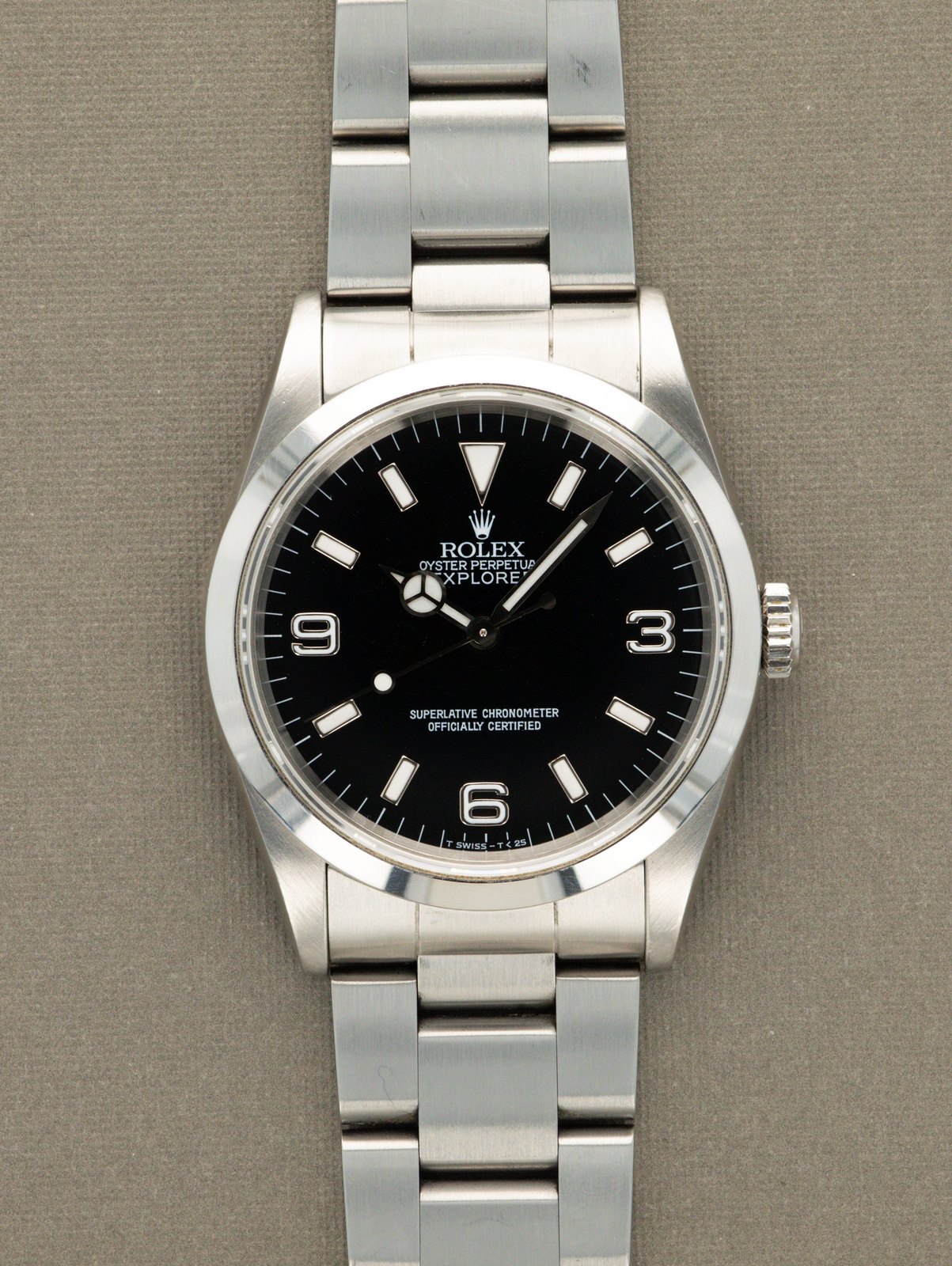
Rolex Explorer ref. 14270, 'Tritium' Dial
- Maker / attribution
- Rolex (maker)
- Date
- c. 1996
- Historical period
- Mechanical Renaissance (1990 – 2010)
- Country of origin
- Switzerland
- Object type
- Wristwatch
- Stock no.
- OC2994
- Credit line
- Dealer listing, Oliver & Clarke (OC2994)
- Catalogue title (original)
- Rolex Explorer Ref. 14270 - 'Tritium' Dial (English)
View the source record (dealer listing) ↗ (opens another website in a new tab)Suggest a correction
Record summary
Catalogued by Oliver & Clarke (dealer), United Kingdom (stock number OC2994), this is a wristwatch by Rolex, made in Switzerland, dated c. 1996. The Atlas places it in the Mechanical Renaissance period (1990 – 2010) of its Wristwatches collection. The record is illustrated with 6 photographs.
Assembled from the source record's structured fields. Dates and attributions are given as the source states them; where a field is missing the Atlas leaves it blank rather than estimating.
Catalogue description
Dealer description — Oliver & Clarke
May 29, 1953 After an arduous journey starting on March 10th of 1953, and an extremely difficult assault on the summit, Tenzing Norgay and Sir Edmund Hillary became the first people to successfully summit Mt. Everest. On their wrist? NOT a Rolex Explorer. Whoops. Well, to be fair the Rolex Explorer wasn’t created yet. So why the hullabaloo about Sir Edmund Hillary? Well - he was wearing a Rolex. A Rolex Oyster Perpetual. After hearing of the success of this expedition and ruggedness of the watch - the decision was made to replace the Oyster Perpetual with a new model named in Hillary’s honor - The Explorer. Or so the story goes. Either way, the Rolex Explorer I was introduced in 1953 but like many Rolex models, the first series was not considered ‘the best’ reference. For many collectors, the most desirable Explorer I reference is the 1016, but of course like nearly everything in the world of watches, this is subjective... The 1016's replacement, the Ref. 14270 was a major departure from the 1016s, utilizing a glossy black dial with applied white gold indices, a sapphire crystal, and was naturally met with some negative feedback at launch. Of course, any negativity would have been purely subjective and it didn't take long for for some of the negativity to fade after enthusiasts began getting hands-on time and wearing these for awhile. Like so many other reference, this model underwent a series of changes over its roughly 12-year production run and is typically broken down into three different variants, each with their own appeal. The early pieces had Tritium indices and handsets, whereas models produced after 1997-1998 introduced Luminova units. The third variants showed up around 1999 with the only real difference to the previous variant being the utilization of SuperLuminova for its luminous properties. Additionally, in the mid 1990s the brand shifted from a more traditional blade-style clasp to a fliplock for this 14270, and the earliest examples up until about 1993 still features lug holes on their cases. The example that we have here is a 'T-serial' dating to circa 1996. It comes to us in fantastic overall condition, with an excellent Oyster case, correct smooth steel bezel, and correct Oyster bracelet with a blade clasp — all of which show matching light wear throughout. The dial within features the white-painted 3, 6, & 9 markers and Tritium-filled white gold indices surrounding them. It remains clear and glossy, seemingly devoid of any 'spidering' or 'stippling.' The handset matches the dial beautifully. These early 14270s in particular are fantastic daily wearers — perhaps even perfect. The updated sapphire crystal and deep glossy black dial combined with more traditional features like the Tritium dial elements and simple blade clasp on the bracelet amount to something that has a foot in the worlds of both modern and vintage. The very definition of neo-vintage.
Historical context
Mechanical Renaissance (1990 – 2010)
Mechanical watches return as cultural objects; independent watchmaking flourishes.
Mechanical watches returned as cultural and luxury objects. Complications, tourbillons and new materials proliferated; independent watchmakers such as George Daniels, F.P. Journe and Philippe Dufour revived artisanal watchmaking; collecting vintage watches became a major field.
Read the period in the timelineMore wristwatches from this periodEarlier: Quartz Revolution
Atlas type guide
Wristwatches
Bracelet watches were worn by women from the early nineteenth century — Breguet made one for Caroline Murat, Queen of Naples, in 1810–12 — but the wristwatch only became a man's instrument with military use and aviation in the early twentieth century. Between the World Wars it overtook the pocket watch; the 1920s and 1930s brought rectangular Art Deco cases, water-resistant cases and the first automatic winding systems.
After 1945 the wristwatch became a carrier of identity — dress watches, sports and dive watches, chronographs, calendars — produced by Swiss, American, Japanese, German, Soviet and Chinese industries. The quartz revolution after 1969 and the mechanical renaissance since the 1990s, including the rise of independent watchmakers, complete the story.
What to look for
- The reference number (between the lugs or inside the case back) and serial number, the starting point for dating.
- The calibre: its maker and number are often stamped under the dial or on the bridge.
- Originality of dial, hands and crown — refinished ('redial') dials are common.
- Case material marks: 18K/750, 14K/585, stainless steel, gold-filled, plated.
Dating clues
- Wire-lug cases: before c. 1925.
- Water-resistant screw-down cases: from 1926.
- Quartz movements: from 1969; sapphire crystals widespread after c. 1980.
General guidance written by the Atlas editors about this kind of object. It is not a statement about this particular piece; for that, rely on the source record above and on physical examination.
Related records

Movements & Components · c. 1970s
Rolex watch movement, c. 1970s
Antiquorum auction archive, Geneva

Pocket Watches · 1982
Fake Rolex watch, gold coloured metal, possibly made in Taiwan, 1982; part of a casual outfit, UK, 1982-84.
Victoria and Albert Museum, London

Wristwatches · c. 1920s
Rolex wristwatch, c. 1920s
Antiquorum auction archive, Geneva

Wristwatches · c. 1920s
Rolex wristwatch, ref. 6194, c. 1920s
Antiquorum auction archive, Geneva

Wristwatches · 2008
Wristwatch by Breitling?, 2008
Museum Rotterdam

Wristwatches · c. 1990s
Audemars Piguet Bamboo, c. 1990s
Antiquorum auction archive, Geneva

Wristwatches · c. 1990
Audemars Piguet Huitieme Perpetual Calendar, ref. 25696PT, c. 1990
Antiquorum auction archive, Geneva

Wristwatches · c. 1990
Breitling Chronomat, ref. b13050.1, c. 1990
Antiquorum auction archive, Geneva