
Wristwatches · Wristwatch
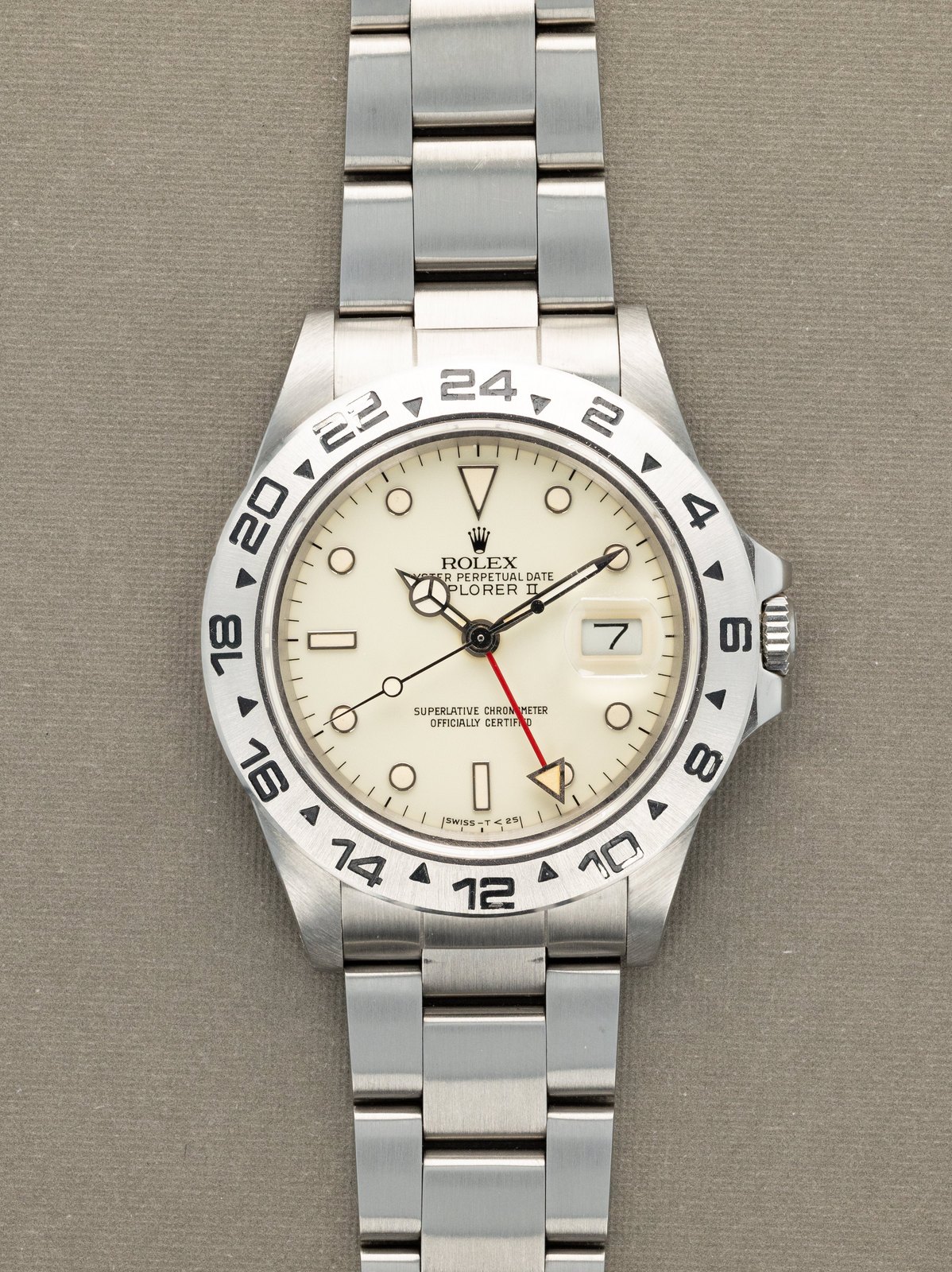
Rolex Explorer II ref. 16550, Cream 'Rail' Dial
- Maker / attribution
- Rolex (maker)
- Date
- c. 1987
- Historical period
- Quartz Revolution (1969 – 1990)
- Country of origin
- Switzerland
- Object type
- Wristwatch
- Stock no.
- OC2770
- Credit line
- Dealer listing, Oliver & Clarke (OC2770)
- Catalogue title (original)
- Rolex Explorer II Ref. 16550 - Cream 'Rail' Dial W/ Box & Papers (English)
View the source record (dealer listing) ↗ (opens another website in a new tab)Suggest a correction
Record summary
Catalogued by Oliver & Clarke (dealer), United Kingdom (stock number OC2770), this is a wristwatch by Rolex, made in Switzerland, dated c. 1987. The Atlas places it in the Quartz Revolution period (1969 – 1990) of its Wristwatches collection. The record is illustrated with 6 photographs.
Assembled from the source record's structured fields. Dates and attributions are given as the source states them; where a field is missing the Atlas leaves it blank rather than estimating.
Catalogue description
Dealer description — Oliver & Clarke
The Rolex Explorer’s core has always been in rugged expedition. While it was originally born out of the Everest celebratory Explorer I - the Explorer II was designed for cave diving. Officially known as spelunking ! While the initial run of Explorer II, the Reference 1655, or 'McQueen' ( spoiler: there is no evidence of a connection or that he ever wore one, but the nickname stuck! ) had black dials with orange accents, while later iterations like the Ref. 16570 added a white dial to the mix. These are commonly referred to as ‘Polar’ dials and they are among the most striking Rolex dials of the last 40 years or so, due to their monochromatic scheme with gloss white dials and blackened outer white gold indices. The watch that we have here, however, is something slightly different to your typical 'Polar.' Prior to the release of the long-running Ref. 16570, there was the Reference 16550 — the first 'Polar.' On the surface these look nearly identical to their successor, but when you look a little closer, there are a few differences, with the most notable being the dial. Ultimately because of the way that these dials were produced, a small run of these early pieces have aged over the years to a variety of cream-tones. The piece that we have here, is one of those early watches. Dating to circa 1987, it comes from nearly the end of Ref. 16550 production and is offered in outstanding overall condition. The case has been professionally refurbished to factory specification, with thick and symmetrical lugs and beautiful chamfers present. The steel 24-hr bezel retains strong finishing and shows only minimal loss of the black paint within the engraved numerals. The real highlight here, however, is that dial. It has aged to a desirable cream tone, and what make this particular piece even more compelling , is the patina that the indices exhibit. Generally, the Tritium-filled white gold indices retain a white or slightly off-white color, but this example has also patinated to a rich cream-tone. The result is a one of the finest 16550 dials that we have ever come across. The handset also matches the dial beautifully both to the naked eye and under UV inspection. Rounding out the package, this piece is accompanied by its inner and outer boxes, booklets, green vinyl folder, and punched papers dated 2/27/1987. All things considered, this is an excellent and compelling example of a neo-vintage model with a cult following, and frankly, are surfacing less and less on the open market.
Historical context
Quartz Revolution (1969 – 1990)
Seiko's Astron begins mass quartz timekeeping; traditional industries contract sharply.
Quartz and digital watches transformed the market after 1969. Swiss employment collapsed, Japanese and Hong Kong production soared, and the Swatch (1983) helped the Swiss industry recover; mechanical watches survived as luxury goods.
Read the period in the timelineMore wristwatches from this periodEarlier: Modern Mechanical Horology
Atlas type guide
Wristwatches
Bracelet watches were worn by women from the early nineteenth century — Breguet made one for Caroline Murat, Queen of Naples, in 1810–12 — but the wristwatch only became a man's instrument with military use and aviation in the early twentieth century. Between the World Wars it overtook the pocket watch; the 1920s and 1930s brought rectangular Art Deco cases, water-resistant cases and the first automatic winding systems.
After 1945 the wristwatch became a carrier of identity — dress watches, sports and dive watches, chronographs, calendars — produced by Swiss, American, Japanese, German, Soviet and Chinese industries. The quartz revolution after 1969 and the mechanical renaissance since the 1990s, including the rise of independent watchmakers, complete the story.
What to look for
- The reference number (between the lugs or inside the case back) and serial number, the starting point for dating.
- The calibre: its maker and number are often stamped under the dial or on the bridge.
- Originality of dial, hands and crown — refinished ('redial') dials are common.
- Case material marks: 18K/750, 14K/585, stainless steel, gold-filled, plated.
Dating clues
- Wire-lug cases: before c. 1925.
- Water-resistant screw-down cases: from 1926.
- Quartz movements: from 1969; sapphire crystals widespread after c. 1980.
General guidance written by the Atlas editors about this kind of object. It is not a statement about this particular piece; for that, rely on the source record above and on physical examination.
Related records

Movements & Components · c. 1970s
Rolex watch movement, c. 1970s
Antiquorum auction archive, Geneva

Pocket Watches · 1982
Fake Rolex watch, gold coloured metal, possibly made in Taiwan, 1982; part of a casual outfit, UK, 1982-84.
Victoria and Albert Museum, London

Wristwatches · c. 1920s
Rolex wristwatch, c. 1920s
Antiquorum auction archive, Geneva

Wristwatches · c. 1920s
Rolex wristwatch, ref. 6194, c. 1920s
Antiquorum auction archive, Geneva

Wristwatches · 1970
Wristwatch by Heno, Switzerland, 1970
Museum Rotterdam

Wristwatches · 1960–1986
'Tri-Compax' calendar chronograph wristwatch in gold case, by Universal, Geneva, Switzerland, 1960–1986.
Science Museum Group, London

Wristwatches · 1969–1970
Beta 21 Quartz wristwatch movement, made in Switzerland, 1970.
Science Museum Group, London

Wristwatches · c. 1969
Omega Speedmaster Moonwatch, ref. 145022-69st, c. 1969
Antiquorum auction archive, Geneva