
Wristwatches · Wristwatch
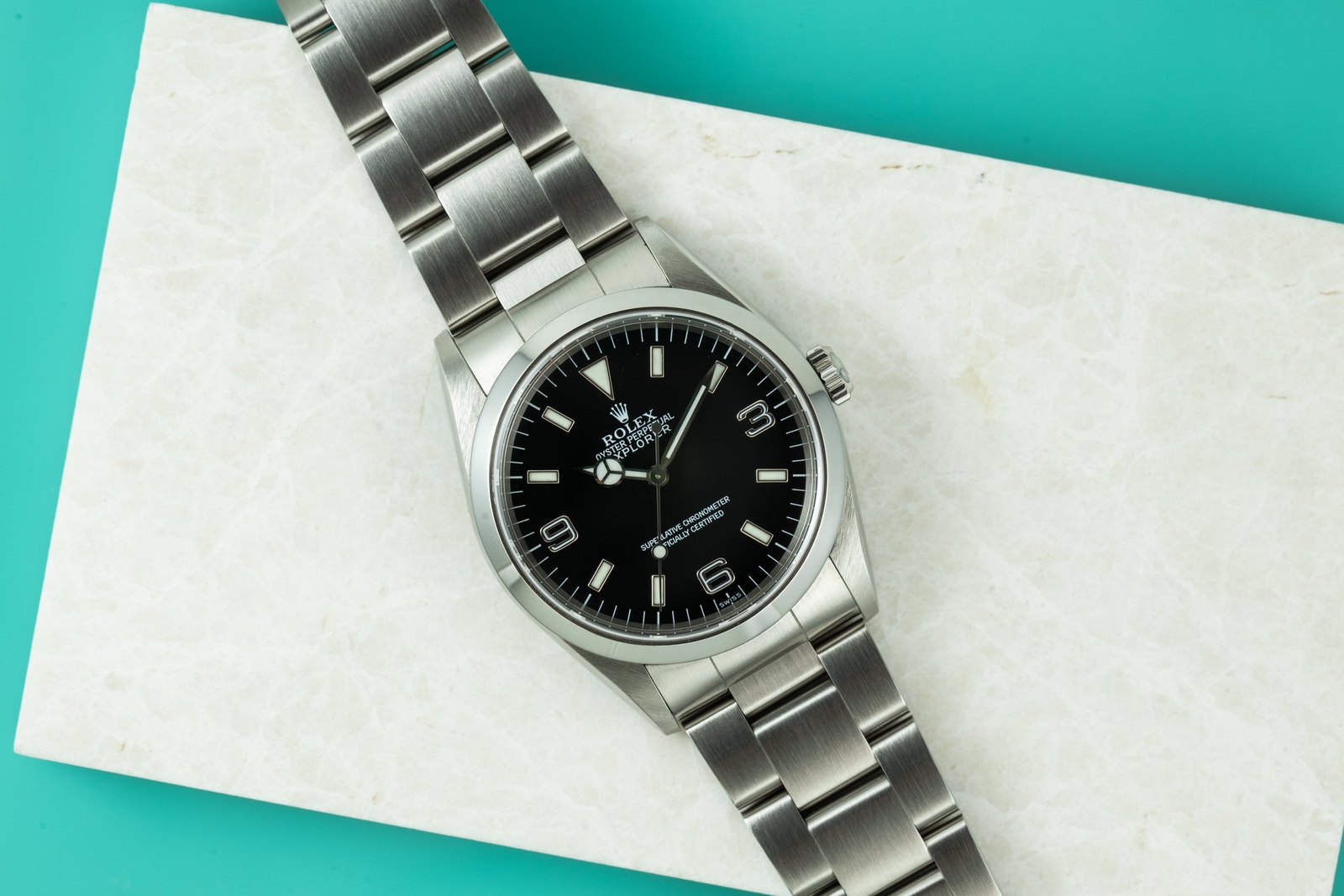
Rolex Explorer I 'Swiss Only', 1999
- Maker / attribution
- Rolex (maker)
- Date
- 1999
- Historical period
- Mechanical Renaissance (1990 – 2010)
- Country of origin
- Switzerland
- Object type
- Wristwatch
- Dimensions
- Case 36 mm
- Stock no.
- Product 4617965535319
- Credit line
- Dealer listing, Analog/Shift (product 4617965535319)
- Catalogue title (original)
- Rolex Explorer I 'Swiss Only' (English)
View the source record (dealer listing) ↗ (opens another website in a new tab)Suggest a correction
Record summary
Catalogued by Analog/Shift (dealer), New York (stock number Product 4617965535319), this is a wristwatch by Rolex, made in Switzerland, dated 1999. The Atlas places it in the Mechanical Renaissance period (1990 – 2010) of its Wristwatches collection. Recorded dimensions: Case 36 mm. The record is illustrated with 6 photographs.
Assembled from the source record's structured fields. Dates and attributions are given as the source states them; where a field is missing the Atlas leaves it blank rather than estimating.
Catalogue description
Dealer description — Analog/Shift
Why We Love It When it comes to design language, the Reference14270 may be the most important Rolex of the contemporary era. Launched in 1990, the 14270 was the follow-up successor to the iconic 1016, and featured a truly avant-garde design language. Moving away from the matte dial 1016, the 14270 features a glossy dial with stylized applied Arabic quadrant indices and a sapphire crystal which gives the watch a thoroughly modern and luxurious visual appeal that was initially a very polarizing departure for the model. With the benefit of hindsight, we can know understand that the 14270 was essentially a test-run for a new design language that would many years later become standard for numerous timepieces across the collection. Early 14270s utilized “holey lug” 36mm Oyster cases and Tritium luminous material as well, giving early variants a Neo-Vintage appeal while later models are truly contemporary classics. While these were slow to be loved by collectors, they are now poised to become one of the most popular models for collectors world-over! This particular example is a 'Swiss Only' example dating to 1999 and comes complete with its inner and outer boxes and papers dated from January 2000. It is offered in near mint condition with an unpolished case - even its case back sticker remains intact - and flawless dial and bracelet. Perfect collector-grade condition in a model creeping up in value every day! The Explorer I Story Few watches have captured the imagination the way the Rolex Explorer has. At its core, the Explorer has always been an understated tool watch, it's spartan appearance belying its hearty robustness. It is perhaps this, more than any other feature, that urges ever onward the spirit of adventure and humankind's unwillingness to accept defeat. In this way, the Explorer - in all of its executions - has formed a kind of cult status among watch enthusiasts and collectors. The Explorer traces its heritage back to the first successful summit of Everest in 1953. While we know now that the watch on Sir Edmund Hillary’s wrist was a Rolex Oyster Precision. The Oyster Precision was the precursor to the Explorer, and it was the Precision that introduced the 3-6-9 Arabic dial that we associate with the Explorer today. It was after the successful summit that Rolex rechristened the model as the Explorer in honor of Hillary and Norgay’s historic accomplishment. Rolex went on to produce the Explorer continuously for nearly seven decades (and counting, since it’s still in production), and the triumph of the 1953 expedition and spirit of adventure and exploration carries on with each new model. It is a memento of our ability to conquer the world through hard work, grit and determination - and of course our ability to do so with timeless style and panache.
Historical context
Mechanical Renaissance (1990 – 2010)
Mechanical watches return as cultural objects; independent watchmaking flourishes.
Mechanical watches returned as cultural and luxury objects. Complications, tourbillons and new materials proliferated; independent watchmakers such as George Daniels, F.P. Journe and Philippe Dufour revived artisanal watchmaking; collecting vintage watches became a major field.
Read the period in the timelineMore wristwatches from this periodEarlier: Quartz Revolution
Atlas type guide
Wristwatches
Bracelet watches were worn by women from the early nineteenth century — Breguet made one for Caroline Murat, Queen of Naples, in 1810–12 — but the wristwatch only became a man's instrument with military use and aviation in the early twentieth century. Between the World Wars it overtook the pocket watch; the 1920s and 1930s brought rectangular Art Deco cases, water-resistant cases and the first automatic winding systems.
After 1945 the wristwatch became a carrier of identity — dress watches, sports and dive watches, chronographs, calendars — produced by Swiss, American, Japanese, German, Soviet and Chinese industries. The quartz revolution after 1969 and the mechanical renaissance since the 1990s, including the rise of independent watchmakers, complete the story.
What to look for
- The reference number (between the lugs or inside the case back) and serial number, the starting point for dating.
- The calibre: its maker and number are often stamped under the dial or on the bridge.
- Originality of dial, hands and crown — refinished ('redial') dials are common.
- Case material marks: 18K/750, 14K/585, stainless steel, gold-filled, plated.
Dating clues
- Wire-lug cases: before c. 1925.
- Water-resistant screw-down cases: from 1926.
- Quartz movements: from 1969; sapphire crystals widespread after c. 1980.
General guidance written by the Atlas editors about this kind of object. It is not a statement about this particular piece; for that, rely on the source record above and on physical examination.
Related records

Movements & Components · c. 1970s
Rolex watch movement, c. 1970s
Antiquorum auction archive, Geneva

Pocket Watches · 1982
Fake Rolex watch, gold coloured metal, possibly made in Taiwan, 1982; part of a casual outfit, UK, 1982-84.
Victoria and Albert Museum, London

Wristwatches · c. 1920s
Rolex wristwatch, c. 1920s
Antiquorum auction archive, Geneva

Wristwatches · c. 1920s
Rolex wristwatch, ref. 6194, c. 1920s
Antiquorum auction archive, Geneva

Wristwatches · 2008
Wristwatch by Breitling?, 2008
Museum Rotterdam

Wristwatches · c. 1990s
Audemars Piguet Bamboo, c. 1990s
Antiquorum auction archive, Geneva

Wristwatches · c. 1990
Audemars Piguet Huitieme Perpetual Calendar, ref. 25696PT, c. 1990
Antiquorum auction archive, Geneva

Wristwatches · c. 1990
Breitling Chronomat, ref. b13050.1, c. 1990
Antiquorum auction archive, Geneva