
Wristwatches · Wristwatch
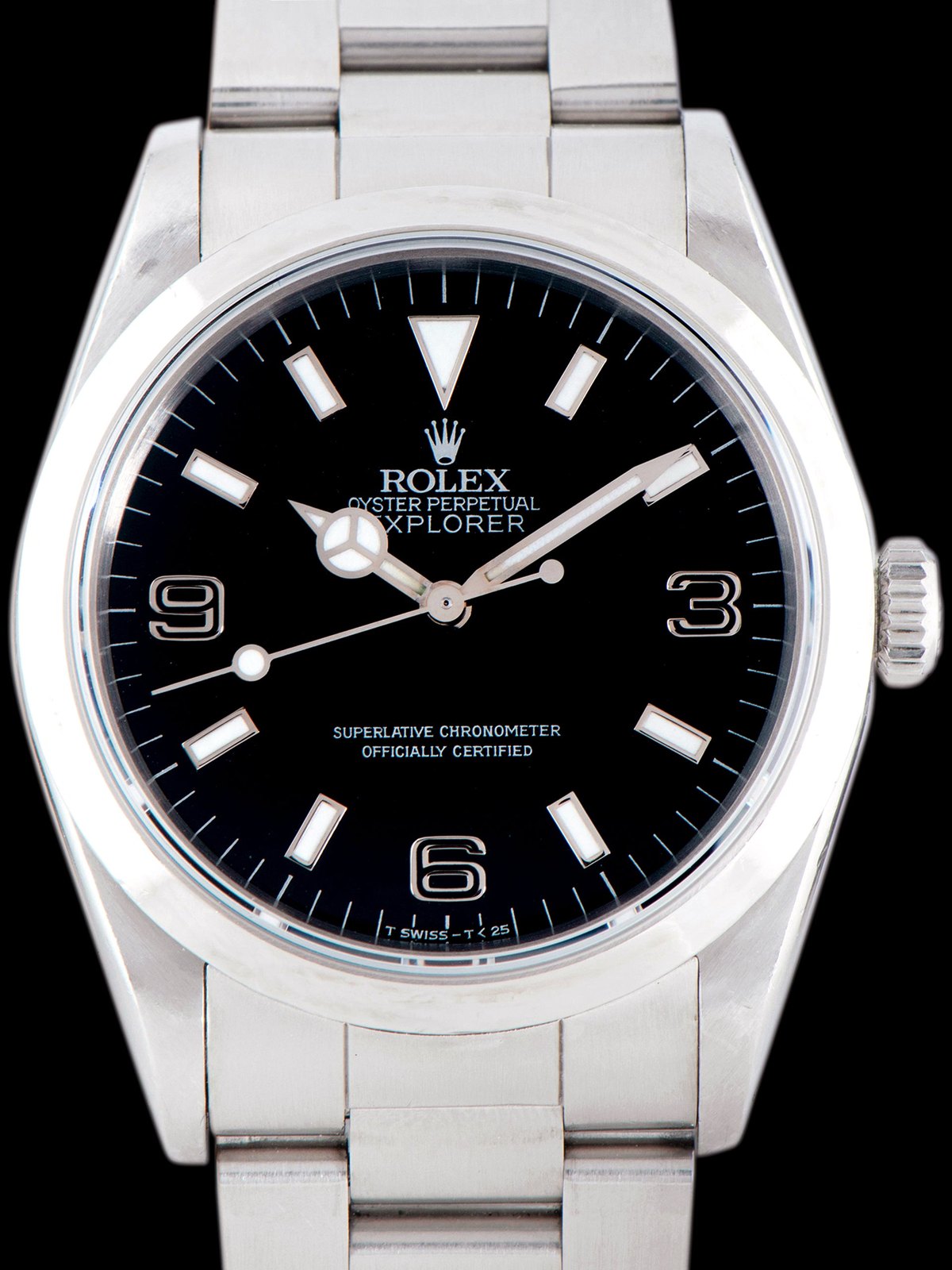
Rolex Explorer I (Ref. 14270) "Blackout", 1990
- Maker / attribution
- Rolex (maker)
- Date
- 1990
- Historical period
- Mechanical Renaissance (1990 – 2010)
- Country of origin
- Switzerland
- Object type
- Wristwatch
- Dimensions
- Case 36 mm
- Stock no.
- RLXEXP14270-BO
- Credit line
- Dealer listing, Craft & Tailored (RLXEXP14270-BO)
- Catalogue title (original)
- 1990 Rolex Explorer I (Ref. 14270) "Blackout" (English)
View the source record (dealer listing) ↗ (opens another website in a new tab)Suggest a correction
Record summary
Catalogued by Craft & Tailored (dealer), Los Angeles (stock number RLXEXP14270-BO), this is a wristwatch by Rolex, made in Switzerland, dated 1990. The Atlas places it in the Mechanical Renaissance period (1990 – 2010) of its Wristwatches collection. Recorded dimensions: Case 36 mm. The record is illustrated with 6 photographs.
Assembled from the source record's structured fields. Dates and attributions are given as the source states them; where a field is missing the Atlas leaves it blank rather than estimating.
Catalogue description
Dealer description — Craft & Tailored
The Rolex Explorer 1 ref. 14270 was introduced by Rolex in 1989 as the successor to the ref. 1016. The Rolex Explorer 1 ref. 1016 was in production for 27 years and saw only minor updates to the dial and bracelet, the ref. 1016 largely remained unchanged throughout its 27 years of production. The ref. 14270, however, was a massive technical update to the Explorer 1. The ref. 14270 received a more modern sapphire crystal, a new, faster-beating Rolex Cal. 1570, and then the Cal. 3000 movements. The updates also featured a more modern solid link bracelet with the later era bracelets receiving a smaller flip-lock clasp, and the most notable difference and update from a design visual perspective is a lacquered dial with applied white gold indices that were filled with tritium luminous material and then later with luminova. The Rolex Explorer ref. 14270 has quickly generated a cult-like following, especially the earlier examples that possess tritium-filled markers and hands. The Rolex Explorer I references bridge the gap between a dress watch and a sports watch. Without the crown guards and rotating bezels commonly found on sports models offered by Rolex, the Explorer I has a cleaner, sleeker profile while incorporating recognizable sports model features into the dial. The highly visible block indices, numerals at the 3 o'clock, 6 o'clock, and 9 o'clock positions, and Submariner style triangle at the 12 o'clock position allow for readability under any conditions. The Submariner-style hands featured on the ref. 14270 adds to the unique feel and appearance. The Rolex Explorer blends the classic and timeless look of a 36mm Rolex Oyster style watch while offering a ruggedness and utilitarian feel that can be worn in the most formal and or casual settings. One of the most exciting models to come from the neo-vintage era is without a doubt the "Blackout" variant of the Rolex Explorer I ref. 14270. Produced from E serial to early X serial in extremely limited quantities, the Blackout was the first dial variation for the Rolex Explorer after the ref. 1016 was discontinued. The "Blackout" nickname comes from the black enamel used within the 3, 6, and 9 numerals, which makes for a more stealthy aesthetic but was changed to a more visible white enamel shortly after. There are two dial variations within the "Blackout", the silver text variant, and the white text variation, however, it is generally accepted that the silver text dial is the most desirable within the Blackout range. The Blackout also features a unique, extra-long second's hand which was also replaced shortly after production with the introduction of the more commonly seen white enamel numeral dial. It is extremely rare to find fully original "Blackout" examples, like the one presented here, as it was extremely common for Rolex to change these dials and hands to the more standard dial variant when the watch went back to them for service. Stock # RLXEXP14270-BO Brand Rolex Style Explorer I Model 14270 Serial E9XXXXX Size Men's Material Stainless Steel Dial Glossy Black 3-6-9 "Blackout" Millimeters 36 Bracelet Rolex Oyster 78360 Bracelet w/ 558B End Pieces CASE & BRACELET The exceptional case exhibits a light sleeve polish from wear but no notable evidence of being actually polished in the past. The thick, crisp, and symmetrical lugs show honest signs of gentle use. The smooth stainless steel bezel shows signs of light use. The original Rolex 78360 Oyster bracelet with 558B end pieces retains 12 links that show very minimal stretch and will fit up to a 7 1/4-inch wrist. DIAL & HANDS The original and very rare glossy black "Blackout" dial with white gold surround markers, silver text, and black enamel inlaid 3, 6, and 9 o'clock numeral markers is in flawless condition, showing no damage or signs of age. The tritium lume plots feature a bright ivory color with no degradation present under UV light inspection. The handset retains the original extra-long second's hand and the original tritium lume matches the dial perfectly, however, there is a slightly darker patina present in the lume nearest to the handstack which is commonly seen in this era. ACCESSORIES None. The watch is keeping time, but the service history is unknown. A movement service can be provided upon request.
Historical context
Mechanical Renaissance (1990 – 2010)
Mechanical watches return as cultural objects; independent watchmaking flourishes.
Mechanical watches returned as cultural and luxury objects. Complications, tourbillons and new materials proliferated; independent watchmakers such as George Daniels, F.P. Journe and Philippe Dufour revived artisanal watchmaking; collecting vintage watches became a major field.
Read the period in the timelineMore wristwatches from this periodEarlier: Quartz Revolution
Atlas type guide
Wristwatches
Bracelet watches were worn by women from the early nineteenth century — Breguet made one for Caroline Murat, Queen of Naples, in 1810–12 — but the wristwatch only became a man's instrument with military use and aviation in the early twentieth century. Between the World Wars it overtook the pocket watch; the 1920s and 1930s brought rectangular Art Deco cases, water-resistant cases and the first automatic winding systems.
After 1945 the wristwatch became a carrier of identity — dress watches, sports and dive watches, chronographs, calendars — produced by Swiss, American, Japanese, German, Soviet and Chinese industries. The quartz revolution after 1969 and the mechanical renaissance since the 1990s, including the rise of independent watchmakers, complete the story.
What to look for
- The reference number (between the lugs or inside the case back) and serial number, the starting point for dating.
- The calibre: its maker and number are often stamped under the dial or on the bridge.
- Originality of dial, hands and crown — refinished ('redial') dials are common.
- Case material marks: 18K/750, 14K/585, stainless steel, gold-filled, plated.
Dating clues
- Wire-lug cases: before c. 1925.
- Water-resistant screw-down cases: from 1926.
- Quartz movements: from 1969; sapphire crystals widespread after c. 1980.
General guidance written by the Atlas editors about this kind of object. It is not a statement about this particular piece; for that, rely on the source record above and on physical examination.
Related records

Movements & Components · c. 1970s
Rolex watch movement, c. 1970s
Antiquorum auction archive, Geneva

Pocket Watches · 1982
Fake Rolex watch, gold coloured metal, possibly made in Taiwan, 1982; part of a casual outfit, UK, 1982-84.
Victoria and Albert Museum, London

Wristwatches · c. 1920s
Rolex wristwatch, c. 1920s
Antiquorum auction archive, Geneva

Wristwatches · c. 1920s
Rolex wristwatch, ref. 6194, c. 1920s
Antiquorum auction archive, Geneva

Wristwatches · 2008
Wristwatch by Breitling?, 2008
Museum Rotterdam

Wristwatches · c. 1990s
Audemars Piguet Bamboo, c. 1990s
Antiquorum auction archive, Geneva

Wristwatches · c. 1990
Audemars Piguet Huitieme Perpetual Calendar, ref. 25696PT, c. 1990
Antiquorum auction archive, Geneva

Wristwatches · c. 1990
Breitling Chronomat, ref. b13050.1, c. 1990
Antiquorum auction archive, Geneva