
Wristwatches · Wristwatch
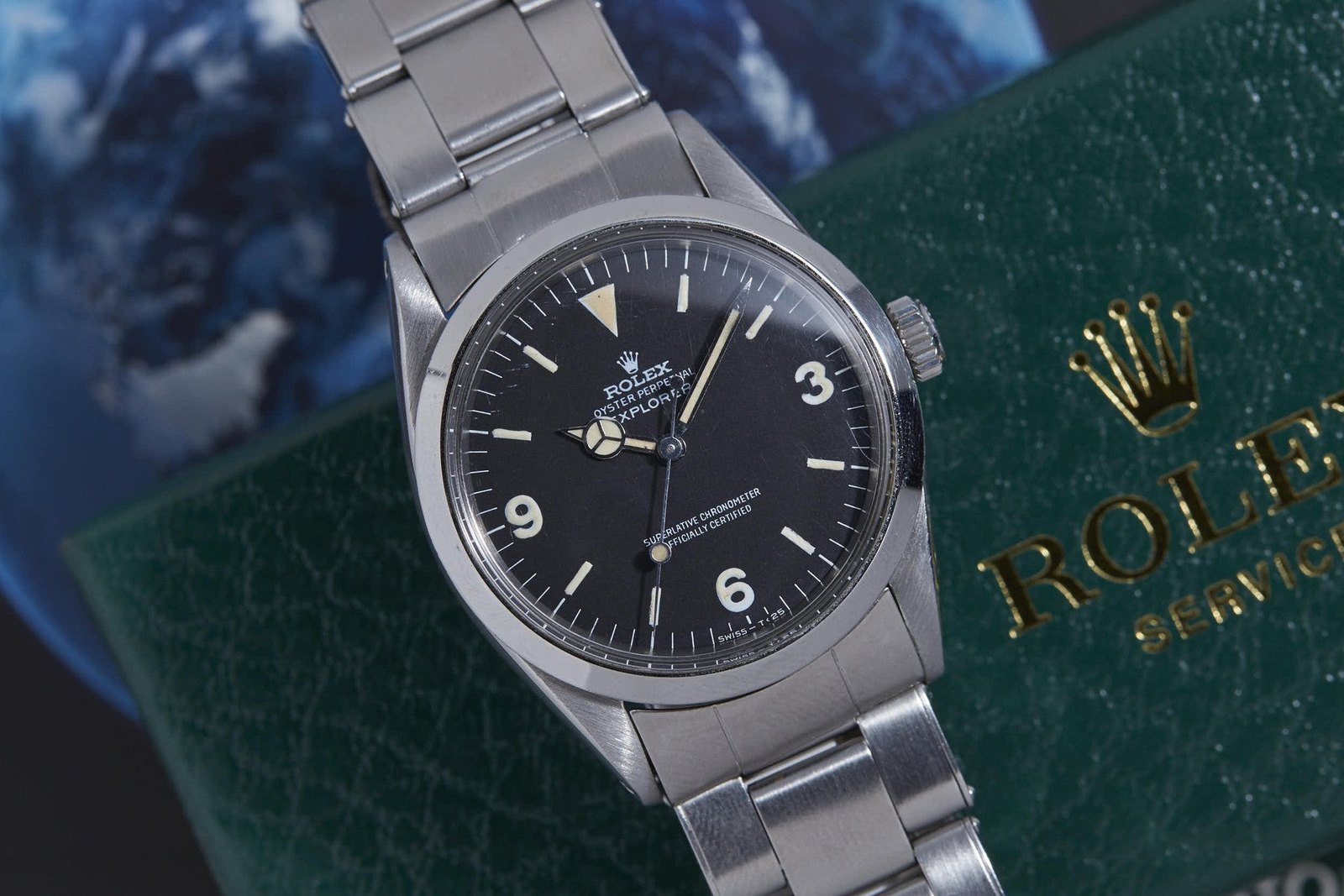
Rolex Explorer, 2011
- Maker / attribution
- Rolex (maker)
- Date
- 2011
- Historical period
- Contemporary Horology (2010 – Present)
- Country of origin
- Switzerland
- Object type
- Wristwatch
- Dimensions
- Case 36 mm
- Stock no.
- Product 8630897857
- Credit line
- Dealer listing, Analog/Shift (product 8630897857)
- Catalogue title (original)
- Rolex Explorer (English)
View the source record (dealer listing) ↗ (opens another website in a new tab)Suggest a correction
Record summary
Catalogued by Analog/Shift (dealer), New York (stock number Product 8630897857), this is a wristwatch by Rolex, made in Switzerland, dated 2011. The Atlas places it in the Contemporary Horology period (2010 – Present) of its Wristwatches collection. Recorded dimensions: Case 36 mm. The record is illustrated with 6 photographs.
Assembled from the source record's structured fields. Dates and attributions are given as the source states them; where a field is missing the Atlas leaves it blank rather than estimating.
Catalogue description
Dealer description — Analog/Shift
Rolex is one of the most widely recognized brands in the world. While you could attribute their fame to a deep-pocketed marketing department or a celebrity endorsement, to do so would be to deny the decades of research and development that Rolex has championed. Through endless testing in myriad environments and conditions, the brand was able to hone their designs and technologies. Icons like the GMT to the Submariner , watches which exude a special kind of toughness and reliability that has fostered a kind of go-anywhere, do-anything mentality among enthusiasts and collectors, were borne of tireless testing and refinement. Among Rolex's great achievements is the development of the Explorer, a much-needed addition to the brand's core collection. At its heart, the Explorer has always been an understated tool watch. With its smaller case and stark black dial and luminescent numerals, it embodies hearty robustness suggestive of a military pragmatism. It's no wonder that it was included in the kits of Sir Edmund Hillary and Tenzing Norgay as they prepared for their historic summiting of Everest. Today, the Explorer--in all of its executions--enjoys a kind of cult status among watch enthusiasts and collectors, but for many, the story really begins and ends with the Reference 1016. For one, it enjoyed the longest production run of all the Explorer models (1963 - 1989), making it the execution widely understood to define the model. Additionally, the trim 36mm steel case and matte Tritium dial resonate with the original form-follows-function design; the simplicity is pleasing when contrasted with the complications (bezels, date functions etc.) of the 1016's successors, the Explorer I and II. And, increased demand has made finding honest 1016s very hard today, with many suffering from over-restoration. This particular 1016 has a serial number in the 170,000 series, putting its production somewhere near 1974. We're reasonably certain of that date, because the previous owner hand-engraved his family name--WOU--and "74" on the case back. Further sleuthing and well-preserved service paperwork (and service box) from Rolex dating to 2011 suggests that the watch was in the care of Mr. Wou since it was originally purchased. It's also accompanied by a letter from Rolex Canada dated May 1, 1975 that welcomes the purchaser to the 'exclusive club of Rolex wearers in Canada,' and forecasts a 'certain pride of ownership that only a Rolex wearer can really understand.' And, coming on a 7206/58 rivet bracelet in solid condition, it's obvious that this one was well loved and cared for. And as 1016s in any condition being hotly coveted, this piece, with all of its uniqueness and the likelihood that it was maintained for decades by the original owner make this Explorer something altogether droolworthy. *Editor's note: The service paperwork denotes that the dial and handset are 'discolored due to age and the luminous at the 3 and 6 o'clock positions is broken' and offers the owner a service replacement for both. Since the dial and hands have not been replaced, we can assume that Mr. Wou declined the replacement, electing to keep the watch in its original condition - way to go, Wou!
Historical context
Contemporary Horology (2010 – Present)
Silicon components, connected watches, optical-lattice research clocks and a thriving independent scene.
Smartwatches became the world's best-selling watches, while mechanical watchmaking focuses on craft, innovation (silicon components, new escapements) and independent makers.
Read the period in the timelineMore wristwatches from this periodEarlier: Mechanical Renaissance
Atlas type guide
Wristwatches
Bracelet watches were worn by women from the early nineteenth century — Breguet made one for Caroline Murat, Queen of Naples, in 1810–12 — but the wristwatch only became a man's instrument with military use and aviation in the early twentieth century. Between the World Wars it overtook the pocket watch; the 1920s and 1930s brought rectangular Art Deco cases, water-resistant cases and the first automatic winding systems.
After 1945 the wristwatch became a carrier of identity — dress watches, sports and dive watches, chronographs, calendars — produced by Swiss, American, Japanese, German, Soviet and Chinese industries. The quartz revolution after 1969 and the mechanical renaissance since the 1990s, including the rise of independent watchmakers, complete the story.
What to look for
- The reference number (between the lugs or inside the case back) and serial number, the starting point for dating.
- The calibre: its maker and number are often stamped under the dial or on the bridge.
- Originality of dial, hands and crown — refinished ('redial') dials are common.
- Case material marks: 18K/750, 14K/585, stainless steel, gold-filled, plated.
Dating clues
- Wire-lug cases: before c. 1925.
- Water-resistant screw-down cases: from 1926.
- Quartz movements: from 1969; sapphire crystals widespread after c. 1980.
General guidance written by the Atlas editors about this kind of object. It is not a statement about this particular piece; for that, rely on the source record above and on physical examination.
Related records

Movements & Components · c. 1970s
Rolex watch movement, c. 1970s
Antiquorum auction archive, Geneva

Pocket Watches · 1982
Fake Rolex watch, gold coloured metal, possibly made in Taiwan, 1982; part of a casual outfit, UK, 1982-84.
Victoria and Albert Museum, London

Wristwatches · c. 1920s
Rolex wristwatch, c. 1920s
Antiquorum auction archive, Geneva

Wristwatches · c. 1920s
Rolex wristwatch, ref. 6194, c. 1920s
Antiquorum auction archive, Geneva

Wristwatches · c. 2010s
Breguet Type XXI, ref. 3810, c. 2010s (Antiquorum Lot 381-24)
Antiquorum auction archive, Geneva

Wristwatches · c. 2010s
Breguet Type XXI, ref. 3810, c. 2010s (Antiquorum Lot 386-229)
Antiquorum auction archive, Geneva

Wristwatches · Sold in September 2010
Breitling Cosmonaute, ref. A 22322, Sold in September 2010
Antiquorum auction archive, Geneva

Wristwatches · c. 2010
Corum Bubble Chrono, ref. 396.150.20, c. 2010
Antiquorum auction archive, Geneva