
Wristwatches · Wristwatch
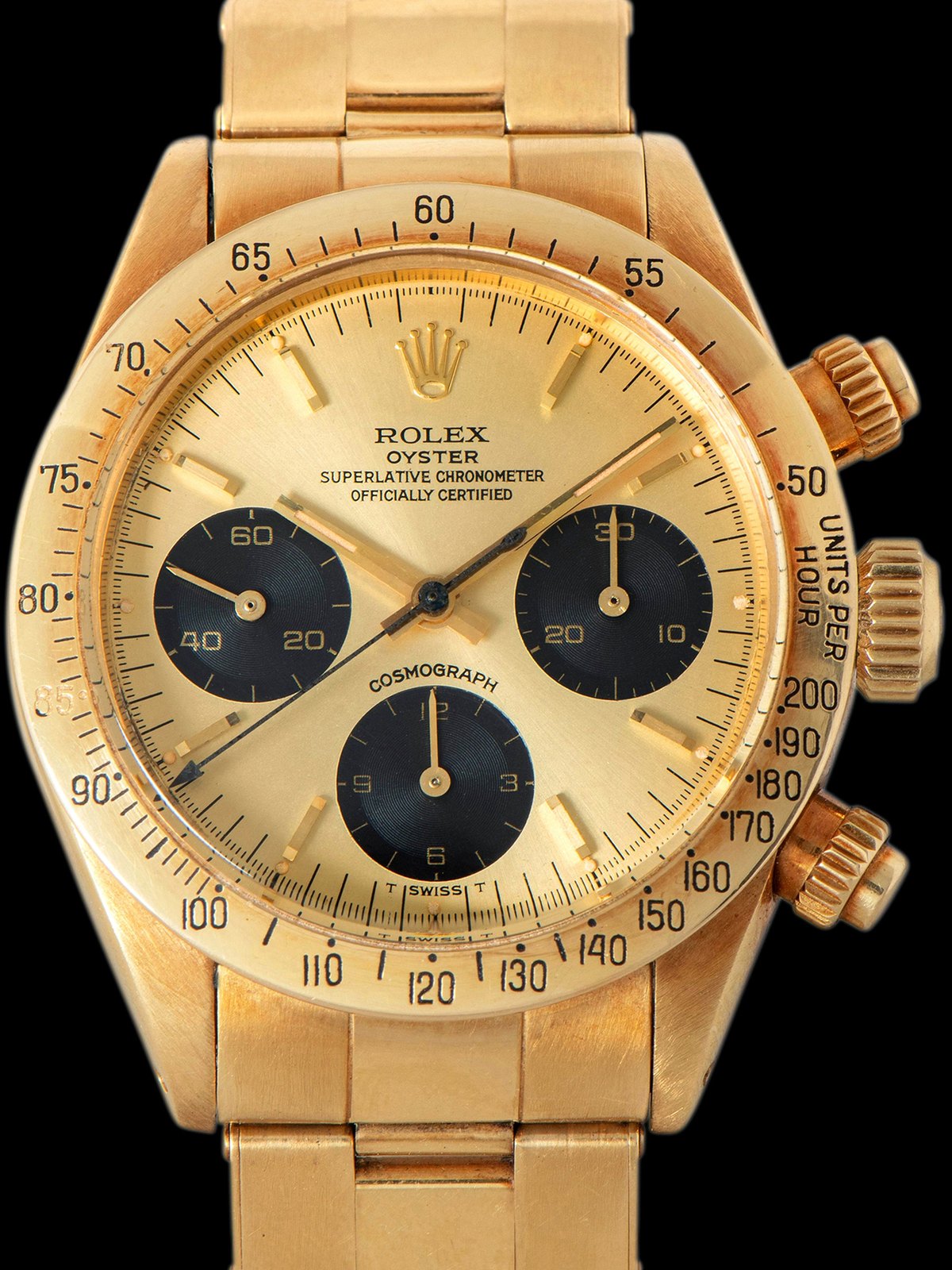
Rolex Daytona 18K YG (Ref. 6265) Champagne Dial, 1978
- Maker / attribution
- Rolex (maker)
- Date
- 1978
- Historical period
- Quartz Revolution (1969 – 1990)
- Country of origin
- Switzerland
- Object type
- Wristwatch
- Dimensions
- Case 36 mm
- Stock no.
- RLXDT626518K-2
- Credit line
- Dealer listing, Craft & Tailored (RLXDT626518K-2)
- Catalogue title (original)
- 1978 Rolex Daytona 18K YG (Ref. 6265) Champagne Dial W/ Box, Papers, & Original Sales Receipt (English)
View the source record (dealer listing) ↗ (opens another website in a new tab)Suggest a correction
Record summary
Catalogued by Craft & Tailored (dealer), Los Angeles (stock number RLXDT626518K-2), this is a wristwatch by Rolex, made in Switzerland, dated 1978. The Atlas places it in the Quartz Revolution period (1969 – 1990) of its Wristwatches collection. Recorded dimensions: Case 36 mm. The record is illustrated with 6 photographs.
Assembled from the source record's structured fields. Dates and attributions are given as the source states them; where a field is missing the Atlas leaves it blank rather than estimating.
Catalogue description
Dealer description — Craft & Tailored
Rolex first introduced the Cosmograph in 1963 in steel, 14k, and 18k yellow gold with a design that was solely focused on automobile racing. The Units Per Hour bezel allowed for the tracking and measuring of average speed and lap times, making for a truly useful tool for racing drivers in the 20th century. Rolex, being the same marketing powerhouse back then as they are today, knew the American market would be their most effective demographic as racing in America was on the rise in the 60s-70s. Effectively, in 1964, the Rolex Cosmograph was branded “Daytona” after the famous race, the 24 Hours of Daytona, and the rest is history. The Daytona saw its first major update in late 1969 when Rolex decided to bring its Oyster technology to the Cosmograph. Accompanying the "Oyster" text on the dial, the case crown was upgraded to a 7mm trip-lock crown, and the most significant upgrade was the introduction of the screw-down chronograph pushers, which is a function we still see today in the modern Daytona offering from Rolex. While the case size of this new model was the same as its predecessor at 36mm, the larger crown and more robust pushers greatly increase the watch's wrist presence. Vintage Rolex Daytonas now sit firmly at the pinnacle of serious watch collecting, with yellow gold examples representing the most refined expression of the model. Melding precious watchmaking with purposeful, utilitarian design, this seemingly unlikely combination is executed with remarkable balance and restraint—an achievement that continues to captivate the most discerning collectors. Produced in extremely limited numbers and surviving in far smaller quantities today, truly original examples are exceedingly rare. The watch presented here stands apart, preserved in exceptional condition and accompanied by remarkable, time-capsule accessories, including its original box, papers, Mayor’s sales receipt, and original Mayor’s appraisal dated 1981 at the time of purchase. SPECS Stock # RLXDT626518K-2 Brand Rolex Style Daytona Model 6265 Serial 54XXXXX Size Men's Material 18K Yellow Gold Dial Champagne W/ Black Sub-Dials Millimeters 36 Bracelet Rolex 7205 18K YG Oyster-Rivet Bracelet W/ 71 End Pieces CASE & BRACELET The excellent 18K yellow gold case displays strong dimensions throughout, showing thick and symmetrical lugs, with minimal evidence of being previously polished and signs of gentle use present. The 18K yellow gold "Units Per Hour" bezel is also in superb condition, exhibiting only light wear and only minor loss to the black enamel inlay. The case and bezel have achieved a warm, rosy patina, enhancing the overall vintage charm of the watch. The case retains its original yellow gold Rolex trip-lock crown and yellow gold Mk II screw-down pushers. The case back remains in excellent condition with nominal wear present. The original Rolex 7205 18K yellow gold Oyster rivet bracelet with 71 end pieces retains 12 links that show almost no stretch and will fit up to a 7.5-inch wrist. DIAL & HANDS The original champagne sunburst dial with matte black sub-dials is exceptionally well-preserved, showing no scratches, marks, or notable signs of age on the dial or sub-dials. The tritium lume plots are all present, though some minor degradation is present in some of the plots when inspected under UV light, and feature an excellent creamy patina. The original tritium yellow gold hands are in wonderful condition and have aged slightly darker than the dial, with no degradation present when inspected under UV light. ACCESSORIES The watch is a complete set, accompanied by its original inner and outer boxes, booklets, Rolex guarantee paper, original Mayor's sales receipt, and original Mayor's appraisal. The service history is unknown and is ready for service. The service can be provided upon request at the time of service.
Historical context
Quartz Revolution (1969 – 1990)
Seiko's Astron begins mass quartz timekeeping; traditional industries contract sharply.
Quartz and digital watches transformed the market after 1969. Swiss employment collapsed, Japanese and Hong Kong production soared, and the Swatch (1983) helped the Swiss industry recover; mechanical watches survived as luxury goods.
Read the period in the timelineMore wristwatches from this periodEarlier: Modern Mechanical Horology
Atlas type guide
Wristwatches
Bracelet watches were worn by women from the early nineteenth century — Breguet made one for Caroline Murat, Queen of Naples, in 1810–12 — but the wristwatch only became a man's instrument with military use and aviation in the early twentieth century. Between the World Wars it overtook the pocket watch; the 1920s and 1930s brought rectangular Art Deco cases, water-resistant cases and the first automatic winding systems.
After 1945 the wristwatch became a carrier of identity — dress watches, sports and dive watches, chronographs, calendars — produced by Swiss, American, Japanese, German, Soviet and Chinese industries. The quartz revolution after 1969 and the mechanical renaissance since the 1990s, including the rise of independent watchmakers, complete the story.
What to look for
- The reference number (between the lugs or inside the case back) and serial number, the starting point for dating.
- The calibre: its maker and number are often stamped under the dial or on the bridge.
- Originality of dial, hands and crown — refinished ('redial') dials are common.
- Case material marks: 18K/750, 14K/585, stainless steel, gold-filled, plated.
Dating clues
- Wire-lug cases: before c. 1925.
- Water-resistant screw-down cases: from 1926.
- Quartz movements: from 1969; sapphire crystals widespread after c. 1980.
General guidance written by the Atlas editors about this kind of object. It is not a statement about this particular piece; for that, rely on the source record above and on physical examination.
Related records

Movements & Components · c. 1970s
Rolex watch movement, c. 1970s
Antiquorum auction archive, Geneva

Pocket Watches · 1982
Fake Rolex watch, gold coloured metal, possibly made in Taiwan, 1982; part of a casual outfit, UK, 1982-84.
Victoria and Albert Museum, London

Wristwatches · c. 1920s
Rolex wristwatch, c. 1920s
Antiquorum auction archive, Geneva

Wristwatches · c. 1920s
Rolex wristwatch, ref. 6194, c. 1920s
Antiquorum auction archive, Geneva

Wristwatches · 1970
Wristwatch by Heno, Switzerland, 1970
Museum Rotterdam

Wristwatches · 1960–1986
'Tri-Compax' calendar chronograph wristwatch in gold case, by Universal, Geneva, Switzerland, 1960–1986.
Science Museum Group, London

Wristwatches · 1969–1970
Beta 21 Quartz wristwatch movement, made in Switzerland, 1970.
Science Museum Group, London

Wristwatches · c. 1969
Omega Speedmaster Moonwatch, ref. 145022-69st, c. 1969
Antiquorum auction archive, Geneva