
Wristwatches · Wristwatch
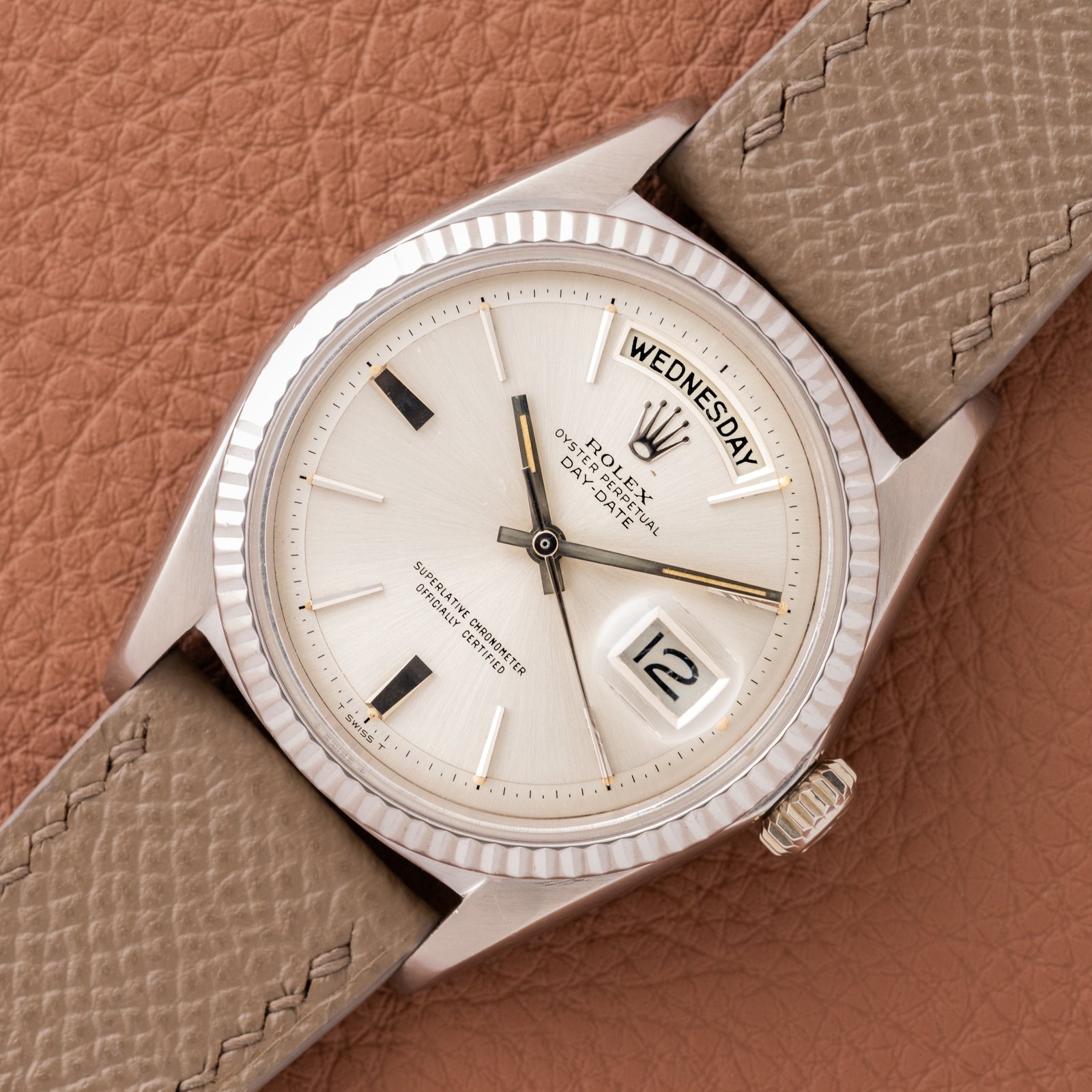
Rolex Day-Date White Gold Door Stop (Ref. 1803), 1967
- Maker / attribution
- Rolex (maker)
- Date
- 1967
- Historical period
- Modern Mechanical Horology (1945 – 1969)
- Country of origin
- Switzerland
- Object type
- Wristwatch
- Materials / technique
- white gold
- Dimensions
- Case 36 mm
- Stock no.
- Product 8731713470647
- Credit line
- Dealer listing, Huntington Company (product 8731713470647)
- Catalogue title (original)
- 1967 Rolex Day-Date White Gold Door Stop (Ref. 1803) (English)
Editor's note
The dealer's brand field named another maker; the dealer's own listing title identifies the watch as Rolex.View the source record (dealer listing) ↗ (opens another website in a new tab)Suggest a correction
Record summary
Catalogued by Huntington Company (dealer) (stock number Product 8731713470647), this is a wristwatch by Rolex, made in Switzerland, dated 1967. The Atlas places it in the Modern Mechanical Horology period (1945 – 1969) of its Wristwatches collection. Materials and techniques recorded by the source: white gold. Recorded dimensions: Case 36 mm. The record is illustrated with 6 photographs.
Assembled from the source record's structured fields. Dates and attributions are given as the source states them; where a field is missing the Atlas leaves it blank rather than estimating.
Catalogue description
Dealer description — Huntington Company
History and Significance The Day-Date has been Rolex's flagship dress watch since its introduction in 1956, but the earliest examples of the reference 1803 feel noticeably different from the watches that followed. Acrylic crystals, pie-pan dials, slender case proportions, and the details of early dial production give these watches a distinctly mid-century character that gradually disappeared as the Day-Date evolved. This example dates to 1967 and is made considerably more unusual by its 18k white gold construction. Yellow gold defined the public image of the Day-Date, while white gold offered the same precious-metal construction in a much quieter package. Even today, an early white gold 1803 can easily be mistaken for a steel watch from a distance. The dial is where this particular watch really sets itself apart. It features the desirable early "door stop" hour markers, named for their unusually broad, raised shape. They give the dial far more dimension than conventional baton markers and are a wonderful example of the small design details found across early Rolex production. Combined with the vertically brushed silver surface, pie-pan profile, and warm aged luminous material, the dial feels unmistakably 1960s. There is nothing flashy about this Day-Date despite being one of the most prestigious watches Rolex offered in 1967. That is exactly what makes the configuration work. White gold disguises the precious-metal case, while the unusual doorstop dial gives collectors something to notice only when they get close. Writer's Thoughts White gold 1803s have always been among our favorite vintage Day-Dates because they almost disguise their identity. There is none of the immediate flash associated with a yellow gold President. From across the room, this could almost pass for a steel watch. The early doorstop markers completely change the watch's personality. They are substantial without being decorative, and against the vertically brushed silver dial they give the watch a distinctly 1960s appearance. The warm aging of the luminous plots and hands adds just enough contrast to an otherwise monochromatic watch. Our Promise Every watch is thoroughly vetted, carefully described with complete transparency, and guaranteed authentic. Each piece is offered in honest condition, ensuring collectors receive a timepiece that reflects both originality and integrity. Specifications Brand: Rolex Model: Day-Date Year: 1967 Case Material: 18k white gold Case Size: 36mm Dial: Silver door stop dial Movement: Automatic Strap/Bracelet: New leather strap Buckle/Clasp: Generic buckle Contents: Watch only Condition Case: The 18k white gold case presents well with visible signs of previous wear and polishing consistent with age. The lugs retain an attractive overall shape, and the white gold fluted bezel remains well defined. Dial: The silver door stop dial is well preserved overall, retaining its finish and distinctive applied markers. There is a small more next to the cornet. The luminous plots have aged to a warm cream tone, with some plots showing minor degradation consistent with age. Hands: The hands remain attractive with warm aged luminous material that complements the dial plots. Crystal: The crystal presents well with light wear consistent with use. Strap/Bracelet: Fitted with a new leather strap. Buckle/Clasp: Fitted with a generic buckle.
Historical context
Modern Mechanical Horology (1945 – 1969)
Tool watches for divers, pilots and astronauts; electric watches anticipate the electronic age.
The classic era of the mechanical wristwatch: dive watches, chronographs for motor racing and space flight, GMT watches for jet travel, slim dress watches, automatic calendars, and the rise of Japanese manufacturers alongside Swiss, American, German and Soviet industries.
Read the period in the timelineMore wristwatches from this periodEarlier: Golden Age of Mechanical Watchmaking
Atlas type guide
Calendar, moon-phase and perpetual calendar watches
Calendar complications range from a simple date to the perpetual calendar, which automatically allows for months of different lengths and leap years until 2100. Pocket watches with perpetual calendars were made in the eighteenth and nineteenth centuries; Patek Philippe made the first perpetual calendar wristwatch in 1925, and series production followed in 1941. The annual calendar (Patek Philippe, 1996) needs correction only once a year.
Moon-phase displays use a disc with two moons and 59 teeth advanced daily, approximating the 29.5-day lunation; more precise trains reduce the error to one day in over a century.
What to look for
- Apertures or subsidiary dials for day, date, month and leap year.
- Moon disc under a 'bosom' shaped aperture.
- Recessed correctors on the case band for setting the calendar.
Dating clues
- Triple-date wristwatches: popular c. 1940–1955.
- Perpetual calendar wristwatches: from 1925 (unique) and 1941 (series).
General guidance written by the Atlas editors about this kind of object. It is not a statement about this particular piece; for that, rely on the source record above and on physical examination.
Related records

Movements & Components · c. 1970s
Rolex watch movement, c. 1970s
Antiquorum auction archive, Geneva

Pocket Watches · 1982
Fake Rolex watch, gold coloured metal, possibly made in Taiwan, 1982; part of a casual outfit, UK, 1982-84.
Victoria and Albert Museum, London

Wristwatches · c. 1920s
Rolex wristwatch, c. 1920s
Antiquorum auction archive, Geneva

Wristwatches · c. 1920s
Rolex wristwatch, ref. 6194, c. 1920s
Antiquorum auction archive, Geneva

Wristwatches · 1945
Wristwatch by Eterna, 1945
Museum Rotterdam

Wristwatches · c. 1945
Breitling Premier, ref. 790, c. 1945
Antiquorum auction archive, Geneva

Wristwatches · c. 1945
Universal Genève Uni-Compax, ref. 22492, c. 1945
Antiquorum auction archive, Geneva

Wristwatches · c. 1950s
Baume & Mercier wristwatch, c. 1950s
Antiquorum auction archive, Geneva