
Wristwatches · Wristwatch
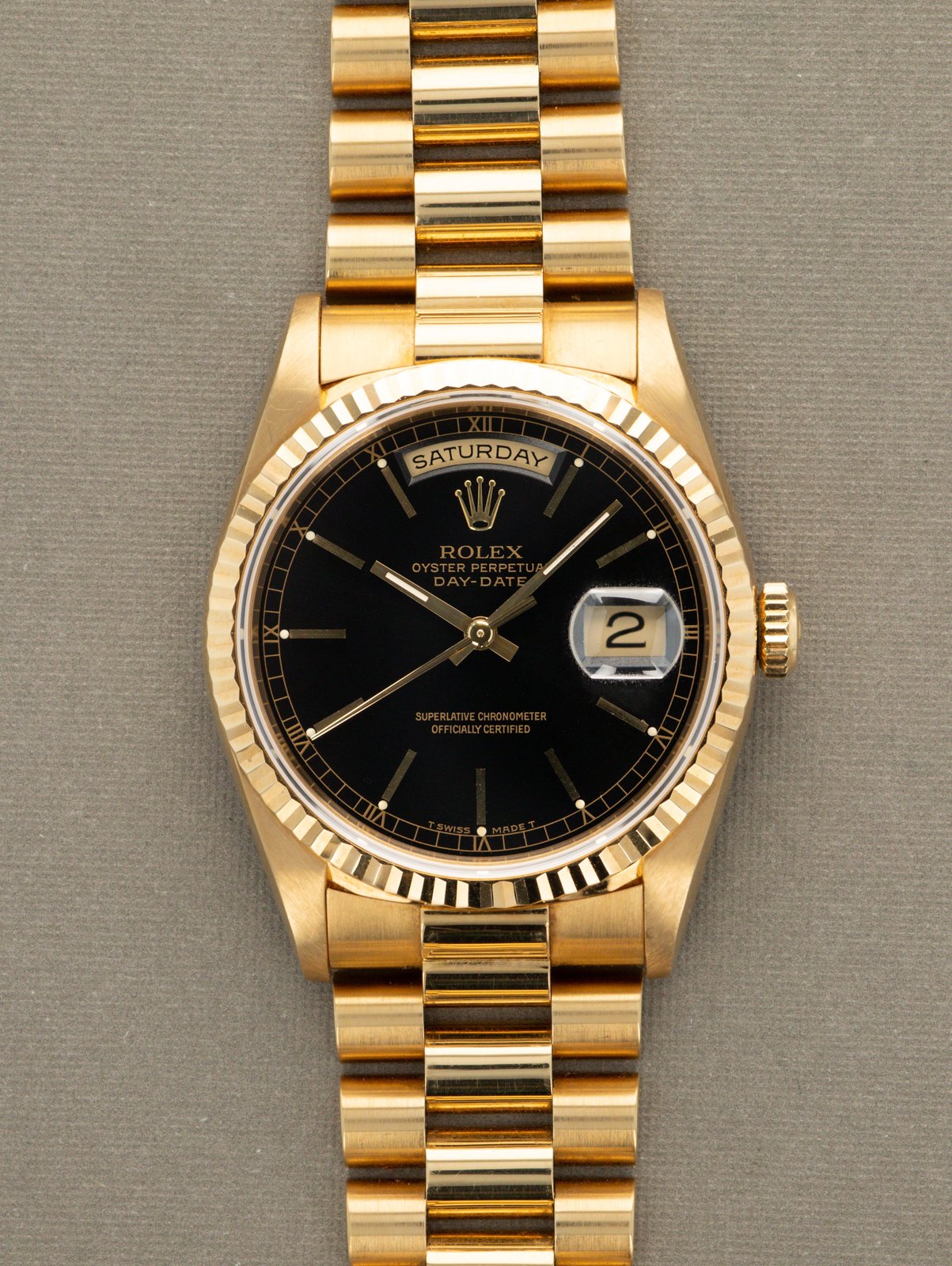
Rolex Day-Date ref. 18238, Black 'Sunburst' Dial
- Maker / attribution
- Rolex (maker)
- Date
- c. 1996
- Historical period
- Mechanical Renaissance (1990 – 2010)
- Country of origin
- Switzerland
- Object type
- Wristwatch
- Stock no.
- OC2675
- Credit line
- Dealer listing, Oliver & Clarke (OC2675)
- Catalogue title (original)
- Rolex Day-Date Ref. 18238 - Black 'Sunburst' Dial Unpolished W/ Box & Papers (English)
View the source record (dealer listing) ↗ (opens another website in a new tab)Suggest a correction
Record summary
Catalogued by Oliver & Clarke (dealer), United Kingdom (stock number OC2675), this is a wristwatch by Rolex, made in Switzerland, dated c. 1996. The Atlas places it in the Mechanical Renaissance period (1990 – 2010) of its Wristwatches collection. The record is illustrated with 6 photographs.
Assembled from the source record's structured fields. Dates and attributions are given as the source states them; where a field is missing the Atlas leaves it blank rather than estimating.
Catalogue description
Dealer description — Oliver & Clarke
When the Day-Date was released in 1956, Rolex had made numerous attempts to capture the market with more complicated timepieces such as the Ref. 6036, the Ref. 8171, and the Ref. 6062, but it seemed like buyers were not particularly fond of complicated Rolexes. All of that changed when President Dwight D. Eisenhower was spotted wearing one Rolex in particular: a Day-Date. The model has since become known worldwide as ‘The President’ and as a symbol of success and prestige. Simply put, this one stuck. The Day-Date was available for many years on a leather strap with a matching gold buckle, but also on a solid gold bracelet (called a 'President' bracelet), like the example that we have here. Dating to circa 1996, this Reference 18238 offers a number of attractive features and is offered in exceptional overall condition. The case, matching 'President' bracelet, and characteristic 'fluted' yellow gold bezel all remain unpolished and show just light signs of wear throughout with no apparent damage. The 'President' bracelet exhibits no stretch and even retains some tightness in its clasp hinge. Flip the piece over and you'll find a fully-intact caseback sticker. Inside, the black dial is surprisingly dynamic, featuring a sunburst finishing that becomes apparent when exposed to natural light, and otherwise mimics a gloss black dial in lower light. It is in fantastic condition with seemingly none of the usual degradation or wear around the applied indices commonly found on colored dials. Being from the very end of the Tritium era, this piece still features Tritium plots rather than Luminova or SuperLuminova that subsequent variants would use, and thankfully, the plots remain fully-intact and are gently patinated. The handset also matches beautifully. Additionally, being a neo-vintage Day-Date, this piece featured the almost magical 'double quickset' movement function for setting the day and date. A real treat if you have ever owned a 4-digit Day-Date! Last but not least, while it would be enough to enjoy this piece on its own, this piece is accompanied by its outer box, inner brown leather box, COSC hangtag, booklets, and guarantee papers dating to 1999. The combination of the uncommon black dial, the overall condition, and the set with matching Japanese papers and caseback sticker accompanying the piece amount to a very compelling package for someone looking for a strong, unique piece in their collection.
Historical context
Mechanical Renaissance (1990 – 2010)
Mechanical watches return as cultural objects; independent watchmaking flourishes.
Mechanical watches returned as cultural and luxury objects. Complications, tourbillons and new materials proliferated; independent watchmakers such as George Daniels, F.P. Journe and Philippe Dufour revived artisanal watchmaking; collecting vintage watches became a major field.
Read the period in the timelineMore wristwatches from this periodEarlier: Quartz Revolution
Atlas type guide
Calendar, moon-phase and perpetual calendar watches
Calendar complications range from a simple date to the perpetual calendar, which automatically allows for months of different lengths and leap years until 2100. Pocket watches with perpetual calendars were made in the eighteenth and nineteenth centuries; Patek Philippe made the first perpetual calendar wristwatch in 1925, and series production followed in 1941. The annual calendar (Patek Philippe, 1996) needs correction only once a year.
Moon-phase displays use a disc with two moons and 59 teeth advanced daily, approximating the 29.5-day lunation; more precise trains reduce the error to one day in over a century.
What to look for
- Apertures or subsidiary dials for day, date, month and leap year.
- Moon disc under a 'bosom' shaped aperture.
- Recessed correctors on the case band for setting the calendar.
Dating clues
- Triple-date wristwatches: popular c. 1940–1955.
- Perpetual calendar wristwatches: from 1925 (unique) and 1941 (series).
General guidance written by the Atlas editors about this kind of object. It is not a statement about this particular piece; for that, rely on the source record above and on physical examination.
Related records

Movements & Components · c. 1970s
Rolex watch movement, c. 1970s
Antiquorum auction archive, Geneva

Pocket Watches · 1982
Fake Rolex watch, gold coloured metal, possibly made in Taiwan, 1982; part of a casual outfit, UK, 1982-84.
Victoria and Albert Museum, London

Wristwatches · c. 1920s
Rolex wristwatch, c. 1920s
Antiquorum auction archive, Geneva

Wristwatches · c. 1920s
Rolex wristwatch, ref. 6194, c. 1920s
Antiquorum auction archive, Geneva

Wristwatches · 2008
Wristwatch by Breitling?, 2008
Museum Rotterdam

Wristwatches · c. 1990s
Audemars Piguet Bamboo, c. 1990s
Antiquorum auction archive, Geneva

Wristwatches · c. 1990
Audemars Piguet Huitieme Perpetual Calendar, ref. 25696PT, c. 1990
Antiquorum auction archive, Geneva

Wristwatches · c. 1990
Breitling Chronomat, ref. b13050.1, c. 1990
Antiquorum auction archive, Geneva