
Wristwatches · Wristwatch
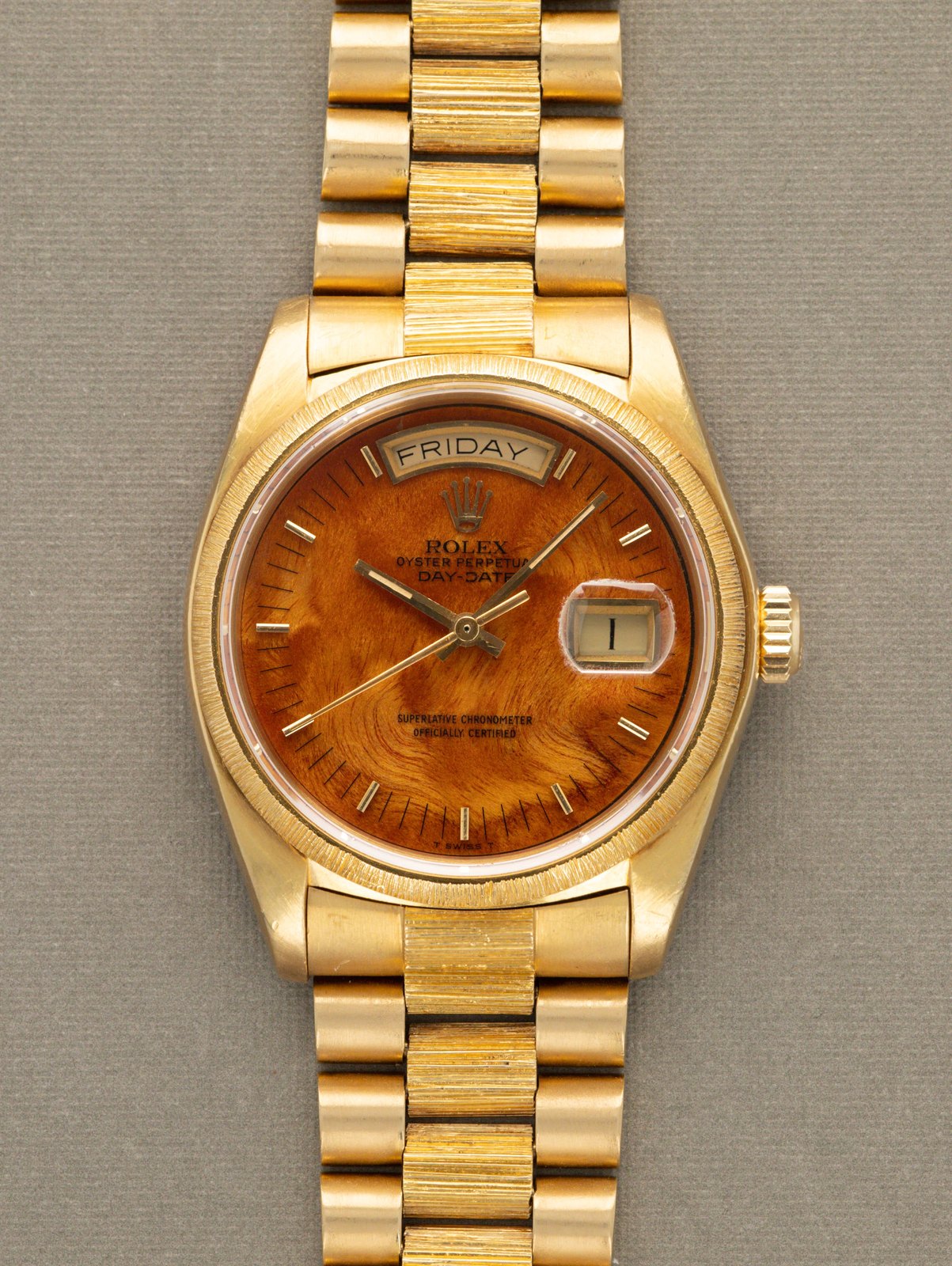
Rolex Day-Date ref. 18078, 'Bark' with 'Birchwood' Dial
- Maker / attribution
- Rolex (maker)
- Date
- c. 1978
- Historical period
- Quartz Revolution (1969 – 1990)
- Country of origin
- Switzerland
- Object type
- Wristwatch
- Stock no.
- OC2659
- Credit line
- Dealer listing, Oliver & Clarke (OC2659)
- Catalogue title (original)
- Rolex Day-Date Ref. 18078 - 'Bark' w/ 'Birchwood' Dial (English)
View the source record (dealer listing) ↗ (opens another website in a new tab)Suggest a correction
Record summary
Catalogued by Oliver & Clarke (dealer), United Kingdom (stock number OC2659), this is a wristwatch by Rolex, made in Switzerland, dated c. 1978. The Atlas places it in the Quartz Revolution period (1969 – 1990) of its Wristwatches collection. The record is illustrated with 6 photographs.
Assembled from the source record's structured fields. Dates and attributions are given as the source states them; where a field is missing the Atlas leaves it blank rather than estimating.
Catalogue description
Dealer description — Oliver & Clarke
When the Day-Date was released in 1956, Rolex had made numerous attempts to capture the market with more complicated timepieces such as the Ref. 6036, the Ref. 8171, and the Ref. 6062, but it seemed like buyers were not particularly fond of complicated Rolexes. All of that changed when President Dwight D. Eisenhower was spotted wearing one Rolex in particular: a Day-Date. The model has since become known worldwide as ‘The President’ and as a symbol of success and prestige. Simply put, this one stuck. The Day-Date was available for many years on a leather strap with a matching gold buckle, but also on a solid gold bracelet (called a 'President' bracelet), like the example that we have here. However, this isn't your run of the mill Day-Date... Dating to circa 1978, the Reference 18078 that we have here features not only a special lacquered wood dial, but a very thematically appropriate case and bracelet to house it. Unique to this reference, this piece stands out amongst your typical Day-Dates from the era with what Rolex might call 'special finishing' — in this case, 'bark' finishing. The bezel and center links on the 'President' bracelet feature a hand-finished pattern that that was found on some Day-Dates in the 1970s into the 1980s. Also during this time, there where a few different wood dial variants available, with the example that we have here being of the 'birchwood' variant. The dial itself remains in very nice overall condition, with a smooth glossy surface and clear gold printing throughout. It has applied indices, framed day and date apertures, an applied logo at the 12 o'clock position, and a matching handset. There is one faint edge fracture visible on the top left of the day aperture, which appears to be on the surface and not the dial. The case, bracelet and bezel are also in excellent condition. The case shows signs of having been very lightly previously polished and shows normal wear throughout with a few small impressions. The matching bracelet appears to have had the outer portion of the links lightly polished, preserving the correct 'bark'-finished center portion, which remain crisp and defined. The bezel is also seemingly devoid of any polishing. The combination of the brown wood dial within the yellow gold 'bark' case is undeniably a very of-it's-time combination and a perfect one at that. We think it had aged beautifully and collectors seem to agree. As a result, these remain sought after and collectible — and its not everyday that they surface in strong, honest condition like this.
Historical context
Quartz Revolution (1969 – 1990)
Seiko's Astron begins mass quartz timekeeping; traditional industries contract sharply.
Quartz and digital watches transformed the market after 1969. Swiss employment collapsed, Japanese and Hong Kong production soared, and the Swatch (1983) helped the Swiss industry recover; mechanical watches survived as luxury goods.
Read the period in the timelineMore wristwatches from this periodEarlier: Modern Mechanical Horology
Atlas type guide
Calendar, moon-phase and perpetual calendar watches
Calendar complications range from a simple date to the perpetual calendar, which automatically allows for months of different lengths and leap years until 2100. Pocket watches with perpetual calendars were made in the eighteenth and nineteenth centuries; Patek Philippe made the first perpetual calendar wristwatch in 1925, and series production followed in 1941. The annual calendar (Patek Philippe, 1996) needs correction only once a year.
Moon-phase displays use a disc with two moons and 59 teeth advanced daily, approximating the 29.5-day lunation; more precise trains reduce the error to one day in over a century.
What to look for
- Apertures or subsidiary dials for day, date, month and leap year.
- Moon disc under a 'bosom' shaped aperture.
- Recessed correctors on the case band for setting the calendar.
Dating clues
- Triple-date wristwatches: popular c. 1940–1955.
- Perpetual calendar wristwatches: from 1925 (unique) and 1941 (series).
General guidance written by the Atlas editors about this kind of object. It is not a statement about this particular piece; for that, rely on the source record above and on physical examination.
Related records

Movements & Components · c. 1970s
Rolex watch movement, c. 1970s
Antiquorum auction archive, Geneva

Pocket Watches · 1982
Fake Rolex watch, gold coloured metal, possibly made in Taiwan, 1982; part of a casual outfit, UK, 1982-84.
Victoria and Albert Museum, London

Wristwatches · c. 1920s
Rolex wristwatch, c. 1920s
Antiquorum auction archive, Geneva

Wristwatches · c. 1920s
Rolex wristwatch, ref. 6194, c. 1920s
Antiquorum auction archive, Geneva

Wristwatches · 1970
Wristwatch by Heno, Switzerland, 1970
Museum Rotterdam

Wristwatches · 1960–1986
'Tri-Compax' calendar chronograph wristwatch in gold case, by Universal, Geneva, Switzerland, 1960–1986.
Science Museum Group, London

Wristwatches · 1969–1970
Beta 21 Quartz wristwatch movement, made in Switzerland, 1970.
Science Museum Group, London

Wristwatches · c. 1969
Omega Speedmaster Moonwatch, ref. 145022-69st, c. 1969
Antiquorum auction archive, Geneva