
Wristwatches · Wristwatch
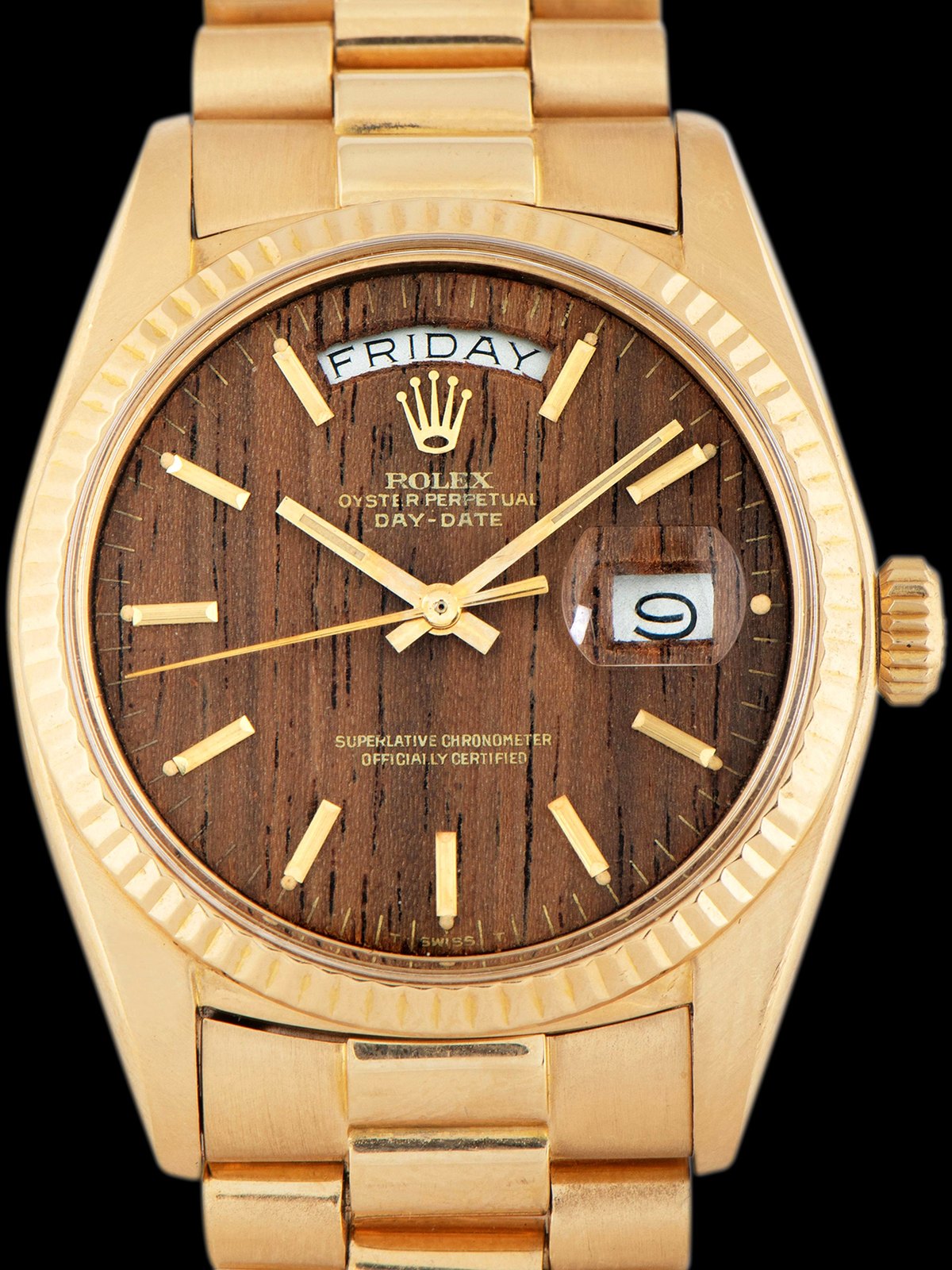
Rolex Day-Date 18K YG (Ref. 1803) Sequoia Wood Dial, 1973
- Maker / attribution
- Rolex (maker)
- Date
- 1973
- Historical period
- Quartz Revolution (1969 – 1990)
- Country of origin
- Switzerland
- Object type
- Wristwatch
- Stock no.
- RLXDD180373SEQ
- Credit line
- Dealer listing, Craft & Tailored (RLXDD180373SEQ)
- Catalogue title (original)
- 1973 Rolex Day-Date 18K YG (Ref. 1803) Sequoia Wood Dial W/ Box & Papers (English)
View the source record (dealer listing) ↗ (opens another website in a new tab)Suggest a correction
Record summary
Catalogued by Craft & Tailored (dealer), Los Angeles (stock number RLXDD180373SEQ), this is a wristwatch by Rolex, made in Switzerland, dated 1973. The Atlas places it in the Quartz Revolution period (1969 – 1990) of its Wristwatches collection. The record is illustrated with 6 photographs.
Assembled from the source record's structured fields. Dates and attributions are given as the source states them; where a field is missing the Atlas leaves it blank rather than estimating.
Catalogue description
Dealer description — Craft & Tailored
The Rolex Day-Date is one of the most iconic and beautiful watches in the Rolex catalog. The Rolex Day-Date earned the nickname "President" after it was rumored that President Dwight Eisenhower wore one, but Eisenhower actually wore a Rolex 18K yellow gold Oyster-Perpetual Datejust, which Rolex gifted to him in 1953. However, the nickname "President" is quite fitting for the Day-Date, as Presidents Kennedy, Johnson, Ford, Reagan, Nixon, and Roosevelt all wore the Rolex Day-Date. Apart from its executive affiliation, the Day-Date is a symbol of status and luxury, only produced in highly refined precious metals, including 18K yellow, white, and rose gold, and also platinum, featuring both the day and date complications within the movement. On an extremely limited basis, Rolex manufactured timepieces featuring exotic materials. Such as dials made from various minerals, woods, and stones, including black onyx, wood, lapis lazuli, birch, malachite, fossil, coral, aventurine, and ferrite, among others… These exotic variants are always strikingly vivid with a minimalist design, and each exotic variant was produced in very limited numbers. With rarity varying between materials, the rarer the material was, the fewer Rolex produced. The “Sequoia” dial represents the earliest iteration of Rolex’s wood dials for the Day-Date. These first-generation examples possess a distinctly raw, prototype-like character, defined by the absence of the lacquer finish later applied to Birch and Burlwood dials. Without this refined topcoat, the natural grain and organic texture of the wood remain fully visible, lending the dial an almost “living-edge” appearance, particularly around the day and date apertures. Unusually, these dials were also fitted with luminous plots—something never again seen on later exotic wood or stone variants—adding another layer of intrigue and charm to their already unique aesthetic. Each Sequoia dial is inherently one-of-a-kind, its individuality amplified by the natural variation of the wood and the experimental spirit of its creation. This rare dial type stands as a testament to a fascinating period in Rolex’s history when the brand dared to push design boundaries, even offering such experimental watches for public sale, albeit in extremely limited numbers. SPECS Stock # RLXDD180373SEQ Brand Rolex Style Day-Date Model 1803 Serial 32XXXXX Size Men's Material 18K Yellow Gold Dial Wood "Sequoia" Millimeters 36 Bracelet Rolex 18K YG President Bracelet CASE & BRACELET The excellent 18K yellow gold case has thick and even lugs that show only gentle signs of use, with minimal evidence of being previously polished present. The 18K yellow gold fluted bezel retains defined lines and edges with minimal signs of use present. The original 18K yellow gold President bracelet retains 21 links that show light stretch and will fit up to an 8.25-inch wrist. DIAL & HANDS The original and simply stunning "Sequoia" wood dial is in truly marvelous condition. The one-of-a-kind dial displays the organic grain of the wood in an unrefined and raw state, while also remaining in virtually perfect condition, with no damage or notable age present. The tritium lume plots all remain fully intact, with no degradation present, and have achieved a charming creamy patina. The original tritium hands match the dial perfectly and exhibit no degradation when inspected under UV light. ACCESSORIES The watch comes as a complete set with its original leather "President" Rolex box, Rolex guarantee paper, and booklets. The watch is keeping time, but the service history is unknown. A movement service can be provided upon request.
Historical context
Quartz Revolution (1969 – 1990)
Seiko's Astron begins mass quartz timekeeping; traditional industries contract sharply.
Quartz and digital watches transformed the market after 1969. Swiss employment collapsed, Japanese and Hong Kong production soared, and the Swatch (1983) helped the Swiss industry recover; mechanical watches survived as luxury goods.
Read the period in the timelineMore wristwatches from this periodEarlier: Modern Mechanical Horology
Atlas type guide
Calendar, moon-phase and perpetual calendar watches
Calendar complications range from a simple date to the perpetual calendar, which automatically allows for months of different lengths and leap years until 2100. Pocket watches with perpetual calendars were made in the eighteenth and nineteenth centuries; Patek Philippe made the first perpetual calendar wristwatch in 1925, and series production followed in 1941. The annual calendar (Patek Philippe, 1996) needs correction only once a year.
Moon-phase displays use a disc with two moons and 59 teeth advanced daily, approximating the 29.5-day lunation; more precise trains reduce the error to one day in over a century.
What to look for
- Apertures or subsidiary dials for day, date, month and leap year.
- Moon disc under a 'bosom' shaped aperture.
- Recessed correctors on the case band for setting the calendar.
Dating clues
- Triple-date wristwatches: popular c. 1940–1955.
- Perpetual calendar wristwatches: from 1925 (unique) and 1941 (series).
General guidance written by the Atlas editors about this kind of object. It is not a statement about this particular piece; for that, rely on the source record above and on physical examination.
Related records

Movements & Components · c. 1970s
Rolex watch movement, c. 1970s
Antiquorum auction archive, Geneva

Pocket Watches · 1982
Fake Rolex watch, gold coloured metal, possibly made in Taiwan, 1982; part of a casual outfit, UK, 1982-84.
Victoria and Albert Museum, London

Wristwatches · c. 1920s
Rolex wristwatch, c. 1920s
Antiquorum auction archive, Geneva

Wristwatches · c. 1920s
Rolex wristwatch, ref. 6194, c. 1920s
Antiquorum auction archive, Geneva

Wristwatches · 1970
Wristwatch by Heno, Switzerland, 1970
Museum Rotterdam

Wristwatches · 1960–1986
'Tri-Compax' calendar chronograph wristwatch in gold case, by Universal, Geneva, Switzerland, 1960–1986.
Science Museum Group, London

Wristwatches · 1969–1970
Beta 21 Quartz wristwatch movement, made in Switzerland, 1970.
Science Museum Group, London

Wristwatches · c. 1969
Omega Speedmaster Moonwatch, ref. 145022-69st, c. 1969
Antiquorum auction archive, Geneva