
Wristwatches · Wristwatch
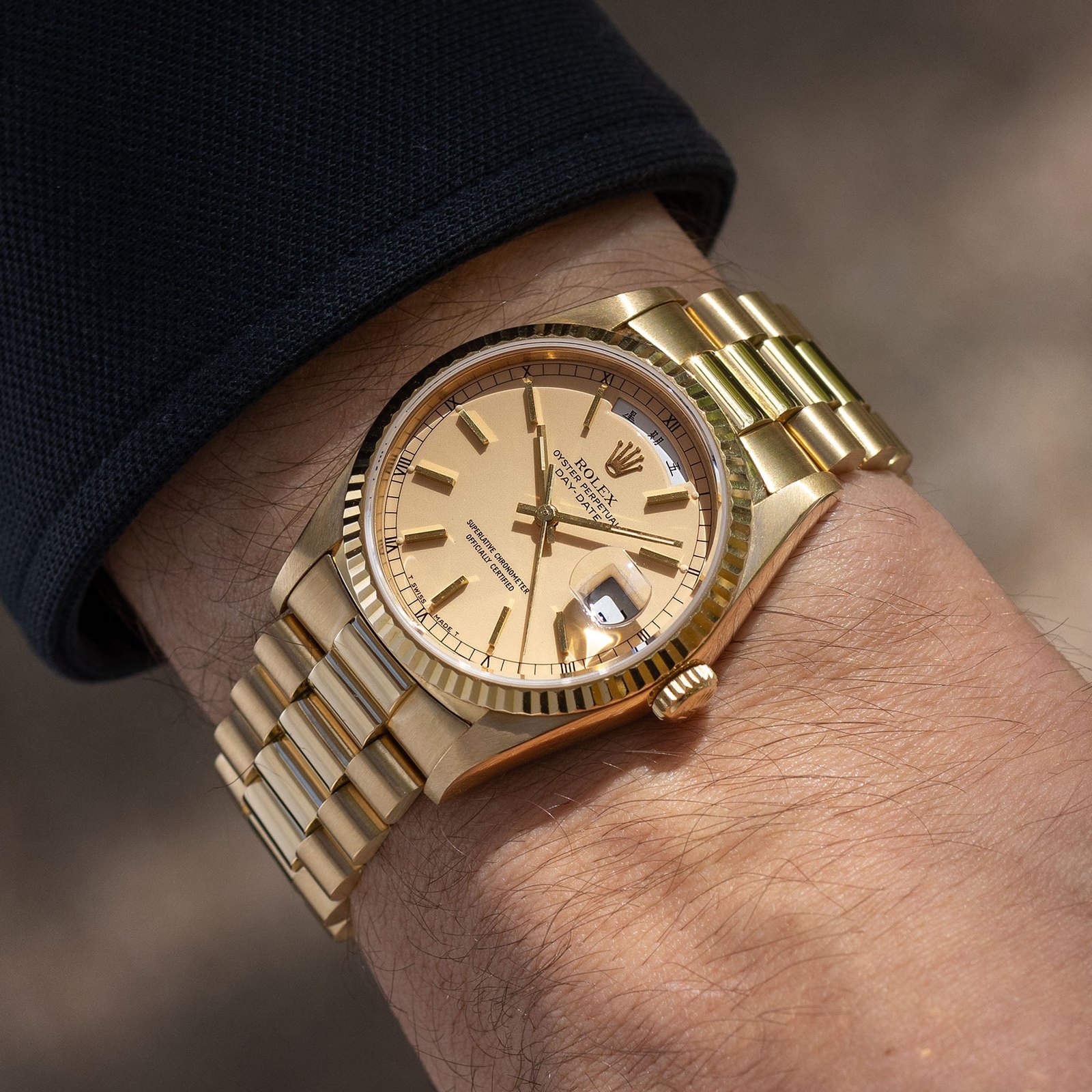
Rolex Day-Date 18238 rare Apricot Stella Dial with Original Guarantee paper in 18k Yellow Gold, 1991
- Maker / attribution
- Rolex (maker)
- Date
- 1991
- Historical period
- Mechanical Renaissance (1990 – 2010)
- Country of origin
- Switzerland
- Object type
- Wristwatch
- Materials / technique
- 18k yellow gold
- Dimensions
- Case 36 mm
- Stock no.
- W-3742
- Credit line
- Dealer listing, Bulang & Sons (W-3742)
- Catalogue title (original)
- Rolex Day-Date 18238 rare Apricot Stella Dial with Original Guarantee paper in 18k Yellow Gold (English)
View the source record (dealer listing) ↗ (opens another website in a new tab)Suggest a correction
Record summary
Catalogued by Bulang & Sons (dealer), Copenhagen (stock number W-3742), this is a wristwatch by Rolex, made in Switzerland, dated 1991. The Atlas places it in the Mechanical Renaissance period (1990 – 2010) of its Wristwatches collection. Materials and techniques recorded by the source: 18k yellow gold. Recorded dimensions: Case 36 mm. The record is illustrated with 6 photographs.
Assembled from the source record's structured fields. Dates and attributions are given as the source states them; where a field is missing the Atlas leaves it blank rather than estimating.
Catalogue description
Dealer description — Bulang & Sons
Introduced in 1956, the Rolex Day-Date set a new benchmark in watchmaking as the first wristwatch to display both the date and the day of the week fully spelled out on the dial. Crafted exclusively in precious metals, the Day-Date quickly established itself as Rolex’s flagship model and, over the decades, became a lasting symbol of prestige, success, and influence — worn by presidents, world leaders, and cultural icons alike. We always aim to source beautiful and interesting Day-Dates, and today we are delighted to present a particularly rare and charismatic example. Presented here is a lovely reference 18238 in 18k yellow gold. The case remains in outstanding condition and is fitted with a beautifully sharp fluted bezel. The undeniable highlight of this watch, however, is its spectacular glossy lacquer dial in a soft cream tone with subtle light Apricot/Peach undertones — one of the famous and highly collectible “Stella” dials. For many years, collectors debated the origin of the “Stella” name. Some believed it referred to the dial’s glossy, almost reflective appearance, with “stella” meaning “star” in Italian. Others linked the name to Frank Stella, the American artist celebrated for his bold and colourful works. The true origin, however, lies in production history. The name derives from Stella S.A., a Swiss lacquer supplier responsible for producing the vibrant, high-gloss enamel finishes used for these extraordinary dials. While “Stella dial” became a popular collector term, it is interesting to note that Rolex itself also referred to them internally as “Lacquered Stella” dials in period catalogues and documentation. Today, Stella dials are admired not only for their rich colours and glossy surfaces, but also for their rarity and their connection to one of Rolex’s most daring and expressive design periods. At the time of their introduction, these colourful dials were considered far too bold for many traditional Day-Date buyers, resulting in relatively low production numbers and very few surviving examples in truly excellent condition. Over recent years, this more unconventional side of Rolex has become increasingly appreciated by collectors, with exceptional Stella dial examples now achieving values comparable to — and sometimes exceeding — those of highly collectible vintage Daytona references. This particular Apricot/peach-toned Stella belongs to the later generation of Stella dials and features a finely printed railroad minute track with elegant Arabic numerals positioned within the track itself. Applied stick hour markers and crisp black printed text complete the design beautifully. The lacquer surface remains wonderfully glossy, while the black text appears almost to “float” above the dial — a charming visual detail we especially love on these Stella configurations. Adding even further rarity, both the day and date discs are executed in Chinese. The watch is paired with a President bracelet, reference 8385, fitted with solid end links and remaining in excellent condition throughout. Furthermore, the watch is accompanied by two original booklets, a red Rolex document holder, a Rolex calendar card, and its original punched guarantee papers showing a 1994 sale in Paris. One of the most expressive and collectible Day-Date configurations Rolex ever produced, the soft Apricot/Peach glossy Stella tone gives this Day-Date a truly unique warmth and personality, We are always happy to help collectors find the right watch — Perhaps this is the one !? Specifications: Rolex Day-Date Reference 18238 36mm 18k yellow gold case, sapphire crystal Super rare Stella dial soft “Apricot/Peach” colour Serial N58xxxx dating to 1991 Rare Chinese language day and date disc Double quick setting movement Yellow gold President bracelet with concealed clasp ref 8385 Rolex Booklets, red document holder, calendar card Punched guarantee paper stating sale in Paris, France 1994 Fully serviced by our watch maker
Historical context
Mechanical Renaissance (1990 – 2010)
Mechanical watches return as cultural objects; independent watchmaking flourishes.
Mechanical watches returned as cultural and luxury objects. Complications, tourbillons and new materials proliferated; independent watchmakers such as George Daniels, F.P. Journe and Philippe Dufour revived artisanal watchmaking; collecting vintage watches became a major field.
Read the period in the timelineMore wristwatches from this periodEarlier: Quartz Revolution
Atlas type guide
Calendar, moon-phase and perpetual calendar watches
Calendar complications range from a simple date to the perpetual calendar, which automatically allows for months of different lengths and leap years until 2100. Pocket watches with perpetual calendars were made in the eighteenth and nineteenth centuries; Patek Philippe made the first perpetual calendar wristwatch in 1925, and series production followed in 1941. The annual calendar (Patek Philippe, 1996) needs correction only once a year.
Moon-phase displays use a disc with two moons and 59 teeth advanced daily, approximating the 29.5-day lunation; more precise trains reduce the error to one day in over a century.
What to look for
- Apertures or subsidiary dials for day, date, month and leap year.
- Moon disc under a 'bosom' shaped aperture.
- Recessed correctors on the case band for setting the calendar.
Dating clues
- Triple-date wristwatches: popular c. 1940–1955.
- Perpetual calendar wristwatches: from 1925 (unique) and 1941 (series).
General guidance written by the Atlas editors about this kind of object. It is not a statement about this particular piece; for that, rely on the source record above and on physical examination.
Related records

Movements & Components · c. 1970s
Rolex watch movement, c. 1970s
Antiquorum auction archive, Geneva

Pocket Watches · 1982
Fake Rolex watch, gold coloured metal, possibly made in Taiwan, 1982; part of a casual outfit, UK, 1982-84.
Victoria and Albert Museum, London

Wristwatches · c. 1920s
Rolex wristwatch, c. 1920s
Antiquorum auction archive, Geneva

Wristwatches · c. 1920s
Rolex wristwatch, ref. 6194, c. 1920s
Antiquorum auction archive, Geneva

Wristwatches · 2008
Wristwatch by Breitling?, 2008
Museum Rotterdam

Wristwatches · c. 1990s
Audemars Piguet Bamboo, c. 1990s
Antiquorum auction archive, Geneva

Wristwatches · c. 1990
Audemars Piguet Huitieme Perpetual Calendar, ref. 25696PT, c. 1990
Antiquorum auction archive, Geneva

Wristwatches · c. 1990
Breitling Chronomat, ref. b13050.1, c. 1990
Antiquorum auction archive, Geneva