
Wristwatches · Wristwatch
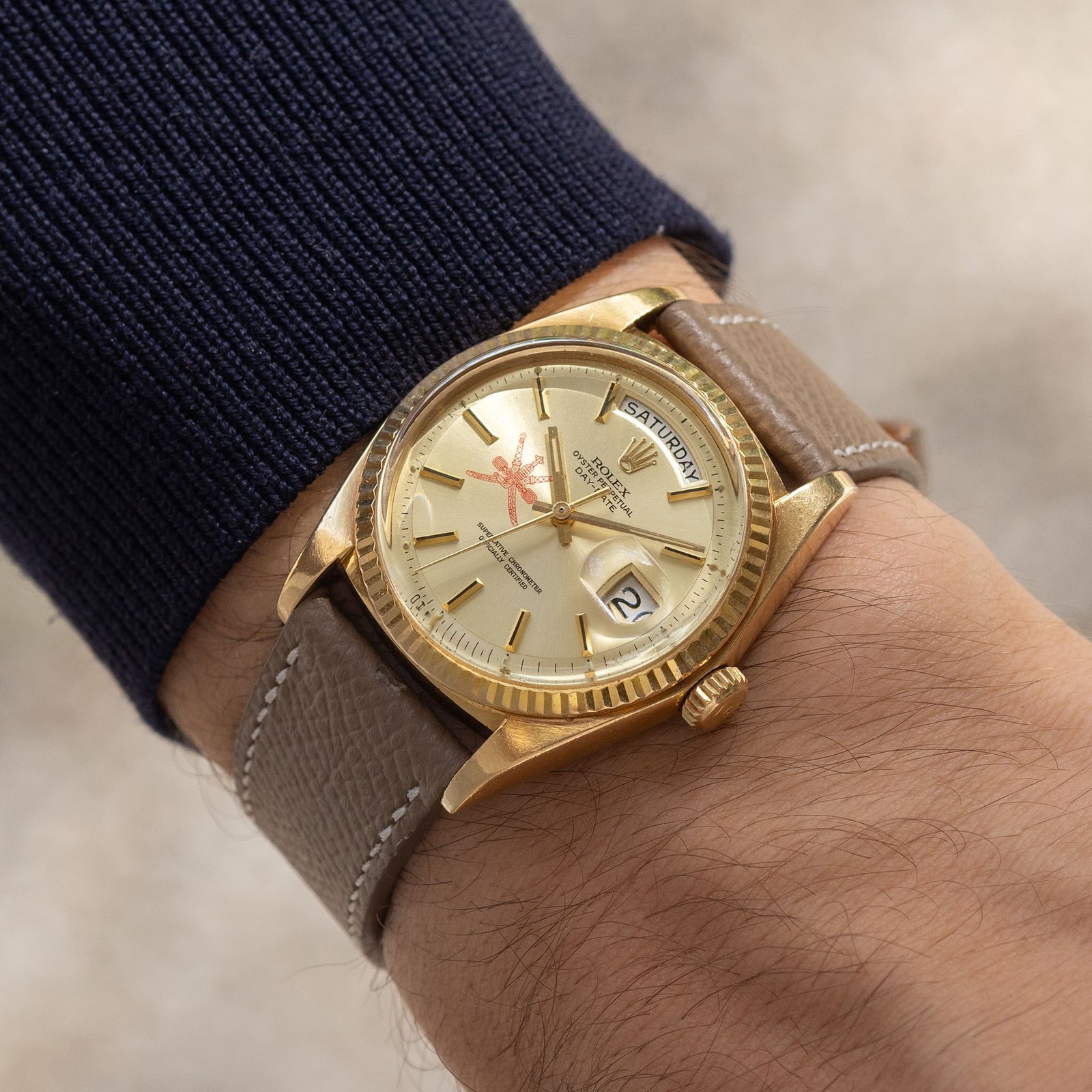
Rolex Day-Date 1803 Khanjar Sigma Champagne Dial, 1974
- Maker / attribution
- Rolex (maker)
- Date
- 1974
- Historical period
- Quartz Revolution (1969 – 1990)
- Country of origin
- Switzerland
- Object type
- Wristwatch
- Dimensions
- Case 36 mm
- Stock no.
- W-3817
- Credit line
- Dealer listing, Bulang & Sons (W-3817)
- Catalogue title (original)
- Rolex Day-Date 1803 Khanjar Sigma Champagne Dial (English)
View the source record (dealer listing) ↗ (opens another website in a new tab)Suggest a correction
Record summary
Catalogued by Bulang & Sons (dealer), Copenhagen (stock number W-3817), this is a wristwatch by Rolex, made in Switzerland, dated 1974. The Atlas places it in the Quartz Revolution period (1969 – 1990) of its Wristwatches collection. Recorded dimensions: Case 36 mm. The record is illustrated with 6 photographs.
Assembled from the source record's structured fields. Dates and attributions are given as the source states them; where a field is missing the Atlas leaves it blank rather than estimating.
Catalogue description
Dealer description — Bulang & Sons
The Rolex Day-Date, introduced in 1956, marked a significant milestone in watchmaking as the world’s first wristwatch to display both the date and the day of the week fully spelled out on the dial. Positioned at the very top of the Rolex catalogue, the Day-Date has exclusively been produced in precious metals — including 18k yellow, white, or rose gold, as well as platinum — reinforcing its status as the brand’s ultimate flagship model! The present watch is a classic 36 mm 18k yellow gold reference 1803, featuring a beautifully preserved case and crisp fluted bezel. While the watch itself is undeniably elegant, the true highlight of this example is undoubtedly its dial!! It features what is arguably the quintessential Day-Date configuration: a sunburst champagne dial with contrasting black printed text, enhanced by a Sigma designation at six o’clock — denoting that the hands and hour markers are crafted from gold. Most notably, the dial proudly bears a rare red Omani Khanjar emblem, adding a fascinating layer of historical significance and collectability. For those less familiar with the emblem, the Omani Khanjar is a traditional ceremonial dagger and one of the most important national symbols of Oman, representing pride, heritage, and status. From the 1970s onward, Qaboos bin Said al Said became widely known for commissioning specially ordered watches adorned with the royal Khanjar crest, either printed on the dial or engraved on the case back. These pieces were typically gifted to high-ranking military officers, diplomats, loyal advisers, and prominent figures within the Sultan’s inner circle, giving them both exceptional rarity and strong historical importance. Many of these special commissions were supplied through Asprey of New Bond Street in London, the Sultan’s official jeweller during the era. Today, Asprey-delivered Khanjar-signed Rolex watches are regarded among the most collectible and desirable special-order vintage Rolex models ever produced, with well-preserved examples becoming increasingly difficult to source. This elegant Day-Date, together with its slow-set movement, has been fully serviced by our watchmaker and is ready to be enjoyed for many years to come. Specifications: Rolex Day-Date Reference 1803 36mm yellow gold case, plexi crystal Serial 360xxxx dating to 1974 Rare Champagne colour Sigma dial, with red Khanjar English day disc Bulang and sons leather strap Fully serviced by our watchmaker
Historical context
Quartz Revolution (1969 – 1990)
Seiko's Astron begins mass quartz timekeeping; traditional industries contract sharply.
Quartz and digital watches transformed the market after 1969. Swiss employment collapsed, Japanese and Hong Kong production soared, and the Swatch (1983) helped the Swiss industry recover; mechanical watches survived as luxury goods.
Read the period in the timelineMore wristwatches from this periodEarlier: Modern Mechanical Horology
Atlas type guide
Calendar, moon-phase and perpetual calendar watches
Calendar complications range from a simple date to the perpetual calendar, which automatically allows for months of different lengths and leap years until 2100. Pocket watches with perpetual calendars were made in the eighteenth and nineteenth centuries; Patek Philippe made the first perpetual calendar wristwatch in 1925, and series production followed in 1941. The annual calendar (Patek Philippe, 1996) needs correction only once a year.
Moon-phase displays use a disc with two moons and 59 teeth advanced daily, approximating the 29.5-day lunation; more precise trains reduce the error to one day in over a century.
What to look for
- Apertures or subsidiary dials for day, date, month and leap year.
- Moon disc under a 'bosom' shaped aperture.
- Recessed correctors on the case band for setting the calendar.
Dating clues
- Triple-date wristwatches: popular c. 1940–1955.
- Perpetual calendar wristwatches: from 1925 (unique) and 1941 (series).
General guidance written by the Atlas editors about this kind of object. It is not a statement about this particular piece; for that, rely on the source record above and on physical examination.
Related records

Movements & Components · c. 1970s
Rolex watch movement, c. 1970s
Antiquorum auction archive, Geneva

Pocket Watches · 1982
Fake Rolex watch, gold coloured metal, possibly made in Taiwan, 1982; part of a casual outfit, UK, 1982-84.
Victoria and Albert Museum, London

Wristwatches · c. 1920s
Rolex wristwatch, c. 1920s
Antiquorum auction archive, Geneva

Wristwatches · c. 1920s
Rolex wristwatch, ref. 6194, c. 1920s
Antiquorum auction archive, Geneva

Wristwatches · 1970
Wristwatch by Heno, Switzerland, 1970
Museum Rotterdam

Wristwatches · 1960–1986
'Tri-Compax' calendar chronograph wristwatch in gold case, by Universal, Geneva, Switzerland, 1960–1986.
Science Museum Group, London

Wristwatches · 1969–1970
Beta 21 Quartz wristwatch movement, made in Switzerland, 1970.
Science Museum Group, London

Wristwatches · c. 1969
Omega Speedmaster Moonwatch, ref. 145022-69st, c. 1969
Antiquorum auction archive, Geneva