
Wristwatches · Wristwatch
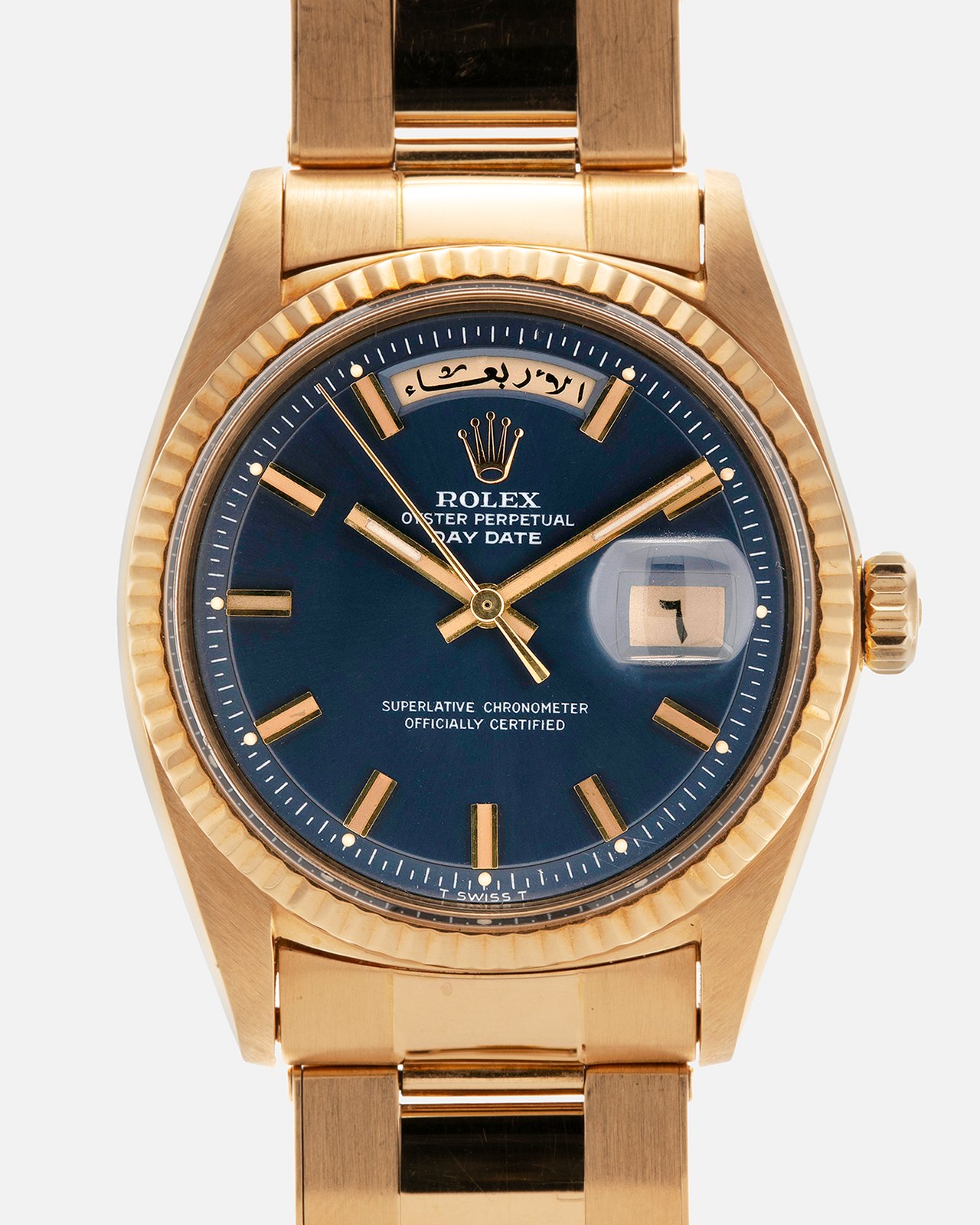
Rolex Day-Date 1803 Blue Wide Boy Oyster Rivet Arabic Date, 1971
- Maker / attribution
- Rolex (maker)
- Date
- 1971
- Historical period
- Quartz Revolution (1969 – 1990)
- Country of origin
- Islamic world
- Object type
- Wristwatch
- Dimensions
- Case 36 mm
- Stock no.
- Product 7527019479127
- Credit line
- Dealer listing, S.Song Watches (product 7527019479127)
- Catalogue title (original)
- Rolex Day-Date 1803 Blue Wide Boy Oyster Rivet Arabic Date (English)
View the source record (dealer listing) ↗ (opens another website in a new tab)Suggest a correction
Record summary
Catalogued by S.Song Watches (dealer), Seattle (stock number Product 7527019479127), this is a wristwatch by Rolex, made in Islamic world, dated 1971. The Atlas places it in the Quartz Revolution period (1969 – 1990) of its Wristwatches collection. Recorded dimensions: Case 36 mm. The record is illustrated with 6 photographs.
Assembled from the source record's structured fields. Dates and attributions are given as the source states them; where a field is missing the Atlas leaves it blank rather than estimating.
Catalogue description
Dealer description — S.Song Watches
To this day, the Rolex Day-Date stands as one of the most iconic watches ever created. Even to those unfamiliar with horology, or watches in general, it’s instantly recognisable. First introduced in 1956, the reference most closely tied to the model’s golden era is the 1803, distinguished by its fluted bezel and timeless proportions. From its inception, one rule has defined the Day-Date: it was to be crafted only in precious metals, with yellow gold as the signature choice. Combined with Rolex’s reputation for durability and precision, the watch became an enduring emblem of prestige and good taste. When it comes to noteworthy Day-Dates, there’s rare, and then there’s the kind of rare that makes even the most seasoned collectors pause. The 1803 we have here sits firmly in that latter category. This isn’t your typical Day-Date; it’s a 1803 featuring an extraordinary blue ‘Wide Boy’ dial paired with an Arabic day wheel—something you simply don’t see very often in the wild. Even for us, this one ranks right up there among some of the most remarkable variants in Rolex collecting. For context, the ‘Wide Boy’ designation refers to a dial-and-hand configuration produced briefly by Rolex in the early to mid-1970s. Found on select Day-Date 1803 and Datejust 16XX models, these variants feature oversized baton hour markers flanked by thick enamel stripes and matching wide ‘cigarette’ hands. The result is a more visually pronounced, distinctive aesthetic. Produced in far smaller numbers than standard stick-marker dials, ‘Wide Boy’ examples are especially sought after among serious vintage Rolex collectors. Another charming detail worth noting is the absence of a hyphen between the ‘Day’ and ‘Date’ text at 12:00, which is a quirk believed to be exclusive only to ‘Wide Boy’ dials. Crafted from 18-carat yellow gold, our ‘Wide Boy’ 1803 example features the classic 36 mm case with its signature fluted bezel, as denoted by the ‘3’ in the reference number. What truly sets this example apart, however, is its arresting blue dial with a subtle, muted quality that pairs beautifully with the warmth of the patinated gold case. As showcased in the listing photos, the dial remains in outstanding condition, retaining its Arabic day and date discs, both of which are quite uncommon, especially with Day-Dates from this era. The luminous material on the dial has aged evenly across the hour markers and hands, forming a warm, cohesive patina. Taken together, the composition exudes a quiet sense of balance, opulence and visual grandeur that’s hard to put into words, but one glance is enough to know this is no ordinary Day-Date 1803. Completing the piece is a period-correct 20mm rivet Oyster bracelet, a highly collectable and early example with exposed rivets and lightweight hollow links. Its pronounced taper toward the clasp enhances comfort and perfectly complements the vintage proportions of the 1803. As far as the movement goes, powering the 1803 from within is Rolex’s Cal. 1556, a chronometer-rated automatic movement that represents the pinnacle of the brand’s 1500-series era. It beats methodically at 19,800 vph and is well-known for its smooth operation and no-frills reliability. This is one of those rare specimens that surfaces once in a blue moon, and we’re genuinely thrilled to be able to offer one here. It is, without any doubt, an exceptional example of a Day-Date that represents the very best of vintage Rolex collecting. For serious enthusiasts, it’s a piece that speaks for itself. The photos tell the story better than words ever could.
Historical context
Quartz Revolution (1969 – 1990)
Seiko's Astron begins mass quartz timekeeping; traditional industries contract sharply.
Quartz and digital watches transformed the market after 1969. Swiss employment collapsed, Japanese and Hong Kong production soared, and the Swatch (1983) helped the Swiss industry recover; mechanical watches survived as luxury goods.
Read the period in the timelineMore wristwatches from this periodEarlier: Modern Mechanical Horology
Atlas type guide
Dive and water-resistant watches
Keeping water and dust out of a wristwatch was a long-standing challenge. Rolex's screw-down Oyster case (1926) and Omega's Marine (1932) were landmarks; in the early 1950s Blancpain's Fifty Fathoms and Rolex's Submariner defined the professional dive watch with rotating bezels for timing dives, luminous dials and high water resistance. The ISO 6425 standard (1982) later codified what a 'diver's watch' must do.
Dive watches became icons of post-war design and exploration, and their evolution — helium escape valves, ceramic bezels, saturation-diving depth ratings — records the history of underwater work.
What to look for
- Unidirectional or bidirectional rotating bezel with minute markings.
- Screw-down crown and case back; depth rating printed on the dial.
- Luminous hands and markers (radium before c. 1960, tritium c. 1960–1998, then Super-LumiNova).
- Reference numbers on the case between the lugs or inside the back.
Dating clues
- Screw-down Oyster cases: from 1926.
- Professional dive watches: from 1953.
- Tritium 'T' marks on dials: c. 1960–1998.
General guidance written by the Atlas editors about this kind of object. It is not a statement about this particular piece; for that, rely on the source record above and on physical examination.
Related records

Movements & Components · c. 1970s
Rolex watch movement, c. 1970s
Antiquorum auction archive, Geneva

Pocket Watches · 1982
Fake Rolex watch, gold coloured metal, possibly made in Taiwan, 1982; part of a casual outfit, UK, 1982-84.
Victoria and Albert Museum, London

Wristwatches · c. 1920s
Rolex wristwatch, c. 1920s
Antiquorum auction archive, Geneva

Wristwatches · c. 1920s
Rolex wristwatch, ref. 6194, c. 1920s
Antiquorum auction archive, Geneva

Wristwatches · 1970
Wristwatch by Heno, Switzerland, 1970
Museum Rotterdam
Wristwatches · 1970s
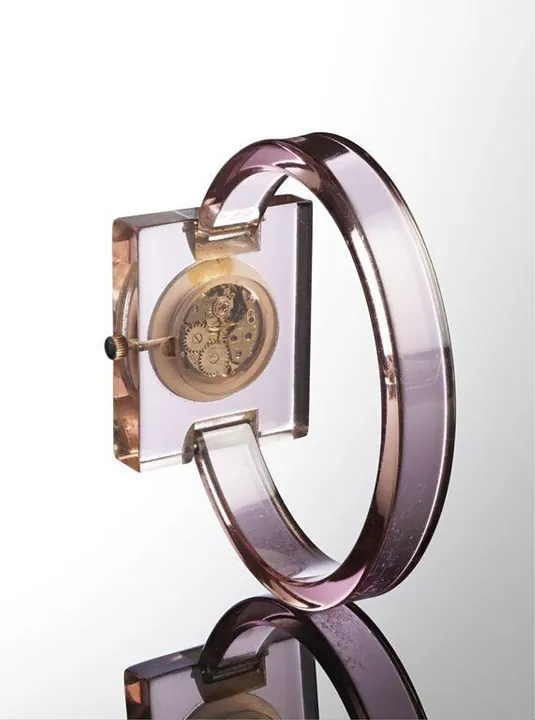
Wristwatch, plastic, by Gucci; Italy, 1970s.
Victoria and Albert Museum, London
Wristwatches · 1978
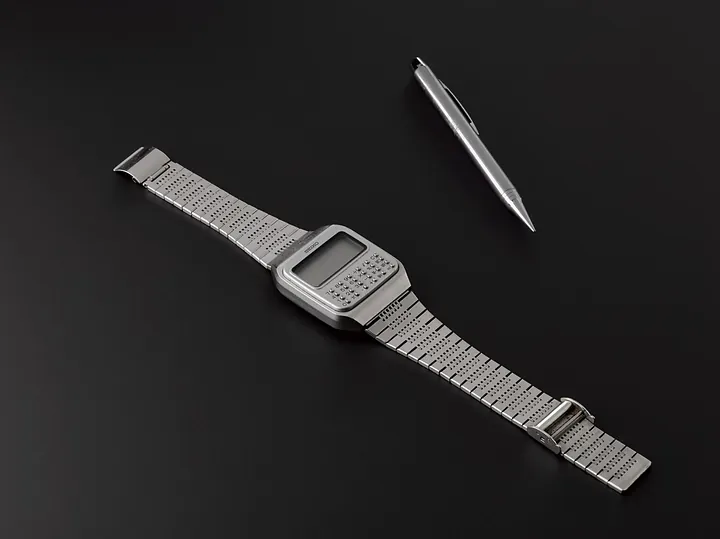
Calculator wristwatch by Suwa Seikosha Co. Limited, Japan, 1978
Science Museum Group, London
Wristwatches · 1980
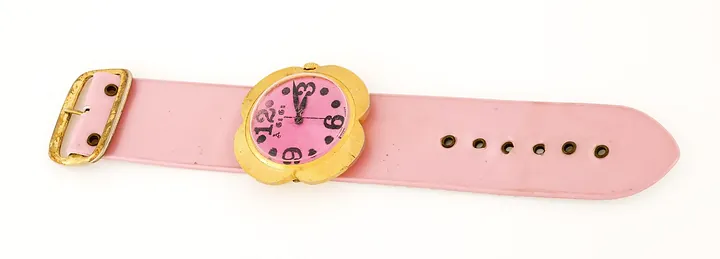
Wristwatch, 1980 (no. 71413)
Museum Rotterdam