
Wristwatches · Wristwatch
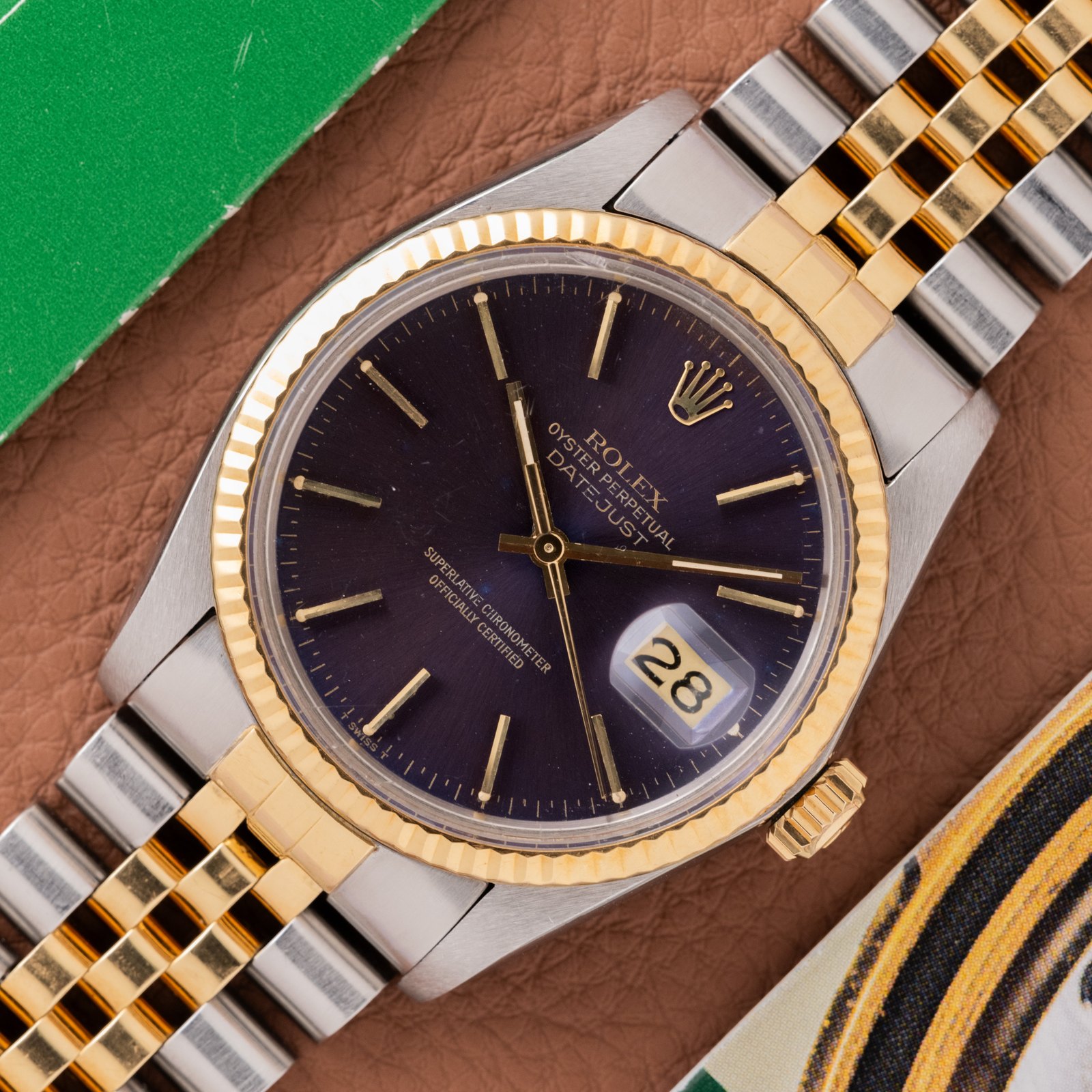
Rolex Datejust Purple Patina Dial (Ref. 16013), 1984
- Maker / attribution
- Rolex (maker)
- Date
- 1984
- Historical period
- Quartz Revolution (1969 – 1990)
- Country of origin
- Switzerland
- Object type
- Wristwatch
- Dimensions
- Case 36 mm
- Stock no.
- Product 15932560179383
- Credit line
- Dealer listing, Huntington Company (product 15932560179383)
- Catalogue title (original)
- 1984 Rolex Datejust Purple Patina Dial - With Paper (Ref. 16013) (English)
View the source record (dealer listing) ↗ (opens another website in a new tab)Suggest a correction
Record summary
Catalogued by Huntington Company (dealer) (stock number Product 15932560179383), this is a wristwatch by Rolex, made in Switzerland, dated 1984. The Atlas places it in the Quartz Revolution period (1969 – 1990) of its Wristwatches collection. Recorded dimensions: Case 36 mm. The record is illustrated with 6 photographs.
Assembled from the source record's structured fields. Dates and attributions are given as the source states them; where a field is missing the Atlas leaves it blank rather than estimating.
Catalogue description
Dealer description — Huntington Company
History and Significance Few watches have remained as relevant to the history of Rolex as the Datejust. Introduced in 1945, the collection established a new standard for the everyday wristwatch by combining an automatically winding movement, a date display, and the versatility of a waterproof Oyster case. Over the following decades, the Datejust evolved through a remarkable variety of dial configurations, case materials, and bracelet combinations while maintaining an unmistakable identity. By the 1980s, the model had become one of the most recognizable watches in the world, occupying a position between the manufacturer's professional sports collections and its more traditional dress watches. The reference 16013 is particularly representative of this period, combining a stainless steel Oyster case with an 18k yellow gold fluted bezel and a two-tone Jubilee bracelet. Introduced during the late 1970s, the reference belonged to the generation of Datejust watches powered by the caliber 3035, which introduced a quickset date function to the collection. This improvement made the watch considerably more convenient to operate while preserving the familiar appearance of earlier Datejust models. The 36mm case, acrylic crystal, and sharply defined fluted bezel retained the proportions and details that had made the collection successful for decades. One of the most fascinating aspects of vintage Rolex collecting is the extraordinary variety of dials produced during the 1970s and 1980s. Rolex experimented with numerous colors, finishes, and decorative treatments, creating configurations that ranged from conservative silver and champagne dials to vibrant blue, burgundy, and unusual stone executions. Over time, some of these dials developed changes in color as their original finishes reacted to age and environmental exposure. These changes can be particularly dramatic on blue dials, where the original color occasionally shifts toward violet, purple, or warmer shades. Such transformations are difficult to predict, making naturally aged examples especially interesting to collectors. The dial on this 1984 reference 16013 is a particularly attractive example of that phenomenon. Originally blue, the surface has developed an even purple coloration that changes in appearance depending on the surrounding light. The warm gold hour markers and hands provide a striking contrast against the cooler violet tones, creating a combination that feels entirely appropriate for the decorative character of a two-tone Datejust. Unlike more conventional dial variations, this particular appearance is the result of decades of natural aging, giving the watch a character that could not have been specified when originally purchased. The preservation of the surrounding components is equally important. The case retains thick, sharply defined lugs, while the fluted gold bezel remains attractive and well proportioned. The two-tone Jubilee bracelet complements the watch without distracting from the unusual dial, maintaining the classic appearance associated with the reference 16013. Accompanied by original papers, this example offers an appealing combination of recognizable Rolex design, period-correct character, and a dial that has developed into something considerably more unusual than its original configuration. Writer’s Thoughts The reference 3546 is particularly appealing because the aging has given the watch a personality that would be difficult to find in a more conventional example. The blue dial has developed a beautiful faded appearance, moving away from the rich, saturated color usually associated with the Golden Ellipse. The original black hands have aged evenly to a ghost-white tone, creating a striking contrast against the softened blue background. These are the kinds of changes that make vintage watches interesting as individual objects rather than simply examples of a particular reference. Our Promise Every watch is thoroughly vetted, carefully described with complete transparency, and guaranteed authentic. Each piece is offered in honest condition, ensuring collectors receive a timepiece that reflects both originality and integrity. Specifications Model: Golden Ellipse Reference: 3546 Year: 1970s Case Material: 18k White Gold Case Size: 27mm Dial: Blue Dial with Attractive Fading and Applied Hour Markers Movement: Manual-Winding Mechanical Movement Strap/Buckle: Original Patek Philippe Leather Strap Buckle/Clasp: Original Patek Philippe Ellipse Buckle Contents: Watch only Condition Case: White gold case remains in excellent vintage condition with light surface wear consistent with age and use. The case appears unpolished and retains attractive original definition. Dial: Blue dial has developed a beautiful, even faded appearance with soft variations in color. The applied hour markers and printing remain well preserved. The marks you se are from light scratches on the orignal crystal. Hands: Original black hands have aged evenly to an attractive ghost-white tone, complementing the faded blue dial. Crystal: Crystal remains in good condition with light surface wear consistent with age and use. Strap/Buckle: Original Patek Philippe leather strap remains in good vintage condition with signs of wear consistent with age. Buckle/Clasp: Original Patek Philippe Ellipse buckle remains in good condition with light surface wear.
Historical context
Quartz Revolution (1969 – 1990)
Seiko's Astron begins mass quartz timekeeping; traditional industries contract sharply.
Quartz and digital watches transformed the market after 1969. Swiss employment collapsed, Japanese and Hong Kong production soared, and the Swatch (1983) helped the Swiss industry recover; mechanical watches survived as luxury goods.
Read the period in the timelineMore wristwatches from this periodEarlier: Modern Mechanical Horology
Atlas type guide
Calendar, moon-phase and perpetual calendar watches
Calendar complications range from a simple date to the perpetual calendar, which automatically allows for months of different lengths and leap years until 2100. Pocket watches with perpetual calendars were made in the eighteenth and nineteenth centuries; Patek Philippe made the first perpetual calendar wristwatch in 1925, and series production followed in 1941. The annual calendar (Patek Philippe, 1996) needs correction only once a year.
Moon-phase displays use a disc with two moons and 59 teeth advanced daily, approximating the 29.5-day lunation; more precise trains reduce the error to one day in over a century.
What to look for
- Apertures or subsidiary dials for day, date, month and leap year.
- Moon disc under a 'bosom' shaped aperture.
- Recessed correctors on the case band for setting the calendar.
Dating clues
- Triple-date wristwatches: popular c. 1940–1955.
- Perpetual calendar wristwatches: from 1925 (unique) and 1941 (series).
General guidance written by the Atlas editors about this kind of object. It is not a statement about this particular piece; for that, rely on the source record above and on physical examination.
Related records

Movements & Components · c. 1970s
Rolex watch movement, c. 1970s
Antiquorum auction archive, Geneva

Pocket Watches · 1982
Fake Rolex watch, gold coloured metal, possibly made in Taiwan, 1982; part of a casual outfit, UK, 1982-84.
Victoria and Albert Museum, London

Wristwatches · c. 1920s
Rolex wristwatch, c. 1920s
Antiquorum auction archive, Geneva

Wristwatches · c. 1920s
Rolex wristwatch, ref. 6194, c. 1920s
Antiquorum auction archive, Geneva

Wristwatches · 1970
Wristwatch by Heno, Switzerland, 1970
Museum Rotterdam

Wristwatches · 1960–1986
'Tri-Compax' calendar chronograph wristwatch in gold case, by Universal, Geneva, Switzerland, 1960–1986.
Science Museum Group, London

Wristwatches · 1969–1970
Beta 21 Quartz wristwatch movement, made in Switzerland, 1970.
Science Museum Group, London

Wristwatches · c. 1969
Omega Speedmaster Moonwatch, ref. 145022-69st, c. 1969
Antiquorum auction archive, Geneva