
Wristwatches · Wristwatch
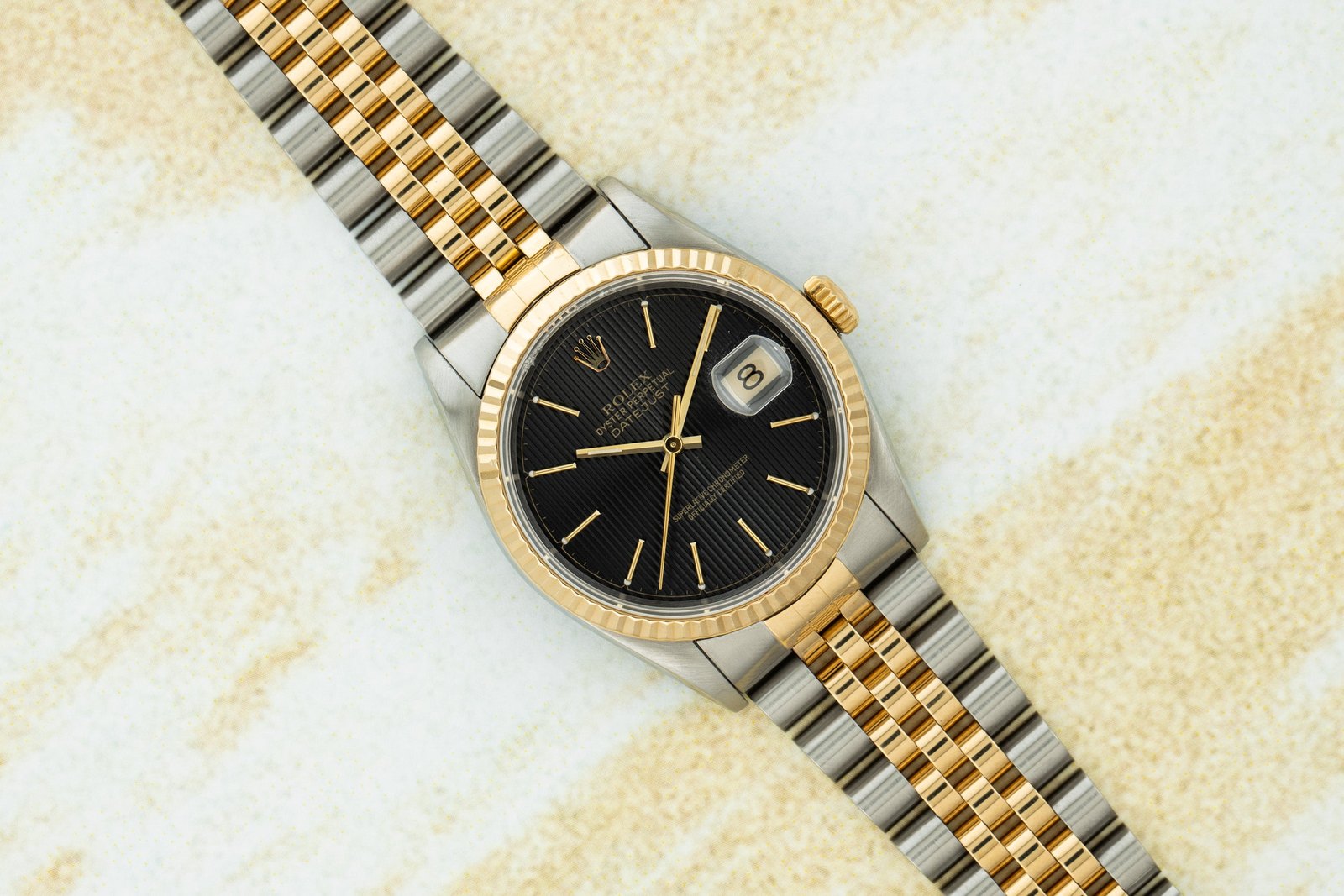
Rolex Datejust, c. 1993
- Maker / attribution
- Rolex (maker)
- Date
- c. 1993
- Historical period
- Mechanical Renaissance (1990 – 2010)
- Country of origin
- Switzerland
- Object type
- Wristwatch
- Dimensions
- Case 36 mm
- Stock no.
- 40920225
- Credit line
- Dealer listing, Analog/Shift (40920225)
- Catalogue title (original)
- Rolex Datejust (English)
View the source record (dealer listing) ↗ (opens another website in a new tab)Suggest a correction
Record summary
Catalogued by Analog/Shift (dealer), New York (stock number 40920225), this is a wristwatch by Rolex, made in Switzerland, dated c. 1993. The Atlas places it in the Mechanical Renaissance period (1990 – 2010) of its Wristwatches collection. Recorded dimensions: Case 36 mm. The record is illustrated with 6 photographs.
Assembled from the source record's structured fields. Dates and attributions are given as the source states them; where a field is missing the Atlas leaves it blank rather than estimating.
Catalogue description
Dealer description — Analog/Shift
Why We Love it So-called “five digit” Datejusts (reference variants with five digits) evolved from the original Oyster Perpetual Datejust line and are a quintessential staple of the Neo-Vintage era. These models showed up in the late 70s and offer the added functionality of a higher-beat movement for accuracy and a quick-set date mechanism. They retain the classic 36mm case proportion of their predecessors and have similar variation for dial, bezel, and bracelet configurations. Luminous models also retain Tritium material, offering tremendous opportunities for unique characteristics of patina. This particular example, a Reference 16233, features a Two-Tone 18K and stainless steel Oyster case with matching solid link Jubilee bracelet and dates to circa 1993. It comes fitted with a stunning and flawless black 'tapestry' dial with Tritium indices, an 18K yellow gold fluted bezel, and a matching 18k yellow gold handset. It remains in excellent condition throughout, showing light wear for its age. In the vast world of Datejusts, this piece stands out offering a slightly different flavor when you take a closer look. These don't come around often, so don't sleep on it! The Datejust Story We've said it over and over again - the Datejust may just be the perfect watch. Coupling perfect proportions, simple dial layouts, and robust movements, Rolex's most prolific model is an icon of timekeeping that has been in continuous production for decades. Moreover, the Datejust is all the watch that just about any of us really need . The beauty of the Datejust is that it is the ultimate do-anything, go-anywhere watch. Equal parts sporty and dressy, the Datejust wears just as well with jeans as it does with a suit, and thanks to the signature Oyster case and tough-as-nails movement, it’s ready for anything that you can throw at it. In production continuously since 1945, the original Datejust was the world's first wristwatch to incorporate a date disc and aperture at the 3:00 position. Since then, date windows at 3:00 have become commonplace, and the Rolex cyclops magnifier bubble has become a hallmark of the brand. Datejusts have proudly been worn by presidents, athletes and movie stars (and probably your grandfather), in a testament to how timeless and versatile the watch truly is. While recent horological trends have favored larger sporty wristwatches, the age of the giant watch is drawing to a close, making more reasonably sized watches like the original Datejust, a pleasantly stylish option that fits the bill in every setting. There's a magic to the Datejust's simple design, a timelessness that proves that true style never dies.
Historical context
Mechanical Renaissance (1990 – 2010)
Mechanical watches return as cultural objects; independent watchmaking flourishes.
Mechanical watches returned as cultural and luxury objects. Complications, tourbillons and new materials proliferated; independent watchmakers such as George Daniels, F.P. Journe and Philippe Dufour revived artisanal watchmaking; collecting vintage watches became a major field.
Read the period in the timelineMore wristwatches from this periodEarlier: Quartz Revolution
Atlas type guide
Calendar, moon-phase and perpetual calendar watches
Calendar complications range from a simple date to the perpetual calendar, which automatically allows for months of different lengths and leap years until 2100. Pocket watches with perpetual calendars were made in the eighteenth and nineteenth centuries; Patek Philippe made the first perpetual calendar wristwatch in 1925, and series production followed in 1941. The annual calendar (Patek Philippe, 1996) needs correction only once a year.
Moon-phase displays use a disc with two moons and 59 teeth advanced daily, approximating the 29.5-day lunation; more precise trains reduce the error to one day in over a century.
What to look for
- Apertures or subsidiary dials for day, date, month and leap year.
- Moon disc under a 'bosom' shaped aperture.
- Recessed correctors on the case band for setting the calendar.
Dating clues
- Triple-date wristwatches: popular c. 1940–1955.
- Perpetual calendar wristwatches: from 1925 (unique) and 1941 (series).
General guidance written by the Atlas editors about this kind of object. It is not a statement about this particular piece; for that, rely on the source record above and on physical examination.
Related records

Movements & Components · c. 1970s
Rolex watch movement, c. 1970s
Antiquorum auction archive, Geneva

Pocket Watches · 1982
Fake Rolex watch, gold coloured metal, possibly made in Taiwan, 1982; part of a casual outfit, UK, 1982-84.
Victoria and Albert Museum, London

Wristwatches · c. 1920s
Rolex wristwatch, c. 1920s
Antiquorum auction archive, Geneva

Wristwatches · c. 1920s
Rolex wristwatch, ref. 6194, c. 1920s
Antiquorum auction archive, Geneva

Wristwatches · 2008
Wristwatch by Breitling?, 2008
Museum Rotterdam

Wristwatches · c. 1990s
Audemars Piguet Bamboo, c. 1990s
Antiquorum auction archive, Geneva

Wristwatches · c. 1990
Audemars Piguet Huitieme Perpetual Calendar, ref. 25696PT, c. 1990
Antiquorum auction archive, Geneva

Wristwatches · c. 1990
Breitling Chronomat, ref. b13050.1, c. 1990
Antiquorum auction archive, Geneva