
Wristwatches · Wristwatch
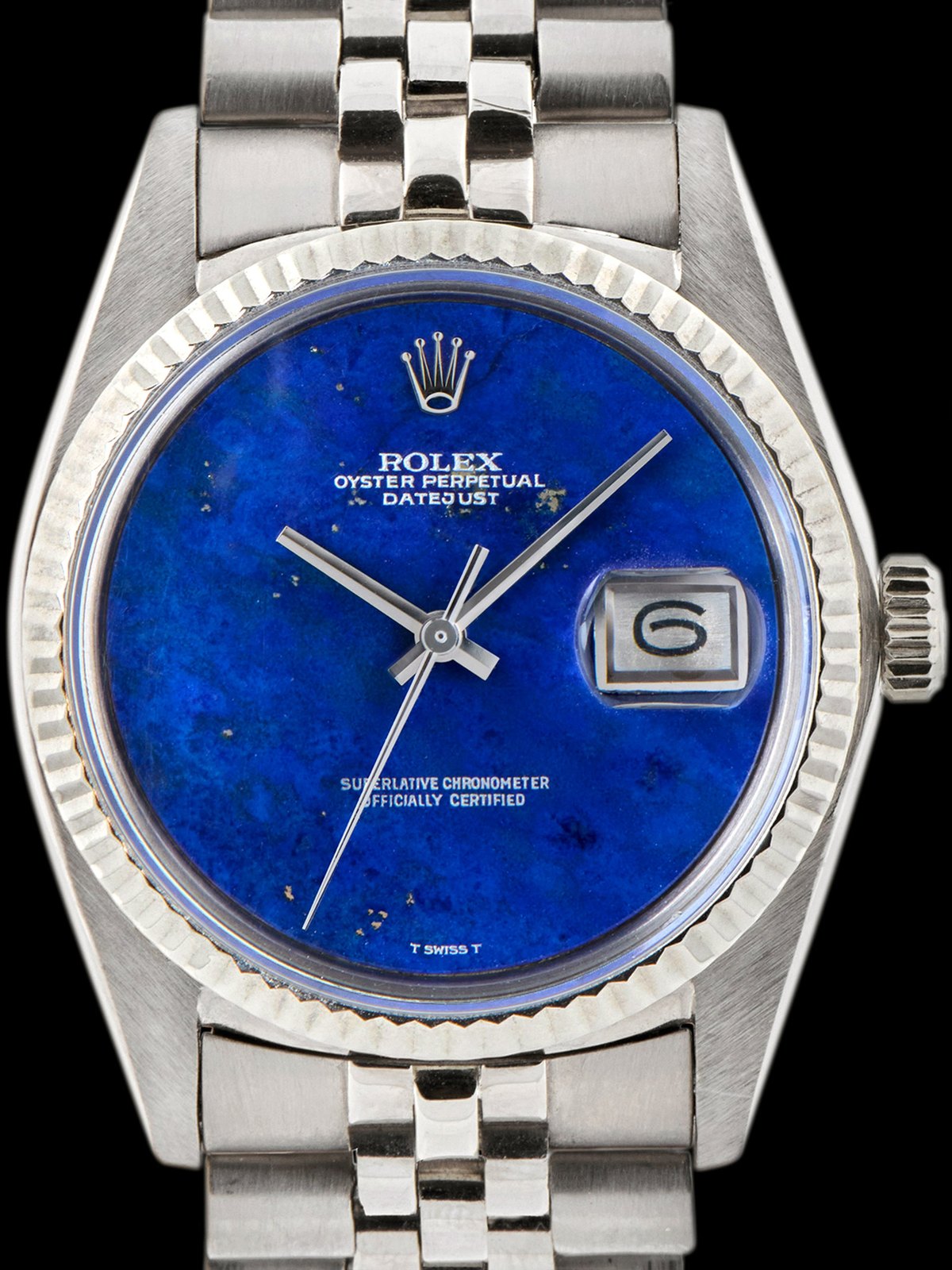
Rolex Datejust 18K WG (Ref. 1601) Lapis Lazuli Stone Dial, 1978
- Maker / attribution
- Rolex (maker)
- Date
- 1978
- Historical period
- Quartz Revolution (1969 – 1990)
- Country of origin
- Switzerland
- Object type
- Wristwatch
- Stock no.
- RLXDJ1601WGLAP
- Credit line
- Dealer listing, Craft & Tailored (RLXDJ1601WGLAP)
- Catalogue title (original)
- 1978 Rolex Datejust 18K WG (Ref. 1601) Lapis Lazuli Stone Dial (English)
View the source record (dealer listing) ↗ (opens another website in a new tab)Suggest a correction
Record summary
Catalogued by Craft & Tailored (dealer), Los Angeles (stock number RLXDJ1601WGLAP), this is a wristwatch by Rolex, made in Switzerland, dated 1978. The Atlas places it in the Quartz Revolution period (1969 – 1990) of its Wristwatches collection. The record is illustrated with 6 photographs.
Assembled from the source record's structured fields. Dates and attributions are given as the source states them; where a field is missing the Atlas leaves it blank rather than estimating.
Catalogue description
Dealer description — Craft & Tailored
Since its introduction in 1945, the Rolex Datejust has remained one of the most recognizable and enduring designs in watchmaking. Its timeless proportions and practical functionality have made it a cornerstone of the Rolex collection, while its many dial variations have given collectors an extraordinary range of expressions to pursue. Few, however, transform the familiar Datejust as dramatically as a natural stone dial. Rolex’s exploration of exotic dial materials produced some of the brand’s most distinctive watches. From onyx and coral to burl wood and lapis lazuli, these materials brought organic texture and rich color to otherwise traditional designs. Their appeal lies as much in their individuality as their scarcity: the natural variations within each material ensure that every dial possesses its own character. Paired with a restrained layout, these intricate surfaces become the centerpiece of the watch, offering an elegance that requires little additional ornamentation. Within this world, stone dial Datejusts occupy a particularly compelling niche. More commonly associated with the Day-Date, these unusual dials are far less frequently encountered in the Datejust collection. White metal examples narrow that field further, representing some of the most elusive and coveted configurations in stone dial collecting. For many enthusiasts, these watches carry “holy grail” status, with certain combinations believed to exist in only a handful of examples. Although exact production numbers are not established, these configurations hold particular significance for collectors drawn to Rolex’s rarest dial and case combinations. This 1978 Datejust ref. 1601 captures that appeal beautifully, pairing an 18K white gold case with its original lapis lazuli dial. The cool tone of the metal emphasizes the stone’s saturated blue, lending the watch a sharper, quieter presence than its yellow gold counterparts. Across the dial, shifting tones and scattered golden flecks create a rich, naturally composed pattern, with the absence of conventional hour markers allowing the lapis to take center stage beneath the applied Rolex coronet. The slender hands and fluted bezel frame the stone with the familiar precision of the Datejust’s design, balancing organic depth with crisp architectural detail. Preserved in remarkable condition, this example retains a flawless dial and an impressively strong case, complementing its rarity with exceptional preservation. Regal yet understated, it offers immediate visual appeal and details that reward a closer look. For the collector drawn to the individuality of Rolex’s stone dials, this white gold lapis Datejust brings together an elusive configuration, a distinctive aesthetic, and the enduring appeal of one of the brand’s most celebrated designs. SPECS Stock # RLXDJ1601WGLAP Brand Rolex Style Datejust Model 1601 Serial 51XXXXX Size Men's Material 18K White Gold Dial Lapis Lazuli Stone Millimeters 36 Bracelet Rolex 6311 18K WG Jubilee Bracelet CASE & BRACELET The impressive 18K white gold case retains exceptional proportions, sharp edges, and well-defined finishing throughout, with no notable evidence of prior polishing and only gentle signs of wear. The 18K white gold fluted bezel remains equally crisp, showing minimal wear, while the case back retains its original contours and distinct finishing. The later-production, era-correct 18K white gold Rolex ref. 6311 Jubilee bracelet bears an “O8” date code and remains in excellent overall condition, with normal stretch for its style and age and expected signs of wear on the clasp. The bracelet retains 19 links and accommodates a wrist up to 7.5 inches. DIAL & HANDS The original lapis lazuli stone dial remains flawless, with no cracks or damage, displaying exceptional depth and vibrancy throughout its natural grain and mineral inclusions. The solid white gold hands remain in excellent condition, beautifully complementing the rich blue stone. The original metallic date wheel features “open” 6 and 9 numerals. ACCESSORIES
Historical context
Quartz Revolution (1969 – 1990)
Seiko's Astron begins mass quartz timekeeping; traditional industries contract sharply.
Quartz and digital watches transformed the market after 1969. Swiss employment collapsed, Japanese and Hong Kong production soared, and the Swatch (1983) helped the Swiss industry recover; mechanical watches survived as luxury goods.
Read the period in the timelineMore wristwatches from this periodEarlier: Modern Mechanical Horology
Atlas type guide
Calendar, moon-phase and perpetual calendar watches
Calendar complications range from a simple date to the perpetual calendar, which automatically allows for months of different lengths and leap years until 2100. Pocket watches with perpetual calendars were made in the eighteenth and nineteenth centuries; Patek Philippe made the first perpetual calendar wristwatch in 1925, and series production followed in 1941. The annual calendar (Patek Philippe, 1996) needs correction only once a year.
Moon-phase displays use a disc with two moons and 59 teeth advanced daily, approximating the 29.5-day lunation; more precise trains reduce the error to one day in over a century.
What to look for
- Apertures or subsidiary dials for day, date, month and leap year.
- Moon disc under a 'bosom' shaped aperture.
- Recessed correctors on the case band for setting the calendar.
Dating clues
- Triple-date wristwatches: popular c. 1940–1955.
- Perpetual calendar wristwatches: from 1925 (unique) and 1941 (series).
General guidance written by the Atlas editors about this kind of object. It is not a statement about this particular piece; for that, rely on the source record above and on physical examination.
Related records

Movements & Components · c. 1970s
Rolex watch movement, c. 1970s
Antiquorum auction archive, Geneva

Pocket Watches · 1982
Fake Rolex watch, gold coloured metal, possibly made in Taiwan, 1982; part of a casual outfit, UK, 1982-84.
Victoria and Albert Museum, London

Wristwatches · c. 1920s
Rolex wristwatch, c. 1920s
Antiquorum auction archive, Geneva

Wristwatches · c. 1920s
Rolex wristwatch, ref. 6194, c. 1920s
Antiquorum auction archive, Geneva

Wristwatches · 1970
Wristwatch by Heno, Switzerland, 1970
Museum Rotterdam

Wristwatches · 1960–1986
'Tri-Compax' calendar chronograph wristwatch in gold case, by Universal, Geneva, Switzerland, 1960–1986.
Science Museum Group, London

Wristwatches · 1969–1970
Beta 21 Quartz wristwatch movement, made in Switzerland, 1970.
Science Museum Group, London

Wristwatches · c. 1969
Omega Speedmaster Moonwatch, ref. 145022-69st, c. 1969
Antiquorum auction archive, Geneva