
Wristwatches · Wristwatch
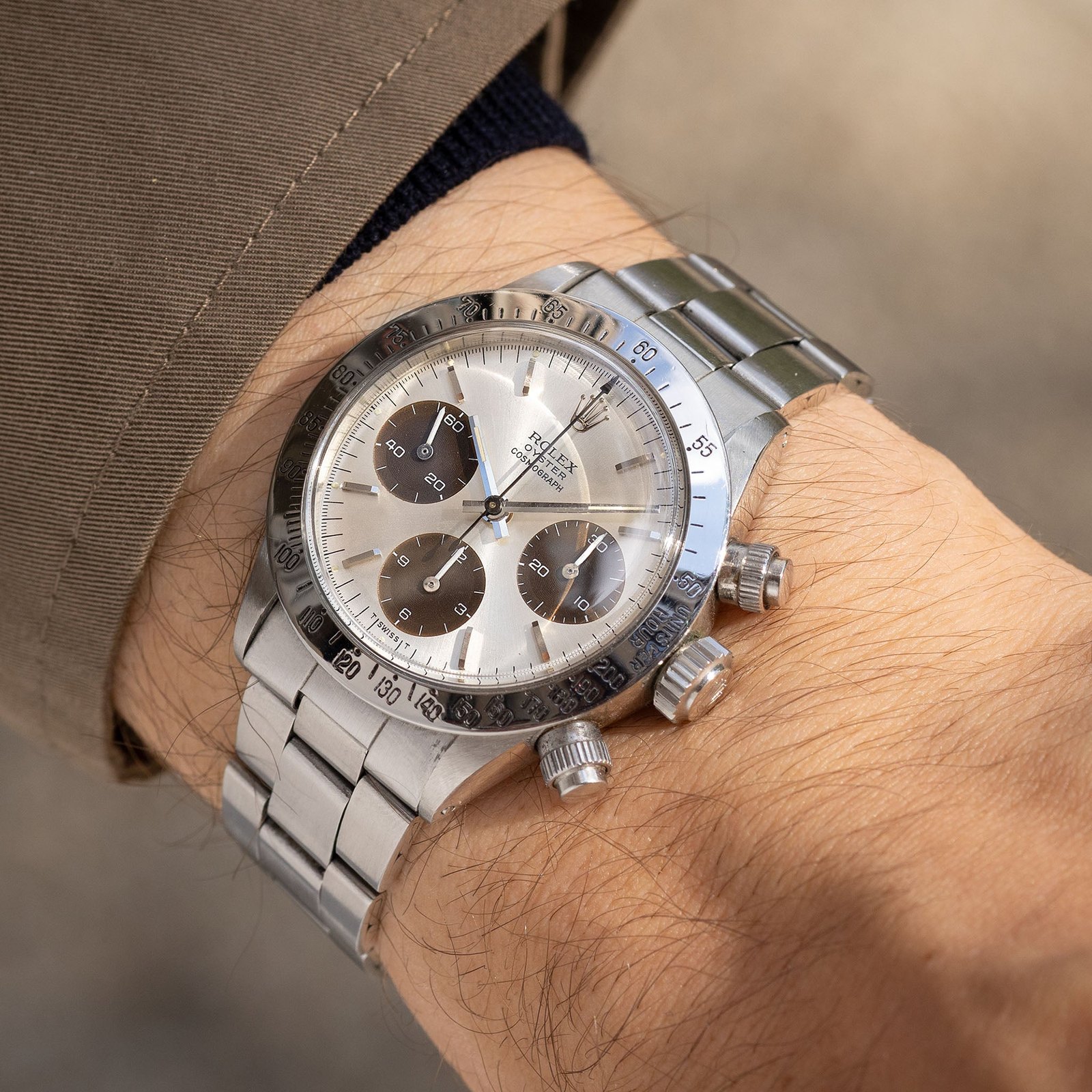
Rolex Cosmograph Daytona 6265 Mk1 Tropical Silver Dial, 1971
- Maker / attribution
- Rolex (maker)
- Date
- 1971
- Historical period
- Quartz Revolution (1969 – 1990)
- Country of origin
- Switzerland
- Object type
- Wristwatch
- Materials / technique
- silver
- Stock no.
- W-3312
- Credit line
- Dealer listing, Bulang & Sons (W-3312)
- Catalogue title (original)
- Rolex Cosmograph Daytona 6265 Mk1 Tropical Silver Dial (English)
View the source record (dealer listing) ↗ (opens another website in a new tab)Suggest a correction
Record summary
Catalogued by Bulang & Sons (dealer), Copenhagen (stock number W-3312), this is a wristwatch by Rolex, made in Switzerland, dated 1971. The Atlas places it in the Quartz Revolution period (1969 – 1990) of its Wristwatches collection. Materials and techniques recorded by the source: silver. The record is illustrated with 6 photographs.
Assembled from the source record's structured fields. Dates and attributions are given as the source states them; where a field is missing the Atlas leaves it blank rather than estimating.
Catalogue description
Dealer description — Bulang & Sons
The magic of Tropical eyes With a production run of 17 years, the reference 6265 stands as one of the most iconic models in Rolex’s Daytona history. Introduced in 1971, reference 6265 was produced until around 1987, alongside reference 6263. Both versions were available in steel, 14 kt and 18 kt gold. The key difference between the two models lies in the bezel: polished steel for the 6265, and steel/bakelite for the 6263. Due to its long manufacturing period, a wide range of dial variations exist. This spectacular and early example features a striking silver Mk1 dial with contrasting recessed sub-dials, typically in black. Over time, thanks to a unique natural aging and environmental exposure — these ridged counters have developed a beautiful and rich patina, shifting to a warm milk chocolate hue. It’s a detail we absolutely adore . The Mk1 dials are distinguished from later versions by the absence of the “Daytona” text. A curious decision by Rolex, considering many earlier predecessors featured it, as did most later variants. Regardless, the result is a clean, minimalistic aesthetic that speaks for itself. We truly love and have a rich passion for the early MK1 and Sigma, due to this clean and elegant appearance. The case of this trophy watch is in fine and fat condition, fitted with a clean steel Mk2 bezel, and still equipped with the finely grooved, first-generation screw-down pushers. This first generation — often regarded as more of a prototype — is sometimes referred to as the "Millerighe" (a nickname coined by Italian collectors), "Mk0," or "Mk1." Whatever the label, what truly matters is the production sequence and the distinctive features of these early pushers: rhodium-plated brass pieces with fine, smooth grooves. The folded Oyster bracelet, reference 7835, is also in excellent condition, with end links marked 271 and a clasp stamped 2/71. This fine Daytona has been fully inspected by our watchmaker, and its hand-wound movement has been professionally regulated. Over the last three decades, the 6265 has shown consistent value growth, establishing itself as a must-have for serious collectors. Its rarity and refined aesthetics make it a cornerstone of vintage horology — and this example is truly exceptional. The moment you take it out of the safe and wear it in daylight, it’s impossible not to smile. Get in touch with us! Specifications Rolex Reference 6265 Daytona Serial 285xxxx dating to 1971 Mk1 Silver ‘Panda ’ dial, with turned to brown sub dials “no Daytona “ Rare "Millerighe" screw down pushers Mk 2 steel bezel Hand wound movement , Rolex 727 based on a Valjoux 72 Oyster bracelet reference 7835 with 271 endlinks Fully checked by our watchmaker
Historical context
Quartz Revolution (1969 – 1990)
Seiko's Astron begins mass quartz timekeeping; traditional industries contract sharply.
Quartz and digital watches transformed the market after 1969. Swiss employment collapsed, Japanese and Hong Kong production soared, and the Swatch (1983) helped the Swiss industry recover; mechanical watches survived as luxury goods.
Read the period in the timelineMore wristwatches from this periodEarlier: Modern Mechanical Horology
Atlas type guide
Wristwatches
Bracelet watches were worn by women from the early nineteenth century — Breguet made one for Caroline Murat, Queen of Naples, in 1810–12 — but the wristwatch only became a man's instrument with military use and aviation in the early twentieth century. Between the World Wars it overtook the pocket watch; the 1920s and 1930s brought rectangular Art Deco cases, water-resistant cases and the first automatic winding systems.
After 1945 the wristwatch became a carrier of identity — dress watches, sports and dive watches, chronographs, calendars — produced by Swiss, American, Japanese, German, Soviet and Chinese industries. The quartz revolution after 1969 and the mechanical renaissance since the 1990s, including the rise of independent watchmakers, complete the story.
What to look for
- The reference number (between the lugs or inside the case back) and serial number, the starting point for dating.
- The calibre: its maker and number are often stamped under the dial or on the bridge.
- Originality of dial, hands and crown — refinished ('redial') dials are common.
- Case material marks: 18K/750, 14K/585, stainless steel, gold-filled, plated.
Dating clues
- Wire-lug cases: before c. 1925.
- Water-resistant screw-down cases: from 1926.
- Quartz movements: from 1969; sapphire crystals widespread after c. 1980.
General guidance written by the Atlas editors about this kind of object. It is not a statement about this particular piece; for that, rely on the source record above and on physical examination.
Related records

Movements & Components · c. 1970s
Rolex watch movement, c. 1970s
Antiquorum auction archive, Geneva

Pocket Watches · 1982
Fake Rolex watch, gold coloured metal, possibly made in Taiwan, 1982; part of a casual outfit, UK, 1982-84.
Victoria and Albert Museum, London

Wristwatches · c. 1920s
Rolex wristwatch, c. 1920s
Antiquorum auction archive, Geneva

Wristwatches · c. 1920s
Rolex wristwatch, ref. 6194, c. 1920s
Antiquorum auction archive, Geneva

Wristwatches · 1970
Wristwatch by Heno, Switzerland, 1970
Museum Rotterdam

Wristwatches · 1960–1986
'Tri-Compax' calendar chronograph wristwatch in gold case, by Universal, Geneva, Switzerland, 1960–1986.
Science Museum Group, London

Wristwatches · 1969–1970
Beta 21 Quartz wristwatch movement, made in Switzerland, 1970.
Science Museum Group, London

Wristwatches · c. 1969
Omega Speedmaster Moonwatch, ref. 145022-69st, c. 1969
Antiquorum auction archive, Geneva