
Wristwatches · Wristwatch
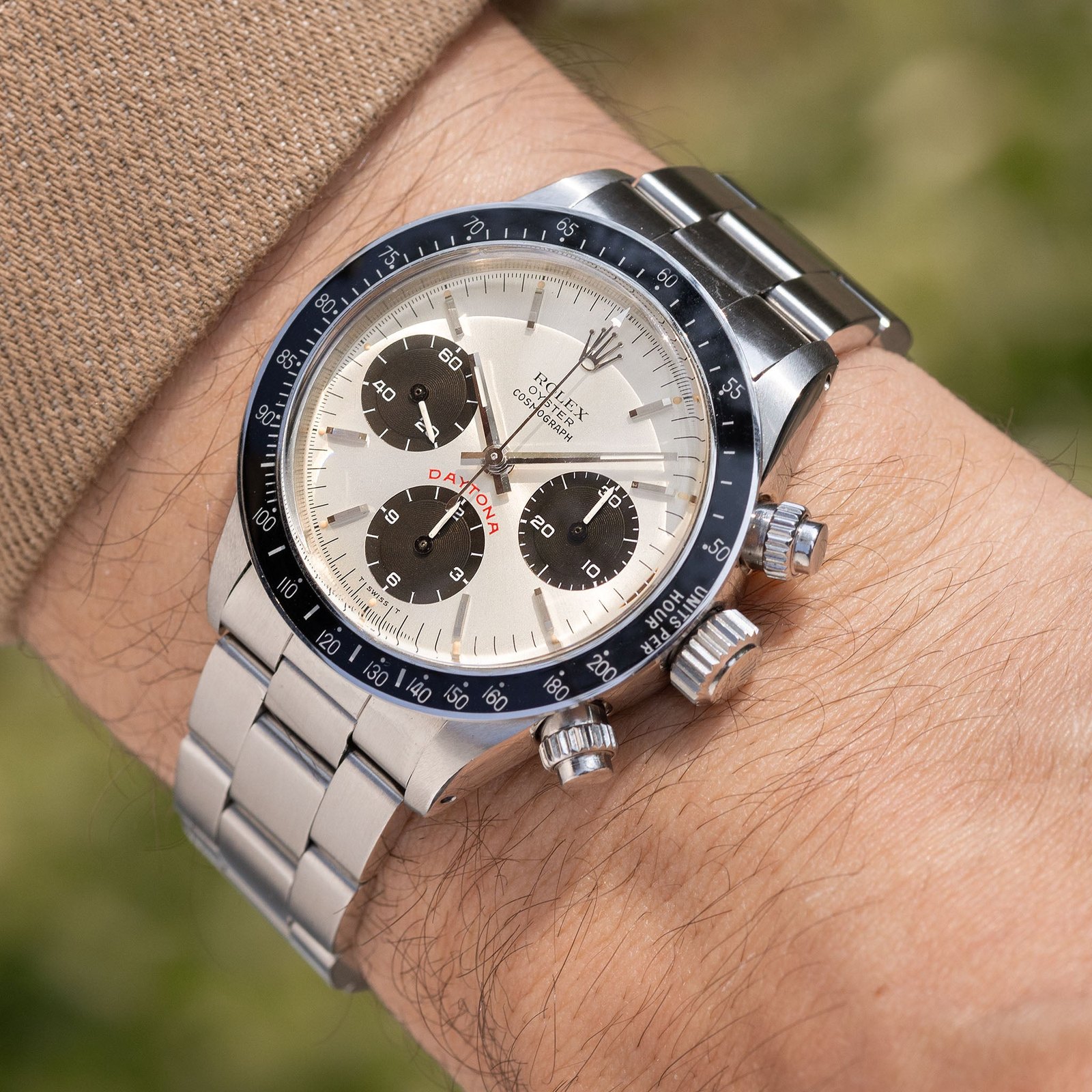
Rolex Cosmograph Daytona 6263 Big Red Floating Silver Soleil Dial, 1980
- Maker / attribution
- Rolex (maker)
- Date
- 1980
- Historical period
- Quartz Revolution (1969 – 1990)
- Country of origin
- Switzerland
- Object type
- Wristwatch
- Materials / technique
- silver
- Dimensions
- Case 37 mm
- Stock no.
- W-3654b
- Credit line
- Dealer listing, Bulang & Sons (W-3654b)
- Catalogue title (original)
- Rolex Cosmograph Daytona 6263 Big Red Floating Silver Soleil Dial (English)
View the source record (dealer listing) ↗ (opens another website in a new tab)Suggest a correction
Record summary
Catalogued by Bulang & Sons (dealer), Copenhagen (stock number W-3654b), this is a wristwatch by Rolex, made in Switzerland, dated 1980. The Atlas places it in the Quartz Revolution period (1969 – 1990) of its Wristwatches collection. Materials and techniques recorded by the source: silver. Recorded dimensions: Case 37 mm. The record is illustrated with 6 photographs.
Assembled from the source record's structured fields. Dates and attributions are given as the source states them; where a field is missing the Atlas leaves it blank rather than estimating.
Catalogue description
Dealer description — Bulang & Sons
The Rolex Daytona 6263 stands in a league of its own. Introduced alongside its sister reference, the 6265, it represents the final and most developed chapter of Rolex’s manual-wind chronograph era. With its screw-down pushers, Oyster case construction and black bakelite bezel, the 6263 brought both a stronger sportier look and improved water resistance over the earlier pump-pusher models — key traits that helped define the legendary Daytona formula collectors remain so drawn to today. Produced over a long period, the reference saw a number of dial variations, with certain executions becoming true collector favourites. Among them, the silver soleil “Big Red” is without question one of the most celebrated. The nickname refers to the large red “DAYTONA” signature curved above the 6 o’clock register — a small detail perhaps, but one that completely changes the personality of the watch. On the best examples, like this one, it gives the dial that extra spark collectors instantly fall for. This particular watch is especially compelling thanks to its outstanding overall condition. The case is incredibly strong, with sharp and even lugs that give it the crisp, well-preserved profile collectors are always hoping to find. The silver soleil dial, itself being slightly rarer due to it’s floating Big Red designation, is beautifully clean and completely mark-free, with all lume plots still intact and aged to a warm vanilla tone. The chronograph registers are equally clean and have taken on a subtle brown discolouration that adds depth, warmth and a wonderful sense of character. It is exactly this kind of honest and attractive ageing that gives a great vintage Daytona its soul. The Mk4 bakelite bezel is in excellent condition, free from cracks or blemishes, and the watch retains its correct period Mk1 pushers. The hand-set has been replaced during service. Inside beats the legendary Valjoux 727-based movement, freshly serviced by our watchmaker, and the watch is fitted with a Rolex 78350 Oyster bracelet with 557B endlinks and M4 clasp code. There is a reason the Daytona has inspired generations of collectors and remains one of the most admired chronographs in the vintage world. The great ones have a presence that goes far beyond specifications alone. This 6263 has exactly that feeling — iconic, beautifully preserved and full of charisma. A truly attractive “Big Red” Daytona with all the right details and that unmistakable grail-like appeal. Specifications Rolex Cosmograph Daytona Reference 6263 Serial 641xxxx dating to 1980 37mm steel case with black bakelite tachymeter scale bezel Silver floating “Big Red” Panda dial with light brown sub dials MK1 Screw down Pushers Oyster bracelet reference 78350 with 557b endlinks Fully serviced by our watchmaker
Historical context
Quartz Revolution (1969 – 1990)
Seiko's Astron begins mass quartz timekeeping; traditional industries contract sharply.
Quartz and digital watches transformed the market after 1969. Swiss employment collapsed, Japanese and Hong Kong production soared, and the Swatch (1983) helped the Swiss industry recover; mechanical watches survived as luxury goods.
Read the period in the timelineMore wristwatches from this periodEarlier: Modern Mechanical Horology
Atlas type guide
Wristwatches
Bracelet watches were worn by women from the early nineteenth century — Breguet made one for Caroline Murat, Queen of Naples, in 1810–12 — but the wristwatch only became a man's instrument with military use and aviation in the early twentieth century. Between the World Wars it overtook the pocket watch; the 1920s and 1930s brought rectangular Art Deco cases, water-resistant cases and the first automatic winding systems.
After 1945 the wristwatch became a carrier of identity — dress watches, sports and dive watches, chronographs, calendars — produced by Swiss, American, Japanese, German, Soviet and Chinese industries. The quartz revolution after 1969 and the mechanical renaissance since the 1990s, including the rise of independent watchmakers, complete the story.
What to look for
- The reference number (between the lugs or inside the case back) and serial number, the starting point for dating.
- The calibre: its maker and number are often stamped under the dial or on the bridge.
- Originality of dial, hands and crown — refinished ('redial') dials are common.
- Case material marks: 18K/750, 14K/585, stainless steel, gold-filled, plated.
Dating clues
- Wire-lug cases: before c. 1925.
- Water-resistant screw-down cases: from 1926.
- Quartz movements: from 1969; sapphire crystals widespread after c. 1980.
General guidance written by the Atlas editors about this kind of object. It is not a statement about this particular piece; for that, rely on the source record above and on physical examination.
Related records

Movements & Components · c. 1970s
Rolex watch movement, c. 1970s
Antiquorum auction archive, Geneva

Pocket Watches · 1982
Fake Rolex watch, gold coloured metal, possibly made in Taiwan, 1982; part of a casual outfit, UK, 1982-84.
Victoria and Albert Museum, London

Wristwatches · c. 1920s
Rolex wristwatch, c. 1920s
Antiquorum auction archive, Geneva

Wristwatches · c. 1920s
Rolex wristwatch, ref. 6194, c. 1920s
Antiquorum auction archive, Geneva

Wristwatches · 1970
Wristwatch by Heno, Switzerland, 1970
Museum Rotterdam

Wristwatches · 1960–1986
'Tri-Compax' calendar chronograph wristwatch in gold case, by Universal, Geneva, Switzerland, 1960–1986.
Science Museum Group, London

Wristwatches · 1969–1970
Beta 21 Quartz wristwatch movement, made in Switzerland, 1970.
Science Museum Group, London

Wristwatches · c. 1969
Omega Speedmaster Moonwatch, ref. 145022-69st, c. 1969
Antiquorum auction archive, Geneva