
Wristwatches · Wristwatch
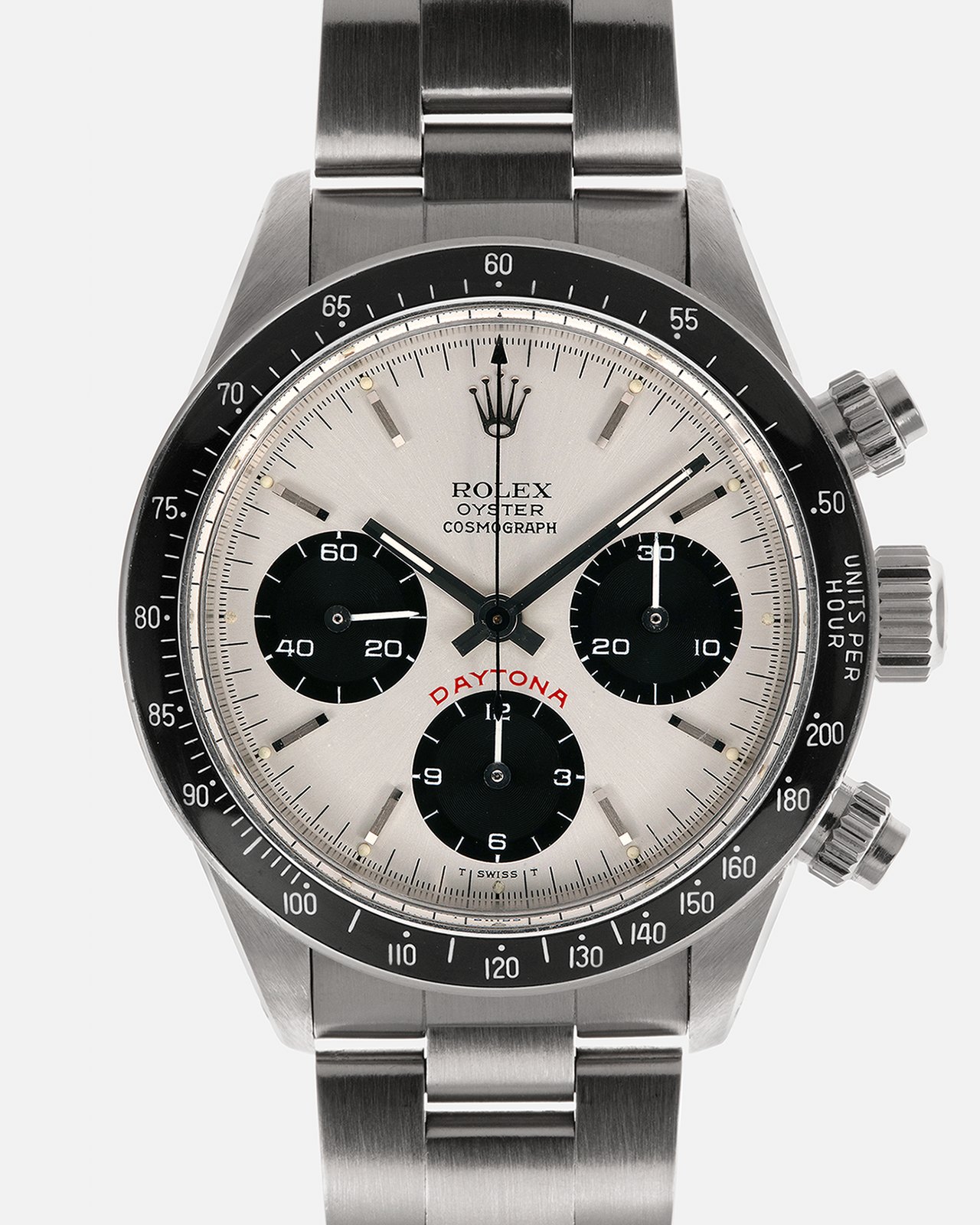
Rolex Cosmograph Daytona 6263 Big Red, 1979
- Maker / attribution
- Rolex (maker)
- Date
- 1979
- Historical period
- Quartz Revolution (1969 – 1990)
- Country of origin
- Switzerland
- Object type
- Wristwatch
- Dimensions
- Case 37.5 mm
- Stock no.
- Product 7551652626519
- Credit line
- Dealer listing, S.Song Watches (product 7551652626519)
- Catalogue title (original)
- Rolex Cosmograph Daytona 6263 Big Red (English)
View the source record (dealer listing) ↗ (opens another website in a new tab)Suggest a correction
Record summary
Catalogued by S.Song Watches (dealer), Seattle (stock number Product 7551652626519), this is a wristwatch by Rolex, made in Switzerland, dated 1979. The Atlas places it in the Quartz Revolution period (1969 – 1990) of its Wristwatches collection. Recorded dimensions: Case 37.5 mm. The record is illustrated with 6 photographs.
Assembled from the source record's structured fields. Dates and attributions are given as the source states them; where a field is missing the Atlas leaves it blank rather than estimating.
Catalogue description
Dealer description — S.Song Watches
In the realm of vintage Daytonas, the story is the same, though arguably even more complex and, for many, more rewarding. With a vast array of references ranging from the 6239 to the 6263, and an even broader spectrum of dial configurations—from the iconic Paul Newman variants to more obscure details such as underlines, double “Swiss” signatures, and uncommon Mk 1 ‘Millerighe’ pushers—vintage Daytonas have long been the subject of intense scrutiny. They are studied meticulously, critiqued rigorously, and revered passionately within the collecting community. While there are plenty of fine details that collectors should pay attention to, the main appeal of the Rolex Daytona ultimately lies in its undeniably iconic aesthetic. With a 37.5mm x 13.5mm case and its signature three sub-dial design, it is a watch that invites admiration more naturally than analysis. A collector-friend of mine once remarked, "Once you go Daytona, you never go back", specifically referring to the vintage models, of course. Frankly speaking, it's really not that difficult to see why; on the wrist, the Daytona offers a compelling blend of elegance and sporty charisma. While many chronographs from the same era may share similar design cues, Rolex consistently excels at perfecting the subtleties. As Ludwig Mies van der Rohe famously said, “God is in the details”—a philosophy that seems almost tailor-made for the Daytona. This particular example offered here today is one of the icons, even within the vintage Daytona spectrum. For many collectors, when they think of a vintage Daytona, there’s a good chance that it’s going to be a 6263. Alongside the 6265, this reference succeeded the 6262 and 6264 and is most recognisable as the first Oyster waterproof Cosmograph Daytona. Produced from 1971 to sometime around 1987/88, it marked the first time Rolex used screw-down pushers, which is a feature that remains the most obvious visual distinction from its predecessors. Our example here comes fitted with a radiant silver dial and black acrylic bezel, in contrast to the 6265, which was paired with a stainless steel or gold bezel. While Daytona 6263s do pop up for sale from time to time, it is hard to find examples in great overall condition. The one offered here today is certainly one of those, with its well-preserved case and period-correct components, paired with the classic panda ‘Big Red’ dial—defined by the large, bold red “ DAYTONA ” script forming a pronounced arc that stretches across and just above the ‘11’ and ‘2’ markers of the 6:00 sub-dial. It’s the hallmark of later 6263 production and a key reason this configuration remains so sought after. As mentioned earlier, the dial layout is anchored by three contrasting sub-dials: a 30-minute counter at 3:00, a 12-hour register at 6:00, and running seconds at 9:00. Just beneath the 6:00 sub-dial sits the familiar T SWISS T designation. Looking closer, the dial on this example is complemented by evenly aged lume plots along the periphery and on the hands. The stainless steel case remains sharp and is fitted with Mk 2 screw-down pushers and a Mk 3 bezel, which is what you’d expect from a late ‘70s example like this one. The Mk 2 pushers are distinguished by their more pronounced teeth-like ridges and thicker grooves. As for the Mk 3 acrylic bezel insert, it is identifiable by several features: a thinner overall font for the numerals, a distinctive ‘5’ with a longer neck, similarly shaped ‘2’s, and increased spacing between the bezel edge and the numerals or dots. Additionally, this 6263 is also fitted with a Triplock screw-down crown, recognisable by the three dots located beneath the Rolex coronet, which is a crown configuration found on later-production 6263 and 6265 models. Details aside, the Rolex Cosmograph Daytona 6263 is an absolute joy to wear on the wrist. With near-perfect proportions, it’s a serious watch to own and truly one of the pinnacle "end-game" pieces when it comes to vintage Rolex collecting.
Historical context
Quartz Revolution (1969 – 1990)
Seiko's Astron begins mass quartz timekeeping; traditional industries contract sharply.
Quartz and digital watches transformed the market after 1969. Swiss employment collapsed, Japanese and Hong Kong production soared, and the Swatch (1983) helped the Swiss industry recover; mechanical watches survived as luxury goods.
Read the period in the timelineMore wristwatches from this periodEarlier: Modern Mechanical Horology
Atlas type guide
Wristwatches
Bracelet watches were worn by women from the early nineteenth century — Breguet made one for Caroline Murat, Queen of Naples, in 1810–12 — but the wristwatch only became a man's instrument with military use and aviation in the early twentieth century. Between the World Wars it overtook the pocket watch; the 1920s and 1930s brought rectangular Art Deco cases, water-resistant cases and the first automatic winding systems.
After 1945 the wristwatch became a carrier of identity — dress watches, sports and dive watches, chronographs, calendars — produced by Swiss, American, Japanese, German, Soviet and Chinese industries. The quartz revolution after 1969 and the mechanical renaissance since the 1990s, including the rise of independent watchmakers, complete the story.
What to look for
- The reference number (between the lugs or inside the case back) and serial number, the starting point for dating.
- The calibre: its maker and number are often stamped under the dial or on the bridge.
- Originality of dial, hands and crown — refinished ('redial') dials are common.
- Case material marks: 18K/750, 14K/585, stainless steel, gold-filled, plated.
Dating clues
- Wire-lug cases: before c. 1925.
- Water-resistant screw-down cases: from 1926.
- Quartz movements: from 1969; sapphire crystals widespread after c. 1980.
General guidance written by the Atlas editors about this kind of object. It is not a statement about this particular piece; for that, rely on the source record above and on physical examination.
Related records

Movements & Components · c. 1970s
Rolex watch movement, c. 1970s
Antiquorum auction archive, Geneva

Pocket Watches · 1982
Fake Rolex watch, gold coloured metal, possibly made in Taiwan, 1982; part of a casual outfit, UK, 1982-84.
Victoria and Albert Museum, London

Wristwatches · c. 1920s
Rolex wristwatch, c. 1920s
Antiquorum auction archive, Geneva

Wristwatches · c. 1920s
Rolex wristwatch, ref. 6194, c. 1920s
Antiquorum auction archive, Geneva

Wristwatches · 1970
Wristwatch by Heno, Switzerland, 1970
Museum Rotterdam

Wristwatches · 1960–1986
'Tri-Compax' calendar chronograph wristwatch in gold case, by Universal, Geneva, Switzerland, 1960–1986.
Science Museum Group, London

Wristwatches · 1969–1970
Beta 21 Quartz wristwatch movement, made in Switzerland, 1970.
Science Museum Group, London

Wristwatches · c. 1969
Omega Speedmaster Moonwatch, ref. 145022-69st, c. 1969
Antiquorum auction archive, Geneva