
Wristwatches · Wristwatch
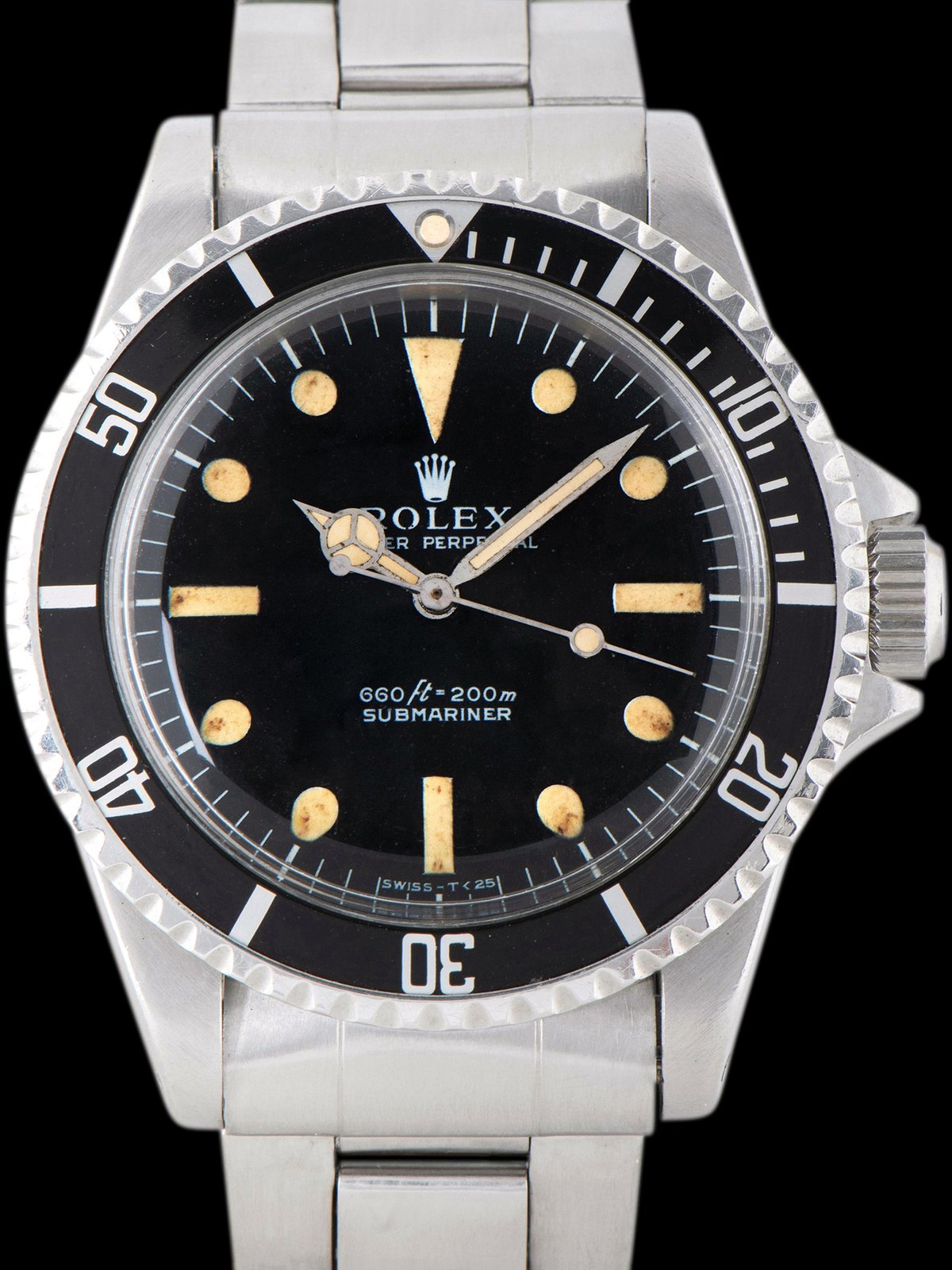
Rolex COMEX Submariner (Ref. 5514) "Non-Serif" Dial, 1972
- Maker / attribution
- Rolex (maker)
- Date
- 1972
- Historical period
- Quartz Revolution (1969 – 1990)
- Country of origin
- Switzerland
- Object type
- Wristwatch
- Stock no.
- RLXSM5514CMX
- Credit line
- Dealer listing, Craft & Tailored (RLXSM5514CMX)
- Catalogue title (original)
- 1972 Rolex COMEX Submariner (Ref. 5514) "Non-Serif" Dial (English)
View the source record (dealer listing) ↗ (opens another website in a new tab)Suggest a correction
Record summary
Catalogued by Craft & Tailored (dealer), Los Angeles (stock number RLXSM5514CMX), this is a wristwatch by Rolex, made in Switzerland, dated 1972. The Atlas places it in the Quartz Revolution period (1969 – 1990) of its Wristwatches collection. The record is illustrated with 6 photographs.
Assembled from the source record's structured fields. Dates and attributions are given as the source states them; where a field is missing the Atlas leaves it blank rather than estimating.
Catalogue description
Dealer description — Craft & Tailored
In the early 1960s deep-sea diving, particularly mixed gas diving, was rapidly advancing. COMEX, a French-based company, was the foremost pioneer in deep-sea experimentation and spearheaded most of the early research and technical advancements that came as a result of the maritime initiative. The COMEX Company is often referred to as the NASA of the Sea. With the danger involved with diving into the unknown, COMEX required the most durable and state-of-the-art equipment to ensure their success and was often directly involved in the creation of the instruments they used in a collaborative effort with the manufacturer to ensure each piece met the exact application it was made for. During the 1960s, the Rolex Submariner was the quintessential diver and set the design standard for most all dive watches that came after. However, the Rolex Submariner was never designed for deep sea operation as it was limited by its max depth rating of only 200m or 660ft. While the Submariner was widely used by COMEX in the beginning, the aquanauts quickly realized their Rolex would suffer catastrophic failure during saturation diving expeditions which would jeopardize their success rate. This led COMEX to work directly with Rolex in the development of a diving wristwatch that could meet the unique specifications and depths required by the aquanauts. This now iconic collaboration between Rolex and COMEX resulted in the creation of the Sea-Dweller in 1967, which remains one of the most well-known wristwatch models in the world. The cornerstone of the Sea-Dweller was the groundbreaking invention of the helium escape valve or HEV, which allowed for the release of expandable gasses within the watch, which previously caused the watch to fail during the ascent of a submersible diving bell. As the Rolex / Comex partnership continued through the 1970s, COMEX commissioned an exclusive Submariner model from Rolex, the ref. 5514, which was never released to the general public. The ref. 5514 Submariner melded the HEV technology of the Sea-Dweller with the already existing Submariner ref. 5513 platform for an extremely experimental COMEX dive watch. The Rolex ref. 5514 Submariner is often identified with the COMEX logo printed on the dial, along with the HEV on the side of the case, however, the dials of early models lack the COMEX logo on the dial entirely. It is understood among collectors that approximately 150 reference 5514s were created by Rolex. Along with the HEV on the left side of the case, this Submariner features the 5514 reference stamped between the lugs. The inside of the case back is correctly stamped 5513 and is also engraved with the matching serial number of the mid-case. The watch predates the more recognizable "COMEX" signed dials, resulting in a far more incognito variation with the beautifully patinated and correct "non-serif" dial and original hands. Stock # RLXSM5514CMX Brand Rolex Style Submariner "COMEX" Model 5514 Serial 380XXXX Size Men's Material Stainless Steel Dial Matte Black Millimeters 40 Bracelet Rolex "Pateted" 9315 Folded-Link Oyster Bracelet W/ 380 End Pieces CASE & BRACELET The very well-preserved case retains thick and symmetrical lugs that show slight chamfers and exhibit evidence of being minimally polished in the past with honest signs of use present. The left side of the case features the HEV. The Mk III "fat font" bezel insert remains deep black in color, exhibits almost no signs of use, and retains its tritium pearl. The case back features its original COMEX engravings, though the small COMEX inventory number is no longer visible, this is common on these variants due to the faint initial application of the number. The inside of the case back is engraved with the matching serial to the mid-case. The original "Pateted" Rolex 9315 folded-link Oyster bracelet with 380 end pieces retains 11 links that display nominal stretch and will fit up to a 7 1/2-inch wrist. DIAL & HANDS The original matte black non-serif dial is in beautiful vintage condition, showing subtle elements of age, most notably are some tonal marks above the hand stack that are invisible to the naked eye but were likely caused by a watchmaker removing the hands in a previous service. The tritium lume plots have achieved a golden-yellow patina and show no degradation when inspected under UV light. The original tritium hands match the dial patina perfectly, under UV light inspection the minute hand exhibits some nominal superficial cracking and remains stable while the rest of the hands display no degradation whatsoever. ACCESSORIES None. The watch is keeping time, but the service history is unknown. A movement service can be provided upon request.
Historical context
Quartz Revolution (1969 – 1990)
Seiko's Astron begins mass quartz timekeeping; traditional industries contract sharply.
Quartz and digital watches transformed the market after 1969. Swiss employment collapsed, Japanese and Hong Kong production soared, and the Swatch (1983) helped the Swiss industry recover; mechanical watches survived as luxury goods.
Read the period in the timelineMore wristwatches from this periodEarlier: Modern Mechanical Horology
Atlas type guide
Dive and water-resistant watches
Keeping water and dust out of a wristwatch was a long-standing challenge. Rolex's screw-down Oyster case (1926) and Omega's Marine (1932) were landmarks; in the early 1950s Blancpain's Fifty Fathoms and Rolex's Submariner defined the professional dive watch with rotating bezels for timing dives, luminous dials and high water resistance. The ISO 6425 standard (1982) later codified what a 'diver's watch' must do.
Dive watches became icons of post-war design and exploration, and their evolution — helium escape valves, ceramic bezels, saturation-diving depth ratings — records the history of underwater work.
What to look for
- Unidirectional or bidirectional rotating bezel with minute markings.
- Screw-down crown and case back; depth rating printed on the dial.
- Luminous hands and markers (radium before c. 1960, tritium c. 1960–1998, then Super-LumiNova).
- Reference numbers on the case between the lugs or inside the back.
Dating clues
- Screw-down Oyster cases: from 1926.
- Professional dive watches: from 1953.
- Tritium 'T' marks on dials: c. 1960–1998.
General guidance written by the Atlas editors about this kind of object. It is not a statement about this particular piece; for that, rely on the source record above and on physical examination.
Related records

Movements & Components · c. 1970s
Rolex watch movement, c. 1970s
Antiquorum auction archive, Geneva

Pocket Watches · 1982
Fake Rolex watch, gold coloured metal, possibly made in Taiwan, 1982; part of a casual outfit, UK, 1982-84.
Victoria and Albert Museum, London

Wristwatches · c. 1920s
Rolex wristwatch, c. 1920s
Antiquorum auction archive, Geneva

Wristwatches · c. 1920s
Rolex wristwatch, ref. 6194, c. 1920s
Antiquorum auction archive, Geneva

Wristwatches · 1970
Wristwatch by Heno, Switzerland, 1970
Museum Rotterdam

Wristwatches · 1960–1986
'Tri-Compax' calendar chronograph wristwatch in gold case, by Universal, Geneva, Switzerland, 1960–1986.
Science Museum Group, London

Wristwatches · 1969–1970
Beta 21 Quartz wristwatch movement, made in Switzerland, 1970.
Science Museum Group, London

Wristwatches · c. 1969
Omega Speedmaster Moonwatch, ref. 145022-69st, c. 1969
Antiquorum auction archive, Geneva