
Wristwatches · Wristwatch
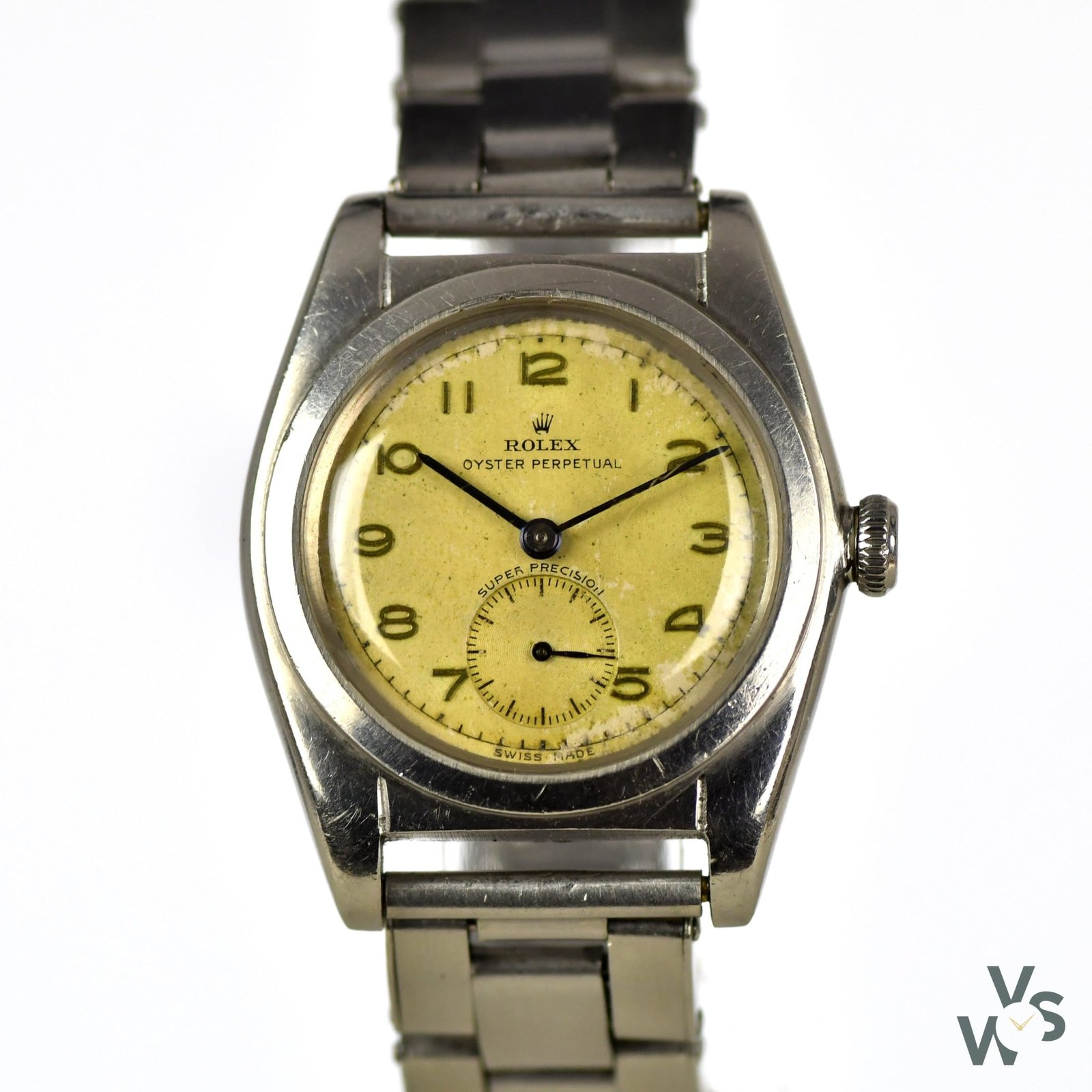
Rolex 'Bubble Back' Super Precision Automatic, ref. 2764, Cal. 620N, circa 1940s
- Maker / attribution
- Rolex (maker)
- Date
- c. 1940s
- Historical period
- Golden Age of Mechanical Watchmaking (1900 – 1945)
- Country of origin
- Switzerland
- Object type
- Wristwatch
- Dimensions
- Case 32 mm
- Stock no.
- vws0689
- Credit line
- Dealer listing, Vintage Watch Specialist (vws0689)
- Catalogue title (original)
- Rolex 'Bubble Back' Super Precision Automatic - Ref. 2764 - Cal. 620N - c.1940s (English)
View the source record (dealer listing) ↗ (opens another website in a new tab)Suggest a correction
Record summary
Catalogued by Vintage Watch Specialist (dealer), United Kingdom (stock number vws0689), this is a wristwatch by Rolex, made in Switzerland, dated c. 1940s. The Atlas places it in the Golden Age of Mechanical Watchmaking period (1900 – 1945) of its Wristwatches collection. Recorded dimensions: Case 32 mm. The record is illustrated with 6 photographs.
Assembled from the source record's structured fields. Dates and attributions are given as the source states them; where a field is missing the Atlas leaves it blank rather than estimating.
Catalogue description
Dealer description — Vintage Watch Specialist
Rolex Oyster Perpetual Super Precision - Automatic 'Bubble Back' - c.1940s Model Reference 2764 - Calibre 620N. The Bubbleback was launched in 1933 and featured the first auto-rotor. Rolex was not the first to create the automatic movement, but this watch does signify the company’s success in developing a self-winding movement. Rolex created the auto-rotor movement from the Aegler movement in Hunter watches that featured a “perpetual motion” winding mass. Rolex patented its first successful perpetually self-winding wristwatch in 1932 and introduced the Bubbleback one year later. Despite the ubiquitous name, Rolex never engraved “Bubbleback” anywhere on the watch or officially recognized the name. However, the thick auto-rotor required a fatter case, and the decision was made to move the case out in the back rather than make the watch larger overall. The first Bubbleback model was a reference 1858, powered by a Reference 520 movement. Early Bubblebacks featured a three-piece case. However, in 1936, Rolex introduced a two-piece case with models 3131 and 3132. What's on offer The present example, a ref 2764 provides an exciting opportunity to acquire one of the most desirable and collectable Rolex models in recent history. Featuring Arabic indices and blued sword hands, this Bubbleback remains in remarkable condition with unpolished stainless steel case and the presence of a fabulous crown that really captivates the eye. Despite its rather compact diameter of 32mm, the "Bubbleback" has a masculine presence on the wrist and offers the same satisfaction that larger and more costly collector’s watches are known for. What really makes the present example even more special is the WAB (Watch Accessories Birmingham) straight end rivet bracelet which in itself is highly sought after and rounds of a serious collector’s piece as they fit several rare Rolex references of watch!
Historical context
Golden Age of Mechanical Watchmaking (1900 – 1945)
The wristwatch displaces the pocket watch; waterproof cases, self-winding and grand complications.
The wristwatch overtook the pocket watch. Military use in the First World War, aviation, water-resistant cases (1926), automatic winding (1923–31), rectangular Art Deco designs and early chronographs and calendars defined the period.
Read the period in the timelineMore wristwatches from this periodEarlier: Industrial Revolution
Atlas type guide
Automatic (self-winding) watches
Self-winding watches use the wearer's motion to wind the mainspring. Abraham-Louis Perrelet and Breguet made 'perpétuelle' pocket watches with oscillating weights in the late eighteenth century, but the principle only became practical in the wristwatch. John Harwood patented a bumper automatic in 1923; Rolex's Perpetual rotor (1931) winding in one direction, and later bidirectional rotors (Eterna, Felsa Bidynator), established the modern form. Micro-rotors (Universal Genève, Buren) and peripheral rotors made automatic watches thinner.
What to look for
- A semicircular rotor turning 360° over the movement, or a 'bumper' weight that rebounds between springs.
- 'Automatic', 'Perpetual' or 'Self-winding' on the dial.
- A sealed screw-back case, since automatic watches are wound less often by the crown.
Dating clues
- Bumper automatics: 1923–c. 1955.
- Full rotors: from 1931 (Rolex); widespread after c. 1950.
- Micro-rotors: from 1954–1958.
General guidance written by the Atlas editors about this kind of object. It is not a statement about this particular piece; for that, rely on the source record above and on physical examination.
Related records

Movements & Components · c. 1970s
Rolex watch movement, c. 1970s
Antiquorum auction archive, Geneva

Pocket Watches · 1982
Fake Rolex watch, gold coloured metal, possibly made in Taiwan, 1982; part of a casual outfit, UK, 1982-84.
Victoria and Albert Museum, London

Wristwatches · c. 1920s
Rolex wristwatch, c. 1920s
Antiquorum auction archive, Geneva

Wristwatches · c. 1920s
Rolex wristwatch, ref. 6194, c. 1920s
Antiquorum auction archive, Geneva

Wristwatches · 1931
Rolex 'Oyster Perpetual' rotor self-winding wrist-watch, lever escapement, in steel case with glass in back, Montres Rolex SA, Geneva, Switzerland, 1931
Science Museum Group, London

Wristwatches · 1900–1999
Wristwatch by Certina, Switzerland, 1900–1999
Nordic Museum Foundation

Wristwatches · 1900–1999
Wristwatch by Omega, Västerås, 1900–1999
Nordic Museum Foundation

Wristwatches · 1900–1999
Wristwatch by Universal, Switzerland, 1900–1999
Nordic Museum Foundation