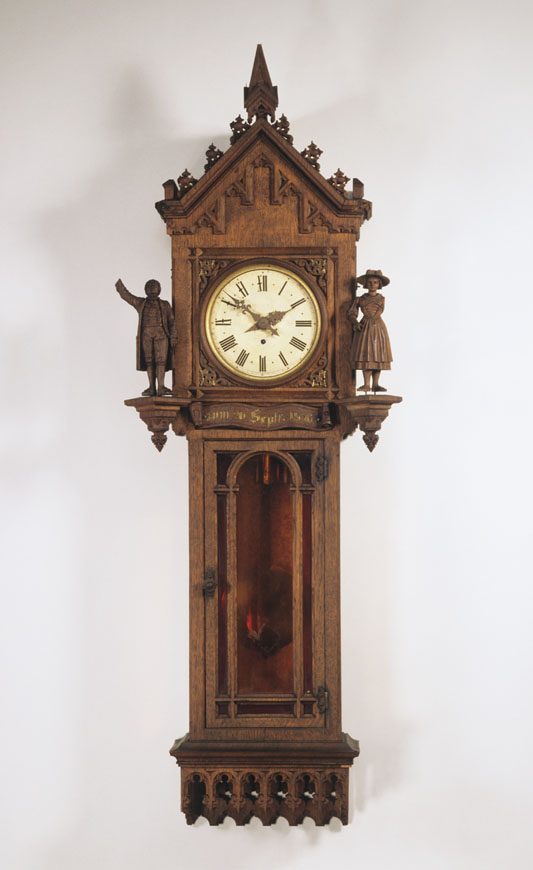
Clocks · Regulator clock
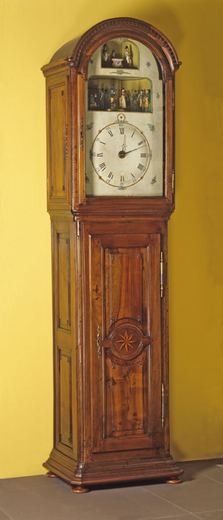
Regulator clock, Germany, 1800–1899
- Maker / attribution
- Unrecorded in source
- Date
- 1800–1899
- Historical period
- Precision & Scientific Horology (1750 – 1850)
- Country of origin
- Germany
- Place
- Schwarzwald
- Object type
- Regulator clock
- Holding institution
- Badisches Landesmuseum Karlsruhe
- Accession / object no.
- item_DULXNSPCWJGOYSNR5GIVHHY6Z3ZRI2XK
- Catalogue title (original)
- Wanduhr mit Regulatorwerk (German)
Record summary
Held and catalogued by Badisches Landesmuseum Karlsruhe (object number item_DULXNSPCWJGOYSNR5GIVHHY6Z3ZRI2XK), this is a regulator clock, made in Schwarzwald, Germany, dated 1800–1899. The Atlas places it in the Precision & Scientific Horology period (1750 – 1850) of its Clocks collection. The record is illustrated with 1 photograph.
Assembled from the source record's structured fields. Dates and attributions are given as the source states them; where a field is missing the Atlas leaves it blank rather than estimating.
Catalogue description
Catalogue description from Badisches Landesmuseum Karlsruhe (German)
Das schlanke, neogotische Gehäuse die Wanduhr ist in Turmform gestaltet mit Giebeldach und Zinnen. Unterhalb des Zifferblatts befindet sich ein geschnitztes Dekorband mit dem Schriftzug: "Zum 20. Septr 1856". Der Pendelkasten ist mit einer gelb eingelegten Glastüre verschlossen, die Sockelzone endet in einem Kreuzbogenfries. Zwei kleine seitliche Sockel tragen jeweils eine männliche und weibliche Figur in Schwarzwälder Tracht. Die Uhr ist ein Geschenk zur Hochzeit Großherzogs Friedrich I. von Baden (1826-1907) mit Luise von Preußen (1838-1923) am 20. September 1856.Die Wanduhr hat ein für den Schwarzwälder Uhrenbau dieser Zeit untypisches Regulatorwerk mit Gewichtaufzug. Mitte des 19. Jahrhunderts war die Produktpalette der Schwarzwälder Uhrmacherei noch von Lackschild- und Rahmenuhren bestimmt. Regulatoren mit Federzugwerk wurden in der Uhrenproduktion erst um die Jahrhundertwende zu den dominierenden Produkten.
Shown in the original language of the source catalogue. An editor-reviewed English translation has not yet been published; we do not publish machine translations as authoritative text.
Historical context
Precision & Scientific Horology (1750 – 1850)
Harrison solves longitude; Mudge invents the lever; Breguet's Paris workshop defines the modern watch.
The age of the deadbeat escapement, compensated pendulums and observatory regulators. Domestic clocks spread through the middle classes: English longcase and bracket clocks, French gilt-bronze mantel clocks, Viennese Biedermeier wall clocks, Black Forest painted-shield clocks, and the first American shelf clocks.
Read the period in the timelineMore clocks from this periodEarlier: Early Modern Horology
Atlas type guide
Regulators, wall and Vienna clocks
A regulator is a precision pendulum clock used as a time standard in observatories, workshops and railway offices. Typical features are a deadbeat or Graham escapement, a temperature-compensated pendulum (mercury jar, gridiron or later invar), maintaining power and a regulator dial that separates hours, minutes and seconds. George Graham's deadbeat escapement (c. 1715) and his mercury pendulum, together with Harrison's gridiron, set the pattern for two centuries.
Wall clocks span a much wider range: the elegant Viennese Laterndluhr and Dachluhr of the Biedermeier period, the Dutch stoelklok and staartklok, English 'dial' clocks used in schools, offices and railway stations, and mass-produced spring and weight wall clocks from Germany (Gustav Becker, Junghans, Kienzle) and America.
What to look for
- Deadbeat escapement and compensated pendulum (gridiron rods, mercury jar or wood rod).
- A regulator dial with a large central minute hand and separate hour and seconds dials.
- Vienna regulators: glazed cases, slender pendulum, small weights, enamel two-piece dials.
- German factory trademarks stamped on the backplate (e.g. Gustav Becker anchor and crown, Junghans star).
Dating clues
- Graham-type deadbeat regulators: from c. 1720.
- Viennese Laterndluhr: c. 1800–1850.
- German factory 'Vienna-style' regulators: c. 1870–1930; Gustav Becker serial numbers allow close dating.
General guidance written by the Atlas editors about this kind of object. It is not a statement about this particular piece; for that, rely on the source record above and on physical examination.
Related records
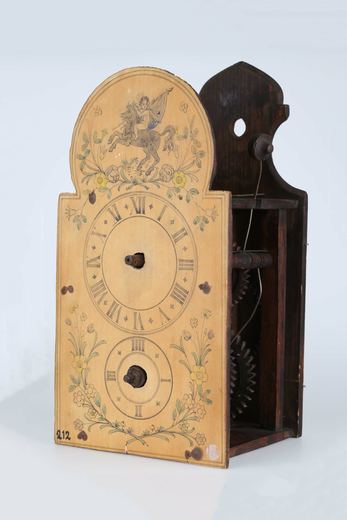
Clocks · 1750
Clock by Georg Gfell, Germany, 1750
German Clock Museum
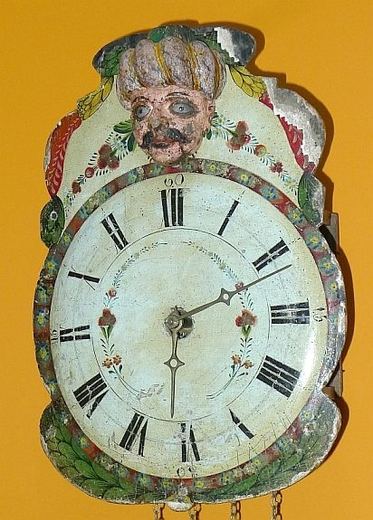
Clocks · 1750–1799
Cuckoo / black forest clock, Germany, 1750–1799
Badisches Landesmuseum Karlsruhe
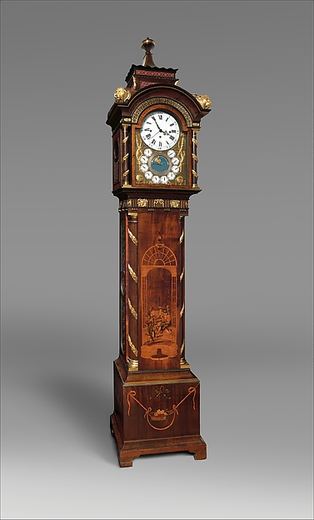
Clocks · ca. 1774–75
Longcase clock by Hermann Achenbach, Germany, ca. 1774–75
The Metropolitan Museum of Art, New York
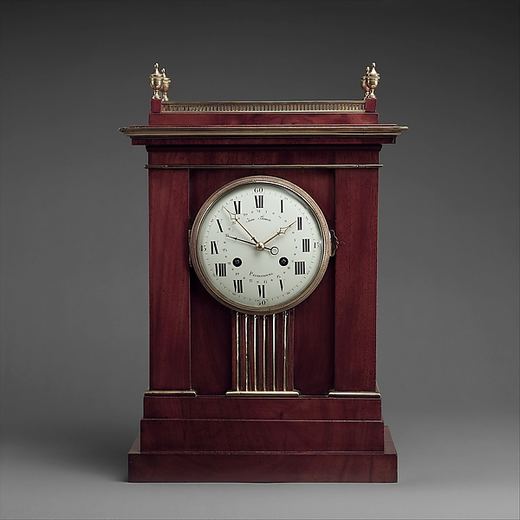
Clocks · ca. 1780–90
Clock by Workshop of David Roentgen, Germany, ca. 1780–90
The Metropolitan Museum of Art, New York
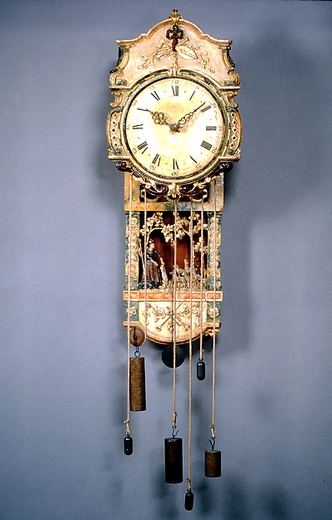
Clocks · ca. 1800
Musical clock by Martin Vanlo?, Germany, ca. 1800
The Metropolitan Museum of Art, New York
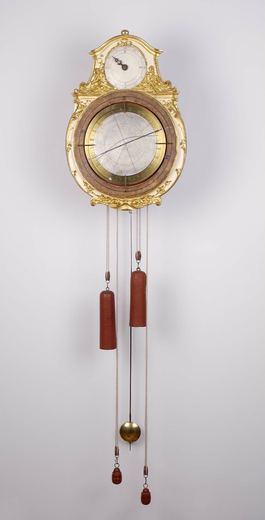
Clocks · 1787
Astronomical clock, Germany, 1787
German Clock Museum
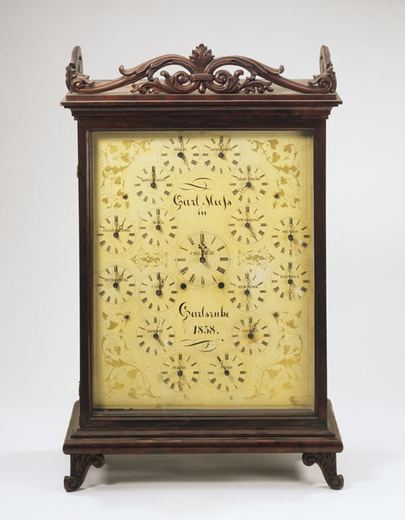
Clocks · 1800–1899
Clock by Carl Meeß, Germany, 1800–1899
Badisches Landesmuseum Karlsruhe
Clocks · 1800–1899
Clock by Ignaz Bruder, Germany, 1800–1899
Badisches Landesmuseum Karlsruhe