
Movements & Components · Pocket watch
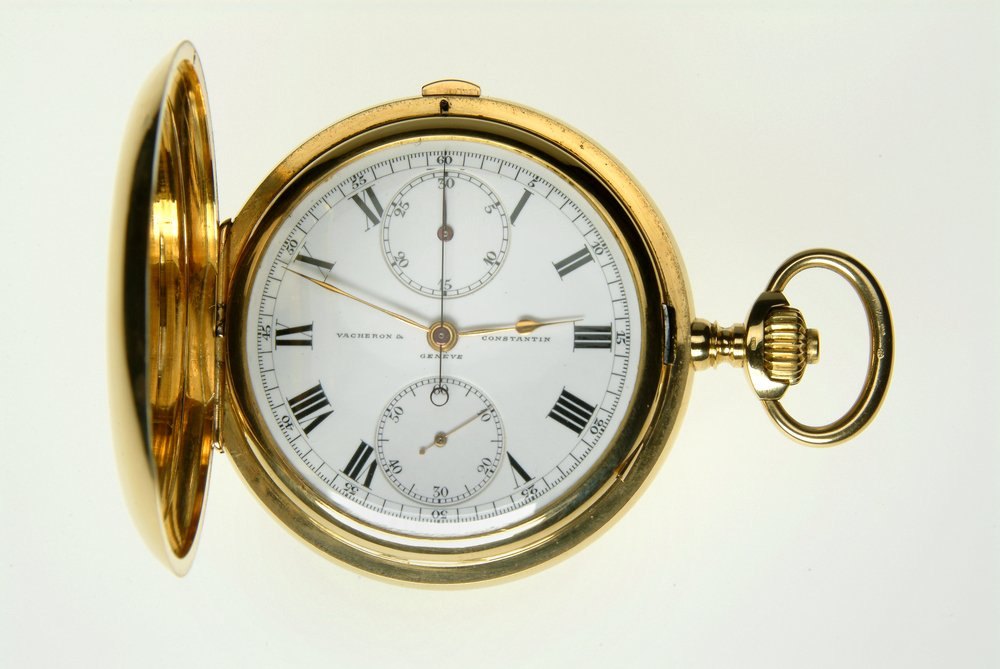
Pocket watch by Vacheron Constantin, Switzerland, 1910
- Maker / attribution
- Vacheron Constantin (Created)
- Date
- 1910
- Historical period
- Golden Age of Mechanical Watchmaking (1900 – 1945)
- Country of origin
- Switzerland
- Place
- Geneva
- Object type
- Pocket watch
- Materials / technique
- 18 Karat Gelbgold, graviert; Emaille; Gold; Glas; Metall, vergoldet, geschwärzt, geschliffen, angliert; Rubine; Metall, gebläut
- Dimensions
- Durchmesser (mit Bügel): 5,2 cm, Tiefe 1,3 cm; Gewicht: 144,45 g
- Holding institution
- Kulturstiftung Sachsen-Anhalt - Museum Schloss Neuenburg
- Accession / object no.
- MSN-V 11639 H
- Credit line
- Kulturstiftung Sachsen-Anhalt - Museum Schloss Neuenburg
- Catalogue title (original)
- Herrentaschenuhr (Chronograph) mit Monogramm (German)
View the source record ↗ (opens another website in a new tab)Suggest a correction
Record summary
Held and catalogued by Kulturstiftung Sachsen-Anhalt - Museum Schloss Neuenburg (object number MSN-V 11639 H), this is a pocket watch by Vacheron Constantin, made in Geneva, Switzerland, dated 1910. The Atlas places it in the Golden Age of Mechanical Watchmaking period (1900 – 1945) of its Movements & Components collection. Materials and techniques recorded by the source: 18 Karat Gelbgold, graviert; Emaille; Gold; Glas; Metall, vergoldet, geschwärzt, geschliffen, angliert; Rubine; Metall, gebläut. Recorded dimensions: Durchmesser (mit Bügel): 5,2 cm, Tiefe 1,3 cm; Gewicht: 144,45 g. The record is illustrated with 2 photographs.
Assembled from the source record's structured fields. Dates and attributions are given as the source states them; where a field is missing the Atlas leaves it blank rather than estimating.
Catalogue description
Catalogue description from Kulturstiftung Sachsen-Anhalt - Museum Schloss Neuenburg (German)
Die Herrentaschenuhr, aufgrund des Sprungdeckels auch Savonnette genannt, wurde um 1910 von der Schweizer Uhrenmanufaktur Vacheron & Constantin in Genf gefertigt. Aufgrund einer eingebauten Stoppuhr ist die Taschenuhr zugleich ein Chronograph. Das schlichte Gehäuse aus 18 Karat Gelbgold wurde im Typ Lucia gefertigt. Auf der vorderen Schale befindet sich ein eingraviertes Monogramm "MB". Am Gehäuserand wurde ein Chronometer-Drücker angebracht. Das Pendant hat einen profilierten Schaft, auf dem eine abgeflachte gerillte Krone mit einem eingesetzten Drücker sowie ein ovaler Bügel befestigt ist. Das Ziffernblatt aus weißem Emaille hat schwarze römische Zahlen, eine umlaufende feingliedrige Chronographen-Sekundenskala und zwei feine Goldzeiger in Lanzen- und Birnenform. Oben befindet sich ein abgesetztes kleineres Minutenziffernblatt mit einem schwarzen Chronographen-Zeiger. Unten wurde ein kleineres abgesetztes Sekundenziffernblatt mit einem geraden goldenen Zeiger eingelassen. Die Cuvette wurde mit "Vacheron & Constantin GENEVE CHRONOMETRE" graviert. Das Uhrwerk hat ein vergoldetes Brückenwerk mit einem sichtbar angeordneten Chronographenmechanismus, geschliffene und anglierte Hebel, ein großes Kompensationsunruhrad mit goldenen Schrauben und einer Breguet-Spirale, eine Ankerhemmung, einen Unruhkloben mit Schwanenhalsfeinregulierung, mehrere Rubinlagersteine, ein Anker- und Unruhrad unter Decksteinen und gebläute Schrauben.
Shown in the original language of the source catalogue. An editor-reviewed English translation has not yet been published; we do not publish machine translations as authoritative text.
Historical context
Golden Age of Mechanical Watchmaking (1900 – 1945)
The wristwatch displaces the pocket watch; waterproof cases, self-winding and grand complications.
Precision lever movements, electric clock mechanisms and new alloys (invar, elinvar) characterised the period.
Read the period in the timelineMore movements & components from this periodEarlier: Industrial Revolution
Atlas type guide
Clock and watch movements
The movement is the mechanism of a clock or watch, without its case and dial. It consists of the power source (weight or mainspring in its barrel, sometimes with a fusee), the going train of wheels and pinions, the escapement and oscillator, the motion work that drives the hands, and in many cases additional trains for striking or complications.
From the eighteenth century watch movements were increasingly produced in stages: Swiss and French ébauche makers supplied rough movements that finishers, repasseurs and retailers completed and signed. Calibre numbers — first used systematically by American and Swiss factories in the nineteenth century — make it possible to identify movements, find spare parts and date watches.
What to look for
- Plate and bridge layout: full plate, three-quarter plate, Lépine bar calibre, bridges and cocks.
- Jewel count and whether jewels are set in chatons or rubbed in.
- Signatures, calibre and serial numbers on the plate or under the dial.
- Finishing: Geneva stripes (Côtes de Genève), perlage, bevelled edges, blued screws.
- Fusee and chain, going barrel, or electrical components.
Dating clues
- Full-plate English movements dominate before c. 1850; three-quarter plate and Lépine calibres after.
- Jewelled movements spread after Facio and Debaufre's patent of 1704, mainly in English work until c. 1800.
- Calibre numbers and factory serials allow close dating for industrial production after c. 1850.
General guidance written by the Atlas editors about this kind of object. It is not a statement about this particular piece; for that, rely on the source record above and on physical examination.
Read next:FuseeVerge escapement
Related records
Pocket Watches · c. 1896
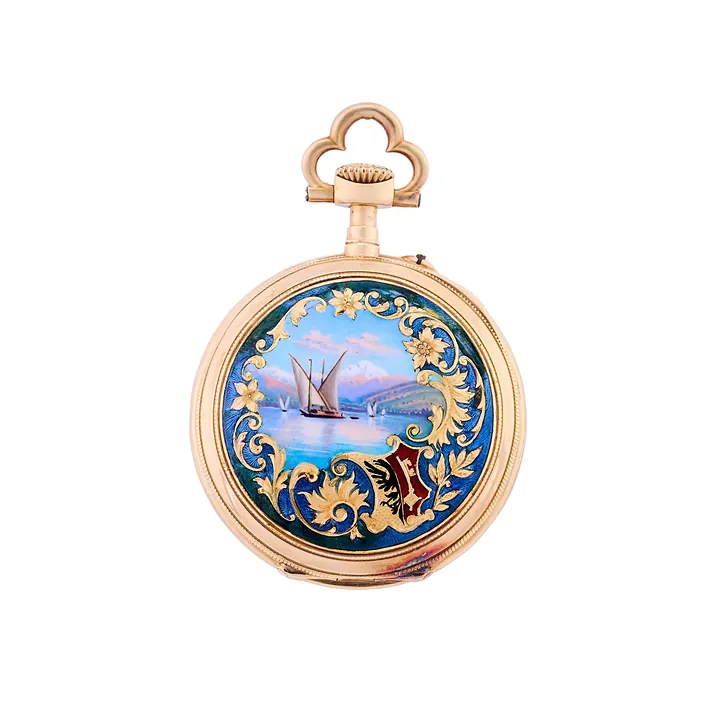
Vacheron Constantin “grand TIR de L’exposition Nationale, Genève 1896, c. 1896
Antiquorum auction archive, Geneva
Pocket Watches · c. 1940
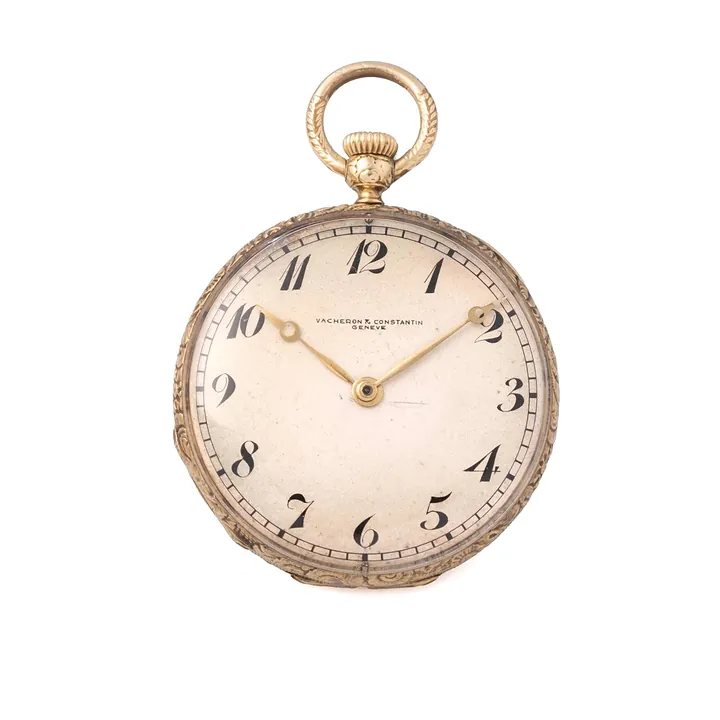
Vacheron Constantin pocket watch, ref. 345, c. 1940
Antiquorum auction archive, Geneva
Pocket Watches · c. 1945
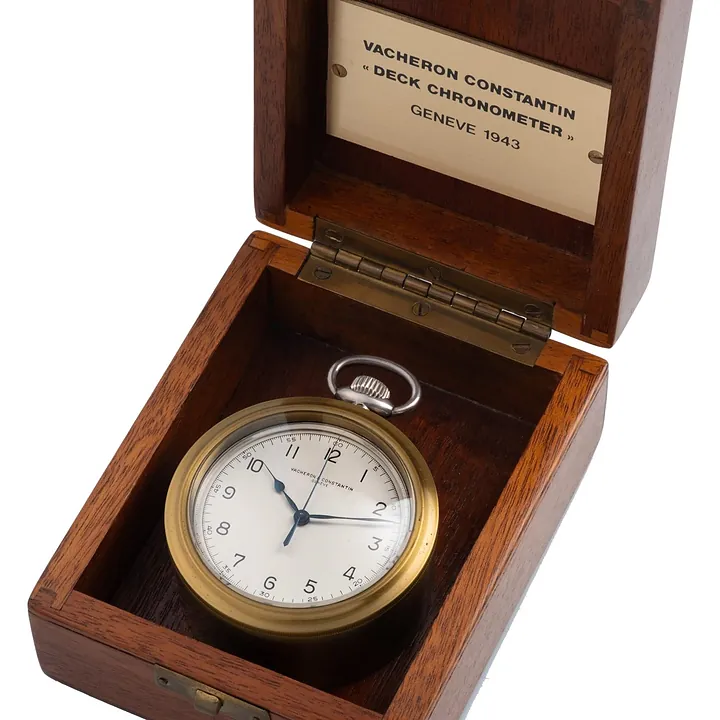
Vacheron Constantin pocket chronometer, c. 1945
Antiquorum auction archive, Geneva
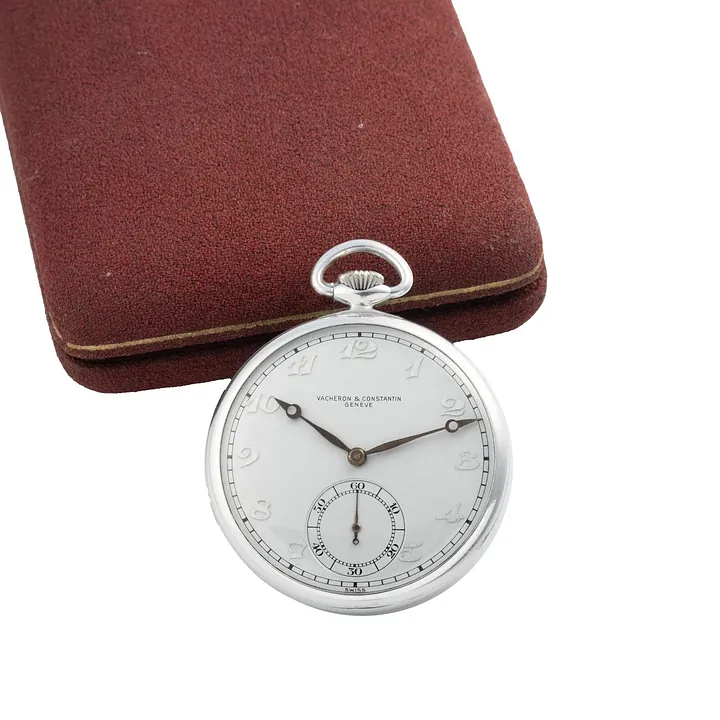
Pocket Watches · c. 1945
Vacheron Constantin watch, c. 1945
Antiquorum auction archive, Geneva
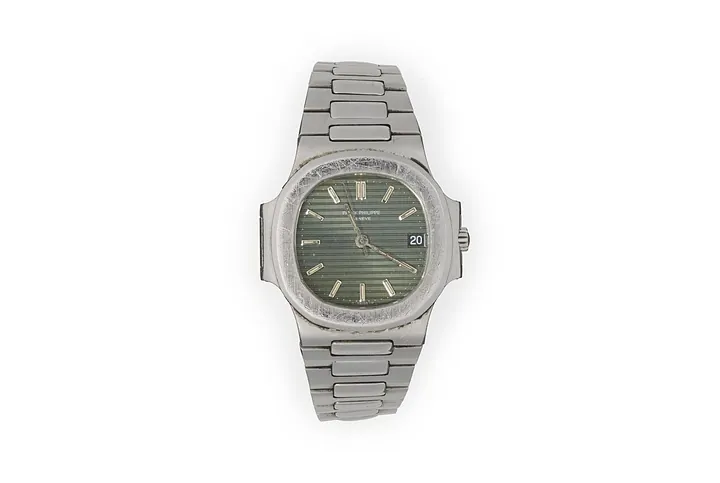
Movements & Components · 1901–2000
Nautilus wristwatch in a stainless steel case by Patek Phillippe, with co-axial escapement fitted by George Daniels, Switzerland/Isle of Man 1981/2.
Science Museum Group, London
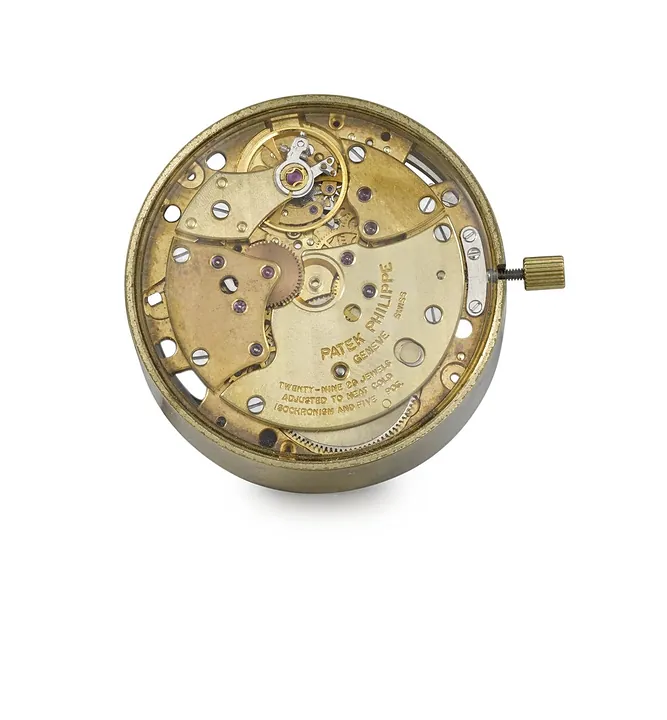
Movements & Components · 1901–2000
Watch movement by Philippe Patek, Switzerland, 1901–2000
Science Museum Group, London
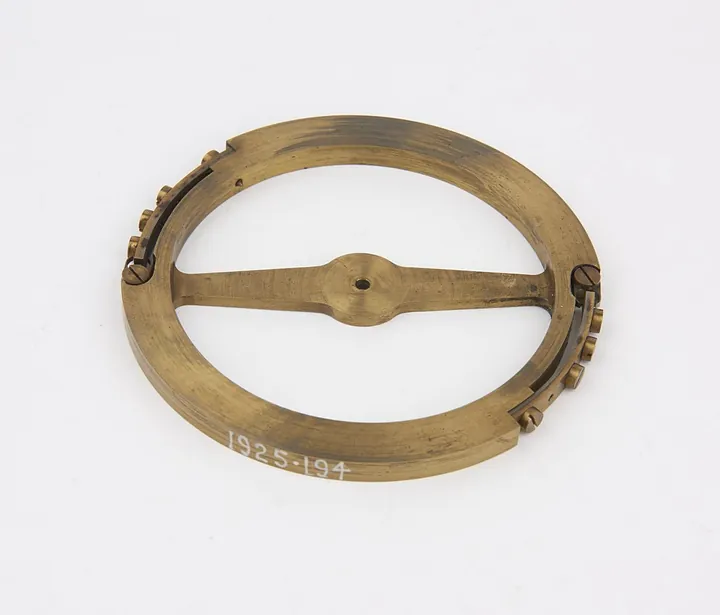
Movements & Components · 1920–1925
Balance / regulating part by Paul Ditisheim, Europe, 1920–1925
Science Museum Group, London
Movements & Components · 1920–1925
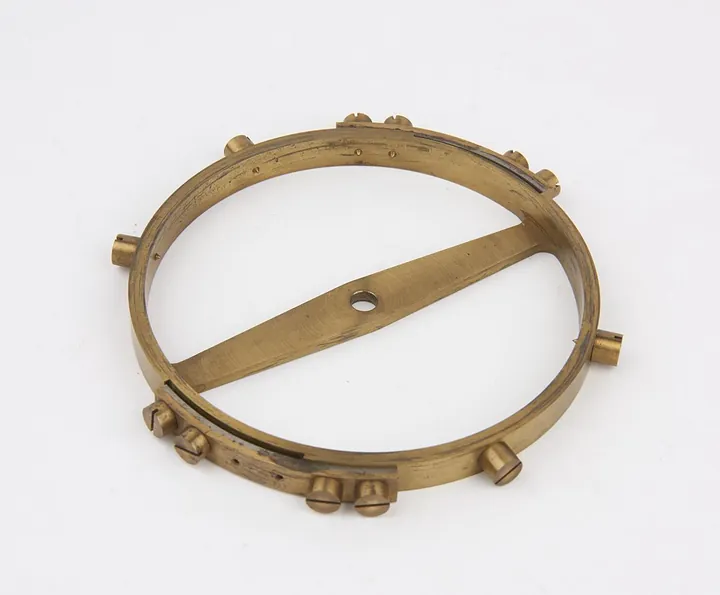
Model of Paul Ditisheim's monometallic compensation balance for use with Elinvar hairsprings, with radial poising screws, Europe, 1920–1925
Science Museum Group, London