
Pocket Watches · Pocket watch
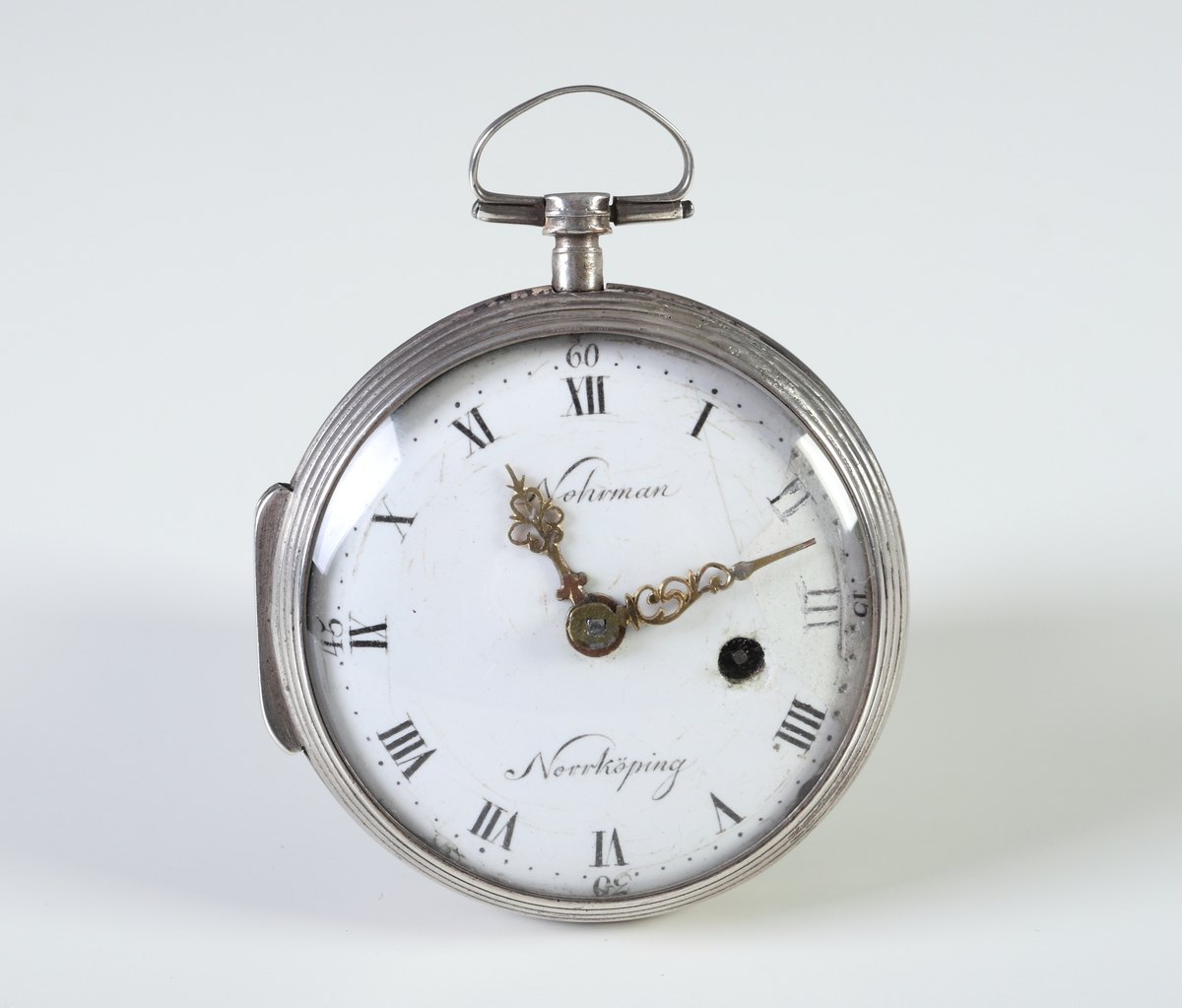
Pocket watch by Eric Nohrman, Sweden, 1761
- Maker / attribution
- Eric Nohrman (Maker)
- Date
- 1761
- Historical period
- Precision & Scientific Horology (1750 – 1850)
- Country of origin
- Sweden
- Place
- Sverige
- Object type
- Pocket watch
- Materials / technique
- Silver Glas Emalj Guld
- Dimensions
- Diameter 57.0 mm
- Holding institution
- Kulturparken Småland
- Accession / object no.
- M 66156-1
- Credit line
- Kulturparken Småland
- Catalogue title (original)
- Fickur (Swedish)
View the source record ↗ (opens another website in a new tab)Suggest a correction
Record summary
Held and catalogued by Kulturparken Småland (object number M 66156-1), this is a pocket watch by Eric Nohrman, made in Sverige, Sweden, dated 1761. The Atlas places it in the Precision & Scientific Horology period (1750 – 1850) of its Pocket Watches collection. Materials and techniques recorded by the source: Silver Glas Emalj Guld. Recorded dimensions: Diameter 57.0 mm. The record is illustrated with 6 photographs.
Assembled from the source record's structured fields. Dates and attributions are given as the source states them; where a field is missing the Atlas leaves it blank rather than estimating.
Catalogue description
Catalogue description from Kulturparken Småland
Fickur i silver. Boett i silver, förgylld invändigt med text: "Eric Nohrman, Norrköping, No 381". Vit emaljerad urtavla med romerska siffror och förgyllda, genombrutna visare. Text; "Nohrman, Norrköping". Tillhörande kedja, se M 66156-2. Inskriven i huvudkatalog 2017. Fickur, fickrova - under 1800-talet och första delen av 1900-talet var fickuret en viktig manlig symbol för status och makt den som bar fickur styrde över sin egen och andras tid. Mera lyxbetonade ur kunde ha en briljant infattad på en av visarna. Det finns även fickur i något mindre storlekar som förr kallades för damur. De äldsta bevarade fickuren är tyska och från omkring 1540. Från Frankrike härstammar ett fickur från 1551. De äldsta fickuren var dos- eller trumformade, och liknade miniatyrer av bordsur. Uren var konstruerade för att bäras om halsen eller i bältet. Den moderna formen för fickur dyker upp i Frankrike runt 1630. Ungefär samtidigt börjar emaljdekoren, som kom att bli mycket populär att dyka upp. Guldsmeden Jean Toutin i Chäteaudun har antagits vara dess upphovsman. Urtavlorna var däremot oftast i silver. Först omkring 1720 börjar emaljurtavlorna att komma i bruk. Många fickur ända in på 1900-talet saknade uppdragskrona. I stället spändes gångfjädern med hjälp av en urnyckel. Denna passade på en liten kvadratisk tapp, som man kom åt genom att med en nagel öppna boetten på urets baksida. Nyckeln passade även på en annan tapp, varmed visarna kunde ställas in på rätt tid. Urnyckeln brukade hängas tillsammans med urkedjan för att lätt vara till hands, när den behövdes.
Shown in the original language of the source catalogue. An editor-reviewed English translation has not yet been published; we do not publish machine translations as authoritative text.
Historical context
Precision & Scientific Horology (1750 – 1850)
Harrison solves longitude; Mudge invents the lever; Breguet's Paris workshop defines the modern watch.
From 1750 to 1850 the watch became a precision instrument. Mudge's lever escapement, the cylinder escapement, Lépine's thin bar calibre, Breguet's innovations (overcoil, tourbillon, perpétuelle) and the pocket chronometer of Arnold and Earnshaw all date from this period, while verge watches remained common in cheaper production.
Read the period in the timelineMore pocket watches from this periodEarlier: Early Modern Horology
Atlas type guide
Pocket watches
The pocket watch was the dominant personal timekeeper from the late seventeenth century until the First World War. Its development tracks the history of the escapement: verge watches with fusees until the late eighteenth century; Thomas Mudge's lever escapement (c. 1755) and the cylinder escapement popularised by George Graham and later by Swiss makers; and the Swiss and English lever watches of the nineteenth century. Lépine's bar-bridge calibre and keyless winding made watches thinner and easier to use.
Industrialisation transformed the trade: American factories such as Waltham (from 1850) and Elgin produced interchangeable parts by machine, and Swiss makers responded with their own mechanisation after the 1876 Philadelphia Exhibition. By 1900 a reliable watch was affordable to millions; the finest makers continued to produce complications and precision watches.
What to look for
- The escapement: verge (crown wheel), cylinder, duplex, English or Swiss lever.
- Key winding (a square arbor in dial or back) or keyless crown winding.
- Signatures and serial numbers on the movement, dial and inside case back.
- Hallmarks, case maker's marks and gold or silver standards stamped in the case.
- Dial material: enamel, silver, gold, later printed metal.
Dating clues
- Verge watches dominate before c. 1800; cylinder watches c. 1770–1900; lever watches after c. 1820.
- Keyless winding: increasingly common after c. 1860.
- Manufacturer serial number lists exist for Waltham, Elgin, Longines, Omega, Patek Philippe and others.
General guidance written by the Atlas editors about this kind of object. It is not a statement about this particular piece; for that, rely on the source record above and on physical examination.
Read next:Verge escapementDetached lever escapementFuseeIdentification Centre
Related records
Pocket Watches · 1800–1899
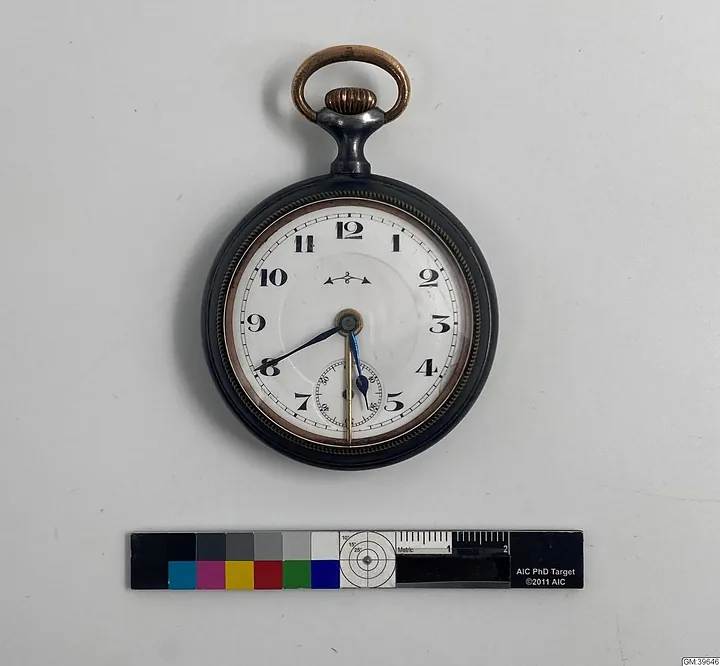
Alarm pocket watch by Eterna w, Gothenburg, 1800–1899
Museum of Gothenburg
Pocket Watches · 1760–1780
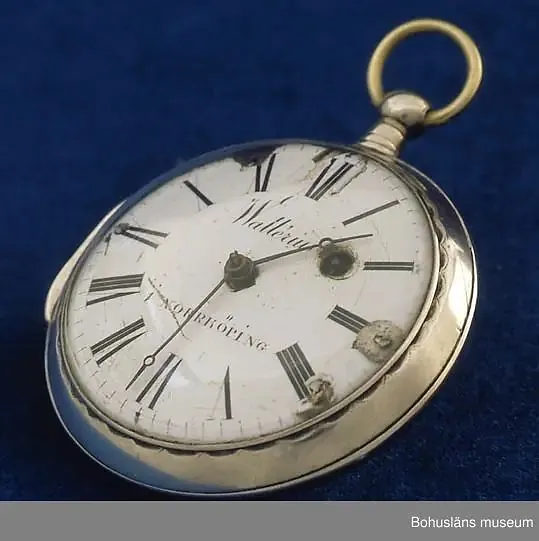
Pocket watch, Sweden, 1760–1780
Bohuslän Museum
Pocket Watches · 1769
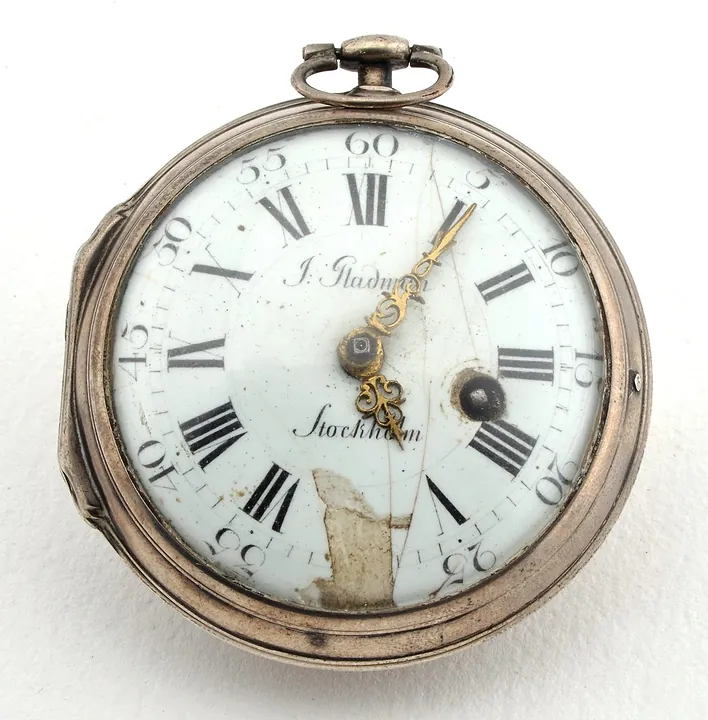
Pocket watch by Johan Gladman, Sweden, 1769
Gävleborg County Museum
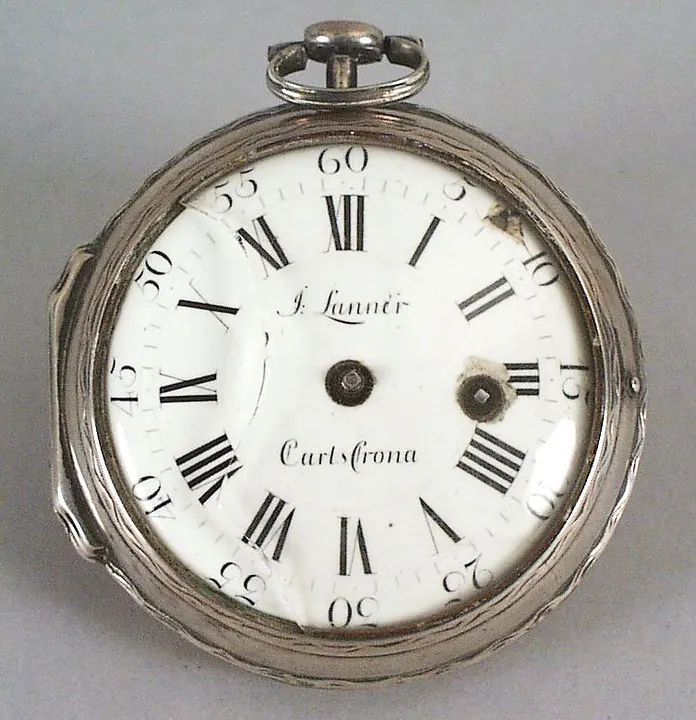
Pocket Watches · 1769
Pocket watch, Sweden, 1769
Blekinge Museum
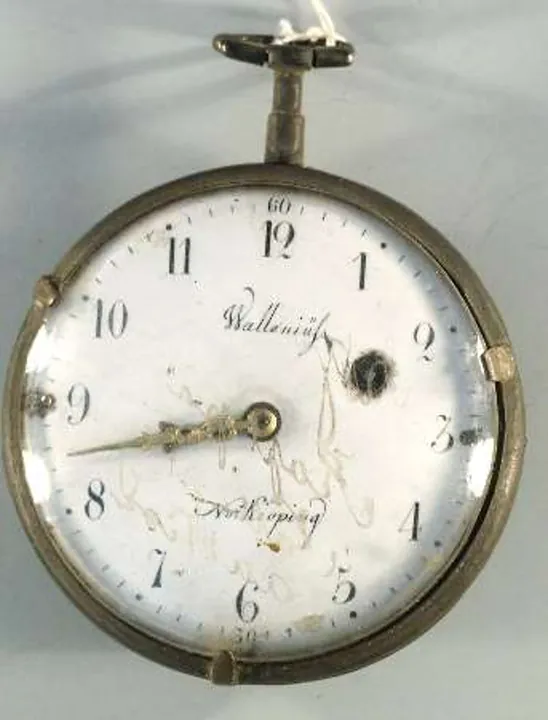
Pocket Watches · 1792
Pocket watch, Sweden, 1792
Upplands Museum
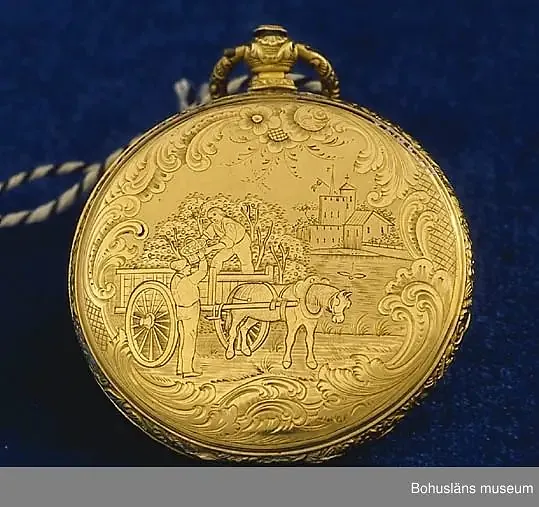
Pocket Watches · 1800–1850
Pocket watch by AIGUIDLES, Sweden, 1800–1850
Bohuslän Museum
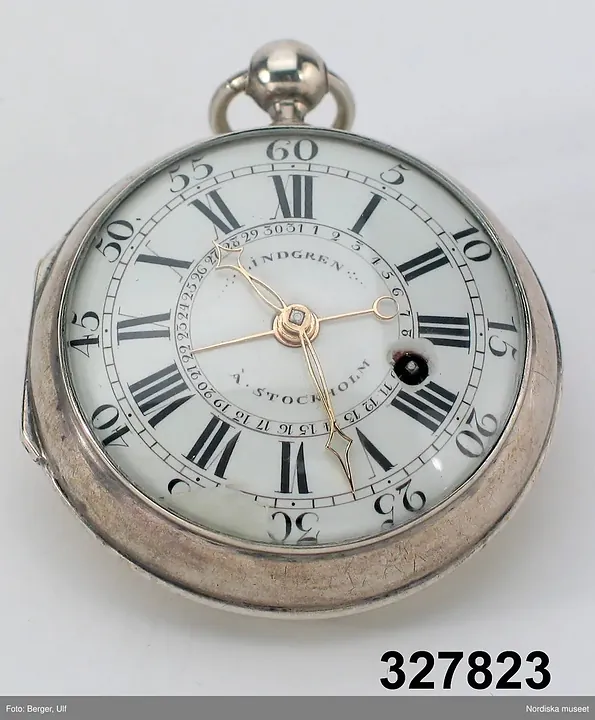
Pocket Watches · 1800–1899
Pocket watch by Erik Lindgren, Sweden, 1800–1899
Nordic Museum Foundation
Pocket Watches · 1800–1899
Pocket watch by Joakim Hovenschiöld, Sweden, 1800–1899
Nordic Museum Foundation