
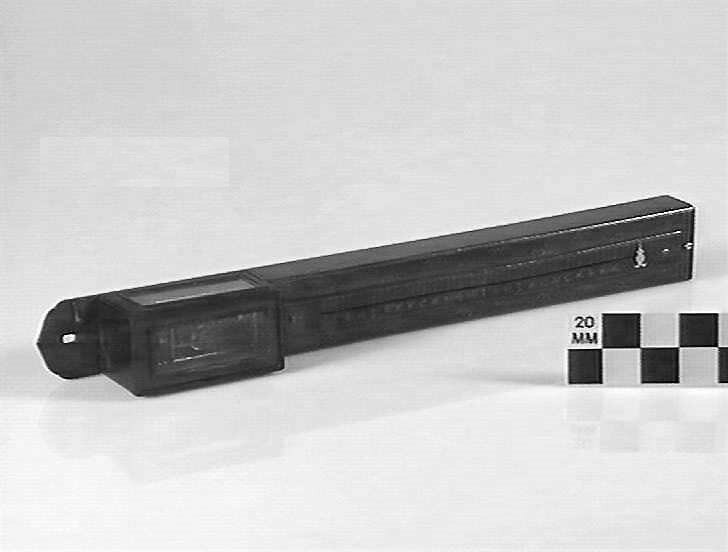
Clocks · Pillar clock
Pillar Clock - Japan, c. 1890
- Maker / attribution
- Unrecorded in source
- Date
- c. 1890
- Historical period
- Industrial Revolution (1850 – 1900)
- Country of origin
- Japan
- Object type
- Pillar clock
- Dimensions
- 5 cm (Length), 4.5 cm (Width), 40 cm (Height)
- Holding institution
- Museums Victoria, Melbourne
- Accession / object no.
- ST 17890
- Catalogue title (original)
- Pillar Clock - Japan, circa 1890 (English)
View the source record ↗ (opens another website in a new tab)Suggest a correction
Record summary
Held and catalogued by Museums Victoria, Melbourne (object number ST 17890), this is a pillar clock, made in Japan, dated c. 1890. The Atlas places it in the Industrial Revolution period (1850 – 1900) of its Clocks collection. Recorded dimensions: 5 cm (Length), 4.5 cm (Width), 40 cm (Height). The record is illustrated with 2 photographs.
Assembled from the source record's structured fields. Dates and attributions are given as the source states them; where a field is missing the Atlas leaves it blank rather than estimating.
Catalogue description
Summary — Museums Victoria
Pillar clock made in Japan, circa 1890. This clock was made after Japan adopted the system of 24 hours of equal length rather than 6 hours of day and 6 hours of night. The Japanese government adopted the 24 hour system in 1873, so this clock dates from after that date.
Physical description — Museums Victoria
Narrow wooden case with brass movement at top under glass cover. Calibrated into 24 equal divisions by red marks. Weight driven; verge escapement.
Provenance
Bequest from George McArthur, Nov 1903
Historical context
Industrial Revolution (1850 – 1900)
American interchangeable-parts manufacture; railroad time standards; Swiss and German factory systems.
Factory production transformed the clock into an everyday object. American makers (Seth Thomas, Ansonia, Waterbury) and German factories (Junghans, Gustav Becker, Lenzkirch) sold millions of shelf, wall and alarm clocks worldwide; France produced standardised Paris movements and carriage clocks; electric time distribution began.
Read the period in the timelineMore clocks from this periodEarlier: Precision & Scientific Horology
Atlas type guide
Japanese clocks (wadokei)
Mechanical clocks reached Japan with European missionaries in the sixteenth century. During the Edo period (1603–1868) Japanese makers adapted them to the native system of unequal temporal hours: daylight and night were each divided into six hours whose length changed with the seasons. Clockmakers solved this with movable hour numerals, double foliots (one for day, one for night) or, on pillar clocks, sliding hour plaques along a vertical scale.
Common forms include the lantern-style yagura-dokei on a pyramidal stand, the bracket-like makura-dokei, and the narrow shaku-dokei (pillar clock) whose weight-driven pointer descends a scale. The temporal system was abolished in 1873 when Japan adopted Western time reckoning, and wadokei production ceased soon after.
What to look for
- Hour numerals in the twelve zodiac animal signs or numbers nine to four.
- Movable hour plaques or a dial with adjustable hour markers.
- Double foliot balances at the top of the movement.
- Brass movements with fine engraving and lacquered wooden cases.
Dating clues
- Double foliots appear from the late seventeenth century.
- Pillar clocks are typical of the eighteenth and nineteenth centuries.
- Production ended after the 1873 calendar reform.
General guidance written by the Atlas editors about this kind of object. It is not a statement about this particular piece; for that, rely on the source record above and on physical examination.
Read next:Foliot
Related records
Clocks · c. 1895
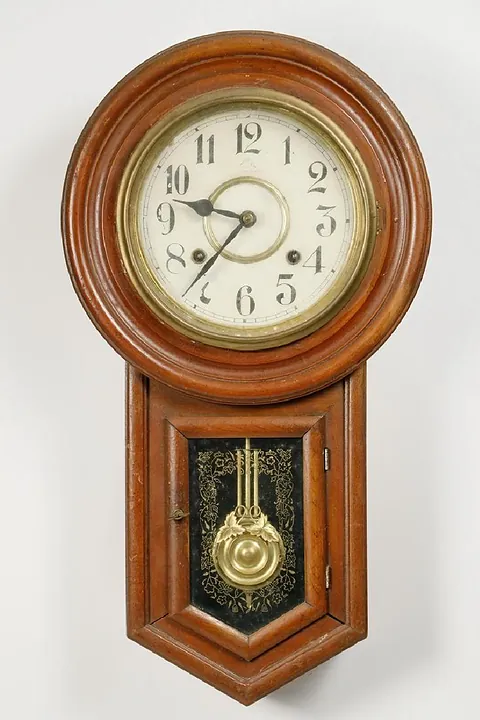
Early Japanese Made School Regulator Clock, c. 1895
LiveAuctioneers auction archive
Clocks · 1830–1870
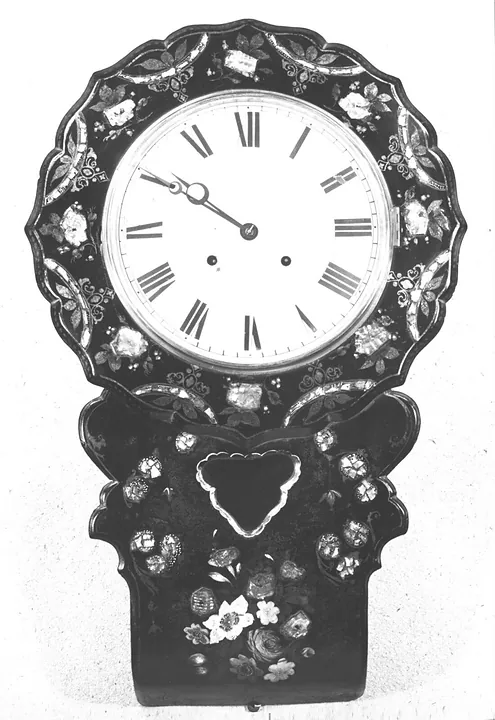
Wall clock in a papier mâché case with painted decoration. English, mid 19th century.
Victoria and Albert Museum, London
Clocks · 1840–1900
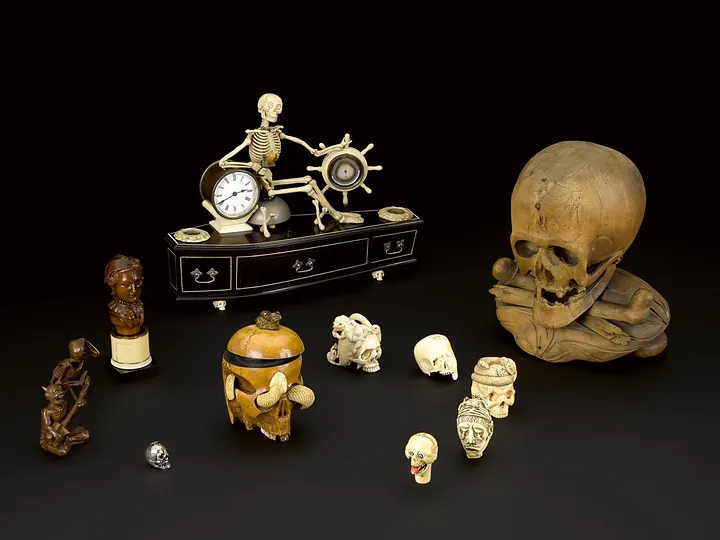
Alarm clock, mounted on model of coffin with skeleton, probably English, 1840–1900
Science Museum Group, London
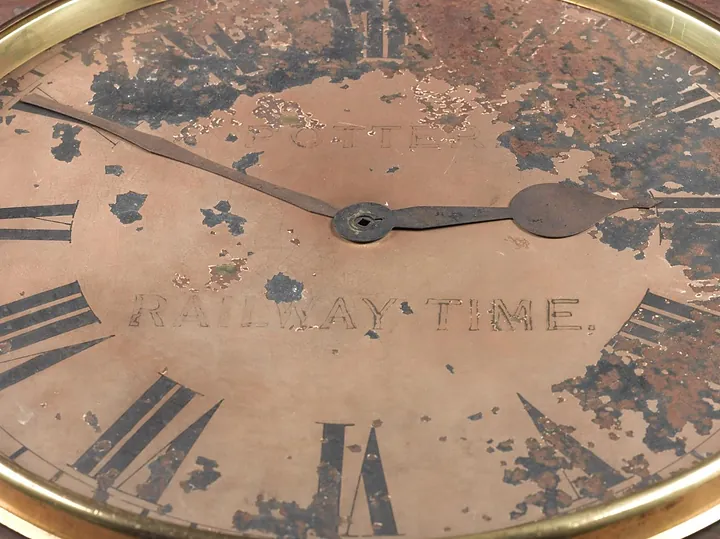
Clocks · 1840–1880
Clock dial marked "Potter, Railway Time" with two hands, unknown maker, British, 1840–1880
Science Museum Group, London
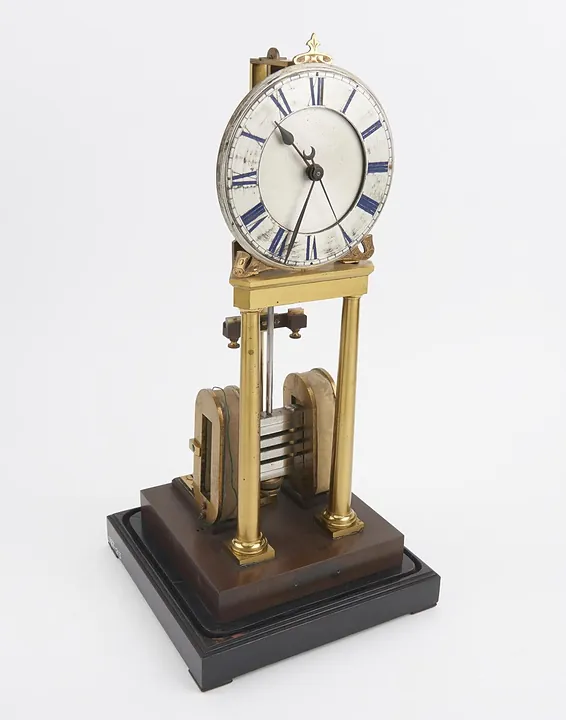
Clocks · 1840–1877
Electric clock of the Bain type
Science Museum Group, London
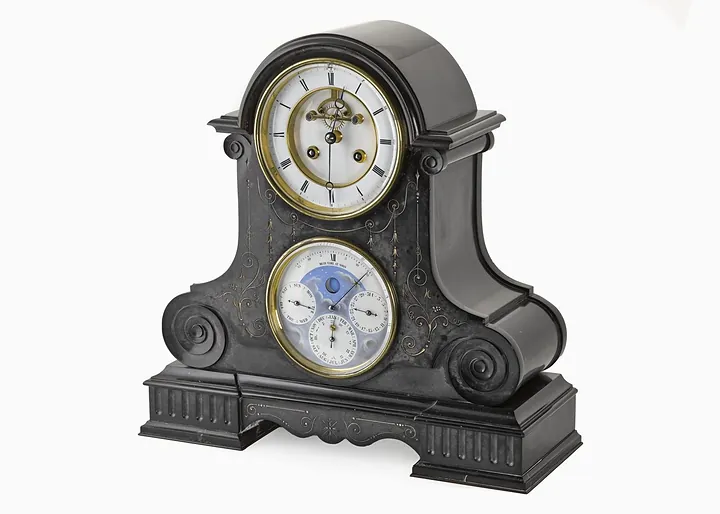
Clocks · 1840–1878
Mantel clock by A. Brocot, France, 1840–1878
Science Museum Group, London
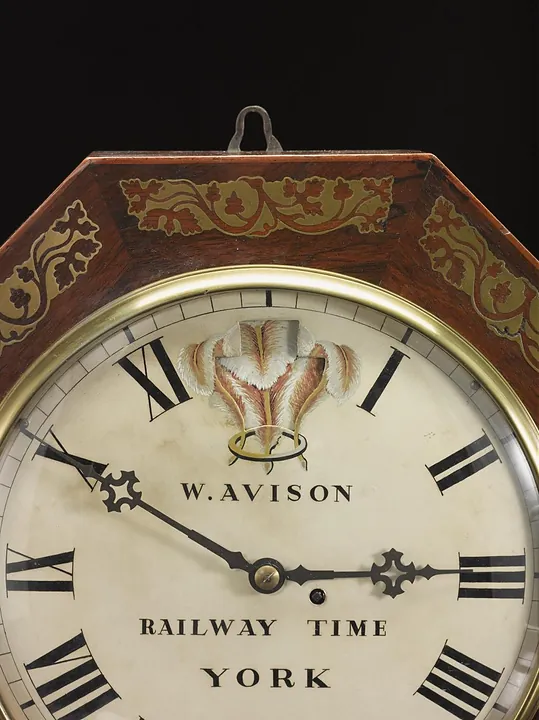
Clocks · 1840–1880
Wall Clock in octagonal case with Prince of Wales Feathers above makers name "W. Avison, Railway Time, York", made by William Avison, England, 1840–1880.
Science Museum Group, London
Clocks · 1841–1870
Contact bar from electric clock, unsigned, London, England, 1841–1870
Science Museum Group, London