
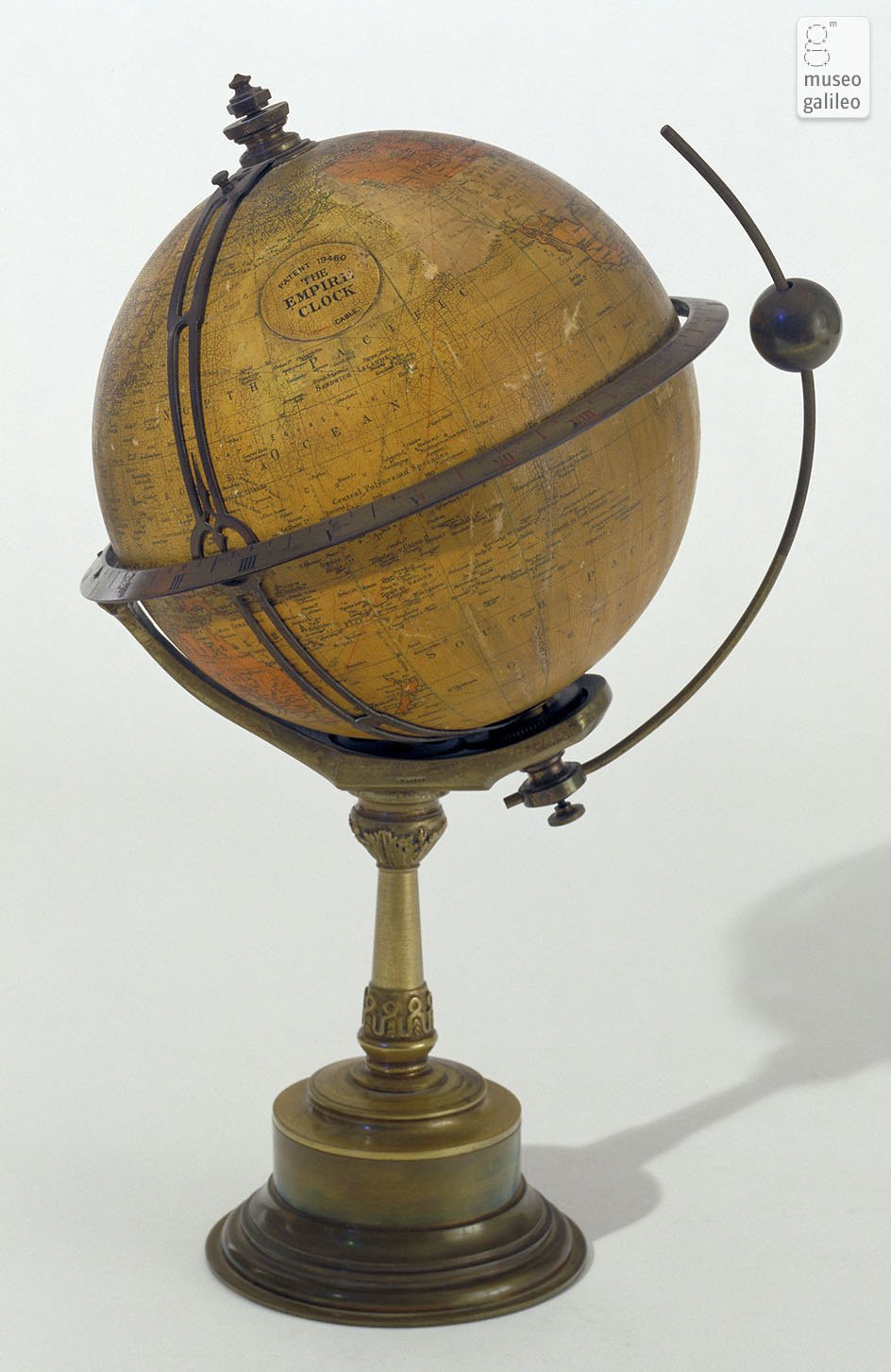
Clocks · Patented universal clock
Patented universal clock, England, c. 1906-1910
- Maker / attribution
- Unrecorded in source
- Date
- c. 1906-1910
- Historical period
- Golden Age of Mechanical Watchmaking (1900 – 1945)
- Country of origin
- England
- Place
- England
- Object type
- Patented universal clock
- Materials / technique
- brass, wood, paper
- Dimensions
- globe diameter 200 mm, height 395 mm, width 250 mm
- Holding institution
- Museo Galileo, Florence
- Accession / object no.
- Inv. 3588
- Credit line
- Museo Galileo, Florence
- Catalogue title (original)
- Patented universal clock (English)
View the source record ↗ (opens another website in a new tab)Suggest a correction
Record summary
Held and catalogued by Museo Galileo, Florence (object number Inv. 3588), this is a patented universal clock, made in England, dated c. 1906-1910. The Atlas places it in the Golden Age of Mechanical Watchmaking period (1900 – 1945) of its Clocks collection. Materials and techniques recorded by the source: brass, wood, paper. Recorded dimensions: globe diameter 200 mm, height 395 mm, width 250 mm. The record is illustrated with 2 photographs.
Assembled from the source record's structured fields. Dates and attributions are given as the source states them; where a field is missing the Atlas leaves it blank rather than estimating.
Catalogue description
Catalogue description — Museo Galileo
A brass pedestal houses the clock and supports the rotating terrestrial globe. The hour is shown at the point where the brass semicircle meets the fixed circle placed on the equator and divided into 24 hours and their fractions. The semicircle can be shifted to any meridian, and the time difference between any location and the preselected one can be found where the other meridians intersect the hour circle. A threaded metal arc is screwed into a support under the terrestrial globe. A small globe representing the Sun can be screwed onto the arc by hand. From one solstice to the next, it moves 23.5° above or below the equator, giving the Sun's seasonal position. The terrestrial globe carries the inscription "Patent 19460 The Empire Clock Cable." The clock movement at the base of the globe is one of the countless variants of the "universal" clock, highly popular in the nineteenth century. Patent no. 19460 was issued to J. H. Overton on August 31, 1906.
Historical context
Golden Age of Mechanical Watchmaking (1900 – 1945)
The wristwatch displaces the pocket watch; waterproof cases, self-winding and grand complications.
Between 1900 and 1945 clocks were electrified: master-clock systems ran factories and offices, synchronous mains clocks entered homes, and the Shortt free-pendulum clock set new standards of accuracy before the first quartz clocks (1927). Art Deco design reshaped mantel and table clocks.
Read the period in the timelineMore clocks from this periodEarlier: Industrial Revolution
Atlas type guide
Domestic clocks
A clock combines four systems: a source of power (falling weight, coiled spring, or later electricity), a gear train that divides time, an escapement and oscillator that regulate it (foliot, pendulum or balance), and an indicating system of dial and hands or a bell. Its history runs from the large iron weight-driven clocks of the late thirteenth century to Renaissance spring-driven table clocks, the pendulum revolution of 1656, the factory clocks of the nineteenth century and electric and quartz clocks of the twentieth.
Domestic clocks also reflect regional furniture and decorative traditions — English longcase and bracket clocks, French pendules, Viennese regulators, Black Forest and American shelf clocks — and therefore record changing tastes as much as technical progress.
What to look for
- How the clock is powered: weights, spring barrel, fusee, electric coil.
- The oscillator: foliot, short pendulum, long seconds pendulum or balance.
- Whether it strikes: hour only (count wheel) or hours and quarters (rack striking).
- The maker or retailer's name on dial and movement, and any factory trademarks.
- Signs of alteration — replaced dials, converted escapements, 'married' cases.
Dating clues
- Before 1656 clocks used foliots or balances; after, most domestic clocks have pendulums.
- Anchor escapements spread after c. 1670; minute hands became common at the same time.
- Factory production in America and Germany transformed prices after c. 1840.
General guidance written by the Atlas editors about this kind of object. It is not a statement about this particular piece; for that, rely on the source record above and on physical examination.
Related records
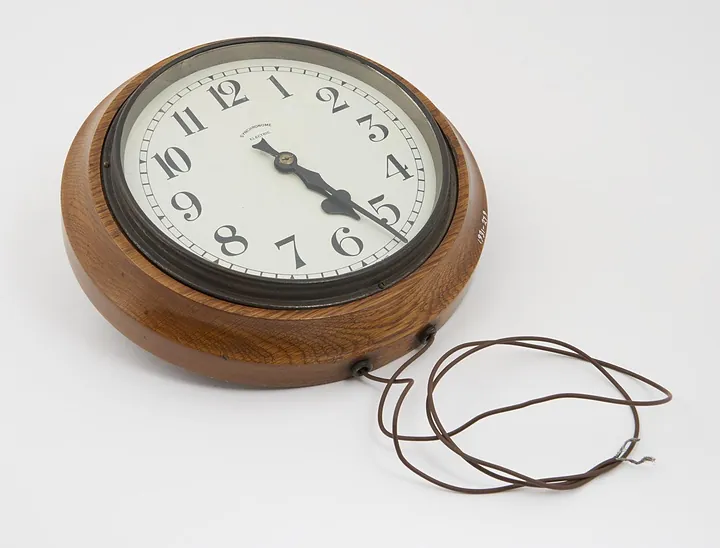
Clocks · 1890–1930
Clock with 8-inch impulse dial, by the Synchronome Company Limited, England, 1890–1930.
Science Museum Group, London
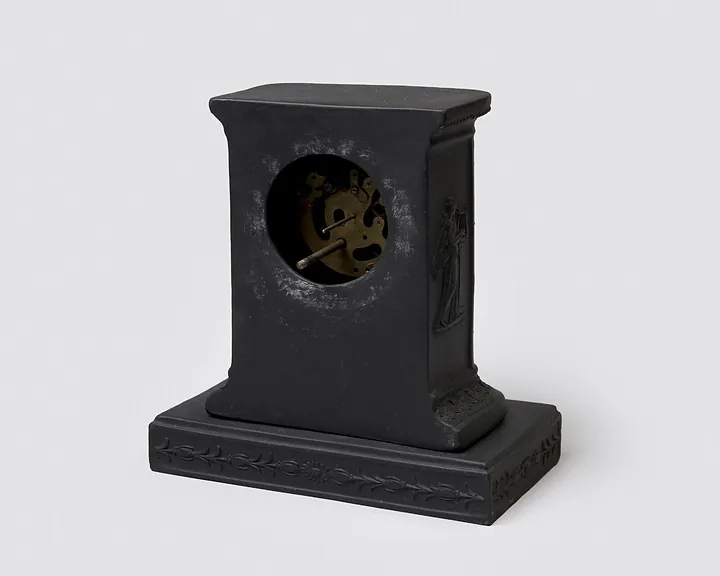
Clocks · c. 1900
Clock, black basalt, brass, Josiah Wedgwood and Sons, Etruria, c. 1900
Victoria and Albert Museum, London
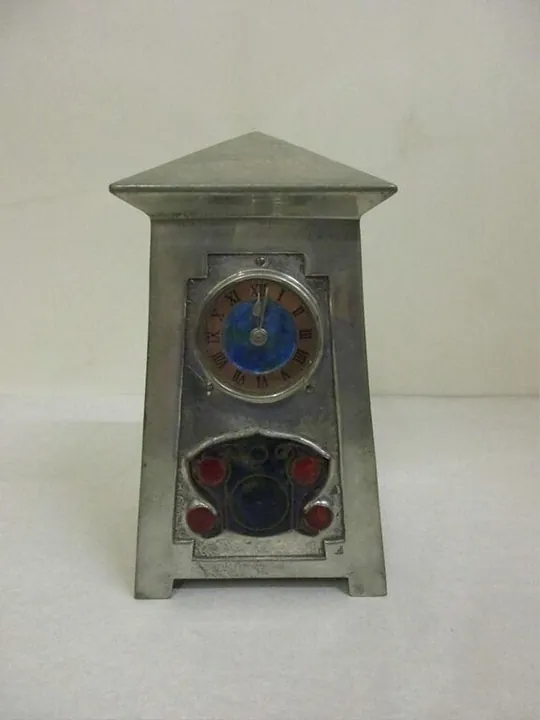
Clocks · c.1903-1904
Clock, pewter, made for Liberty& Co., England. 1903-4.
Victoria and Albert Museum, London
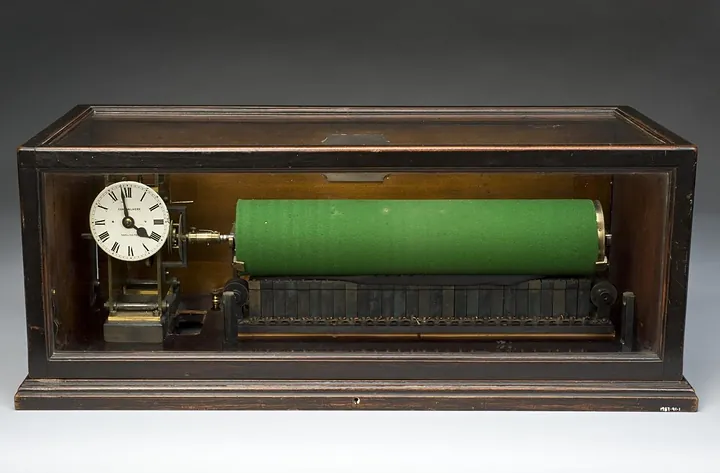
Clocks · 1900–1939
Clock by Cox-Walkers of Darlington, England, 1900–1939
Science Museum Group, London
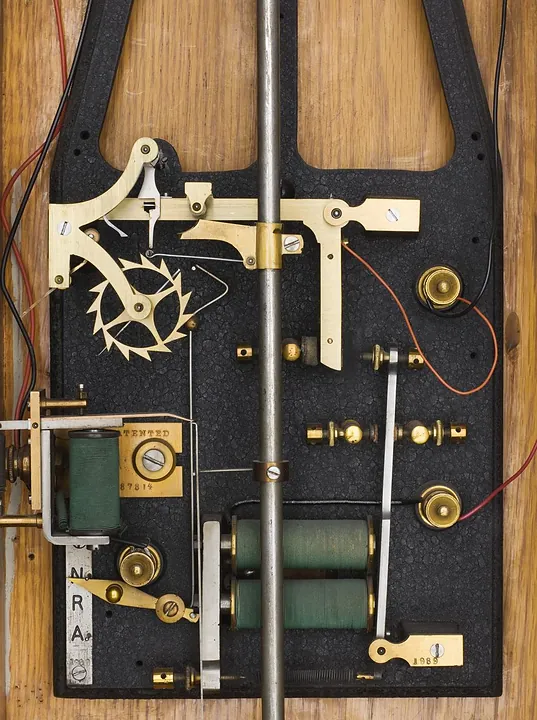
Clocks · 1900–1935
Clock by The Synchronome Company Limited, England, 1900–1935
Science Museum Group, London
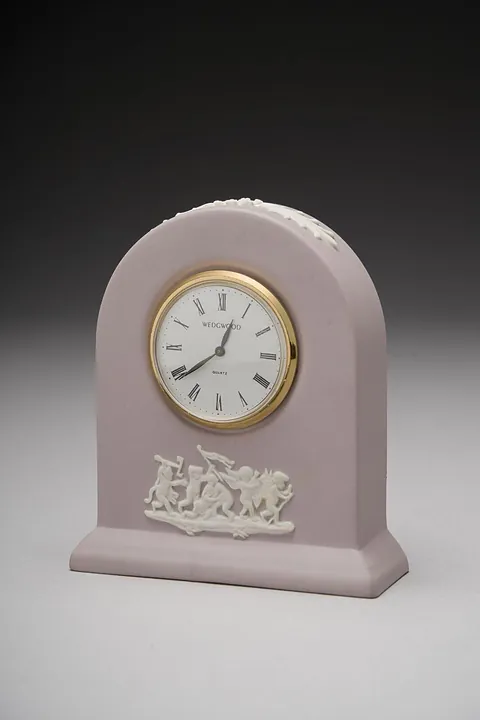
Clocks · 20th century
Clock, Jasperware with applied reliefs and metal and glass, Josiah Wedgwood and Sons, Stoke on Trent, 20th century (V&A WE.15628-2014)
Victoria and Albert Museum, London
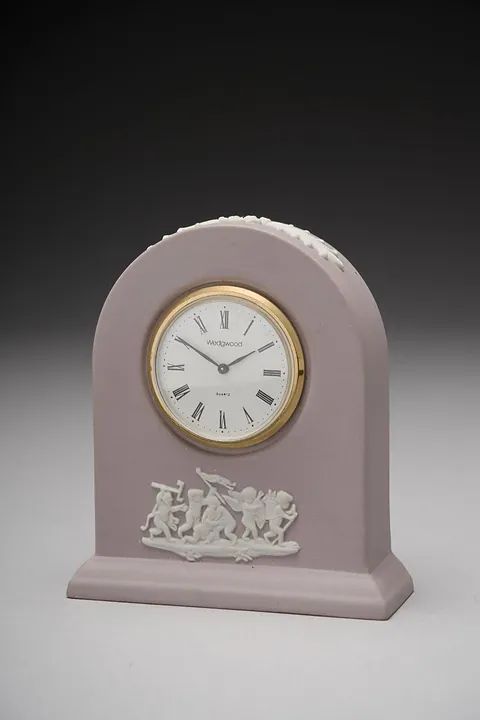
Clocks · 20th century
Clock, Jasperware with applied reliefs and metal and glass, Josiah Wedgwood and Sons, Stoke on Trent, 20th century (V&A WE.15629-2014)
Victoria and Albert Museum, London
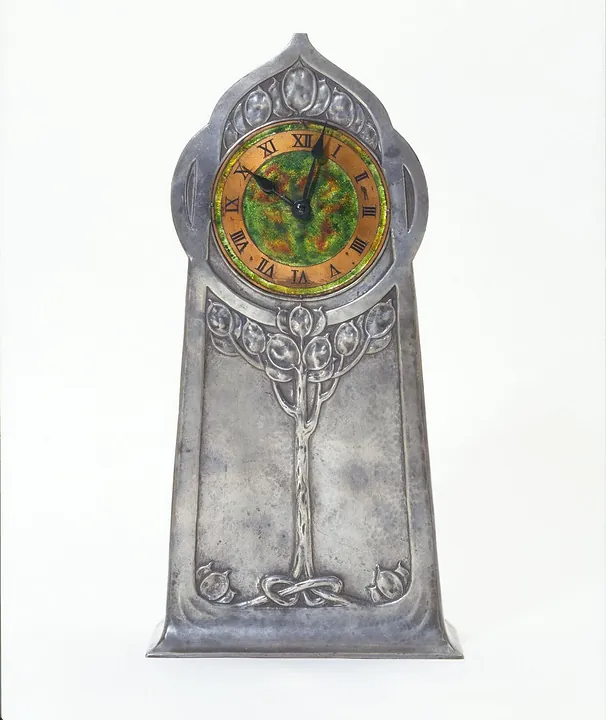
Clocks · c. 1905
Pewter and enamel, "Tudric range, Honesty design" Birmingham ca.1905, made by W.H. Haseler, designed by Archibald Knox.
Victoria and Albert Museum, London